


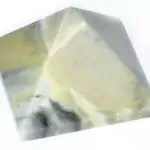
Quick Specs
- Type: Crystal pyramid
- Material: Serpentine
- Size: 30 mm
- Best for: Heart chakra work, kundalini practice, transformation, altar display
Serpentine: Mineral Profile and Global Distribution
Serpentine is not a single mineral but a group of related magnesium silicate minerals, primarily antigorite, lizardite, and chrysotile, that form through the metamorphic alteration of ultramafic rocks such as peridotite and dunite. The characteristic green, mottled, or waxy appearance that gives the stone its name, after the pattern of a serpent’s scales, comes from varying concentrations of iron and other trace elements within the silicate matrix. Major deposits are found in New Zealand, Italy, South Africa, China, and parts of North America.
The stone’s Mohs hardness ranges from 3 to 5, depending on the specific variety, making it softer than quartz but hard enough for carving and polishing. The pyramid form takes the stone’s natural waxy luster well, resulting in a smooth, slightly translucent finish that reveals the internal color variation and mottling characteristic of genuine serpentine specimens. Each pyramid will show a unique pattern of greens, yellows, and blacks that reflects its particular mineral makeup.
Kundalini, Heart Chakra, and Transformation Practice
In metaphysical and crystal healing traditions, serpentine is primarily associated with the kundalini energy pathway, the concept of latent spiritual energy that rises through the body’s energy centers from the base of the spine upward. The stone is used in meditative practices focused on awakening this energy slowly and safely, and its grounding, earth-connected quality is said to support this process without overstimulation. It is also linked to the heart chakra, connecting earth energy with the capacity for compassion and openness.
Practitioners working through significant life transitions often reach for serpentine because its metaphysical associations center on adaptability and the release of outdated patterns. The stone is used in layouts, carried as a pocket piece, or placed on the body during meditation. At the 25-30mm pyramid size, it is compact enough for daily carry and precise enough to position at a specific body point or grid location during intentional practice.
How to Use a Serpentine Crystal Pyramid
Use this serpentine pyramid for kundalini work, heart chakra meditation, and transformation-focused practice.
- Anchor Kundalini or Grid Work
Place the pyramid at the base of the spine position on a body layout, or at the root of a crystal grid, to anchor kundalini-related work. Serpentine is commonly paired with clear quartz to amplify its grounding quality.
- Meditate with the Energy Pathway
Hold the pyramid during seated meditation and bring attention to the base of the spine. Breathe slowly, visualizing a green-gold current rising through each energy center. This practice supports inner stillness and presence.
- Cleanse and Care
Cleanse the pyramid by rinsing it briefly under cool water and leaving it on a windowsill in indirect light for a few hours. Serpentine tolerates water cleansing well but should not soak for extended periods.
The Tarot Fellow Standard
I carry serpentine pyramids because the stone’s association with gradual, grounded transformation gives it a different quality from more intensely activating stones like malachite or ruby. It supports change without forcing it. At 25-30mm, this pyramid is compact and focused, a working piece rather than a display piece. For additional pyramid options in various minerals, browse my crystal pyramids collection. For stones suited to transition and transformation work, explore my change and flexibility crystals section.
Frequently Asked Questions
Serpentine is a magnesium silicate mineral group with a characteristic green, mottled appearance. It forms in ultramafic rocks and is found worldwide, with notable deposits in New Zealand, Italy, and South Africa.
In crystal practice, serpentine is linked to the heart chakra and the kundalini energy pathway. It is used for supporting personal transformation, releasing old patterns, and encouraging adaptability during life changes.
25-30mm describes the base measurement of this pyramid, approximately one inch. This is a compact size suited for a personal altar, meditation pocket piece, or placement at a specific body point during energy work.
Serpentine and kyanite are both used in transformation and alignment work, but serpentine focuses more on kundalini and earth energy while kyanite emphasizes mental clarity. They can be used together in a grid.
Reviews
There are no reviews yet