

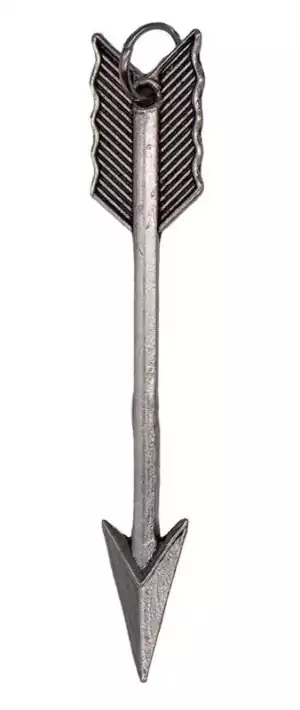

Quick Specs
- Type: Pewter key amulet pendant
- Size: Approximately 3 1/4″
- Best for: Hecate devotion, crossroads magic, unlocking opportunities, threshold rituals
Key Amulet Pendant: Hecate, Janus, and the Threshold Tradition
A key amulet pendant at 3 1/4 inches is a substantial piece, and the scale is appropriate given the weight of the symbol it carries. The key is among the oldest and most consistent magical symbols across unrelated traditions: it represents the authority to open or close, to admit or deny, to cross from one state of being into another. In Greek religion, Hecate is the most prominent divine keyholder. Her Orphic Hymn addresses her as “the world’s key-bearer,” and Roman-era inscriptions call her Kleidouchos, “she who holds the keys.” Her domain, the three-way crossroads, the thresholds between houses and cities, the boundaries between the living and the dead, all require a keyholder who can move freely in both directions.
The Roman god Janus shares the key’s logic from a different angle. He governs beginnings, doorways, and the passage of time, his two faces looking simultaneously backward and forward, and is described by later writers as holding the key to time itself. January, the first doorway of the year, is named for him. In Haitian Vodou, Papa Legba stands at the crossroads and holds the keys that open or close the roads of fate and communication with the loa. No working with the spirits begins without his permission. Keys also appear in Southern Black folk magic (hoodoo), where a Saint Peter’s protection key was worn for protection, and in New Orleans practice Saint Peter, keeper of the keys, was equated with Papa Legba. Where a boundary between worlds exists, a keyholder stands watch.
Working with the Key Symbol in Modern Practice
Contemporary practitioners use key amulets in several ways: as offerings or altar tokens for Hecate, as pendulums for divination, as anchor pieces in witch’s ladders, and as wearable talismans during periods of major transition. The key’s symbolism maps to the Hermetic idea of unlocking hidden knowledge, which is why the Key of Solomon, the foundational Renaissance grimoire of Western ceremonial magic, takes the key as its central metaphor: a structured system of access for interacting with spiritual forces effectively and safely.
At 3 1/4 inches this pendant is large enough to read as a statement piece and substantial enough to use as a focal object during ritual. It is pewter, the traditional material for amulet casting, and arrives ready to wear or hang. If you want something smaller and lighter for everyday layering, this is not that; it’s a prominent talisman suited to intentional wear or altar placement during dedicated Hecate or threshold work.
How to Use the Key Amulet
Step-by-step guide.
- Dedicate the Key to a Specific Threshold
Name the door you want to open: a new opportunity, a blocked path, or a transition you have been hesitating at. Key magic is most effective when the symbolic action is matched to a specific intention rather than a general desire for change or luck.
- Use in Hecate or Crossroads Ritual
Place the key at a three-way crossroads during a dark moon ritual, or hold it during Hecate invocations. Traditional offerings include garlic, honey, eggs, and dark candles. The key can serve as offering token and talisman returned after the ritual.
- Wear or Hang During Transition Periods
Wear this key amulet pendant during any major life threshold: a new home, a new role, or the end of a long chapter. Many practitioners hang it near the front door between workings, invoking Janus or Elegua as guardians of the doorway and crossroads.
The Tarot Fellow Standard
Most key pendant listings skip the cross-cultural richness of this symbol entirely and settle for “unlocking your heart.” The key’s actual magical history, Hecate as Kleidouchos, Janus and the Roman doorway tradition, Papa Legba and Elegua as crossroads gatekeepers, the Key of Solomon as a structured system of spiritual access, makes this pendant far more useful. I stock it because practitioners who understand that context get more out of the piece. Browse my full amulet collection for related pieces, or explore my ritual supplies for tools that complement crossroads and threshold work. Hoodoo is a living tradition, and I offer this as an entry point, not a substitute for learning from practitioners and community.
Frequently Asked Questions
Key amulets are used for unlocking opportunities, threshold and crossroads work, and as devotional pieces for Hecate, Janus, and Papa Legba. The key represents the authority to open or close passages between states of being, central to liminal work.
Hecate is called Kleidouchos, she who holds the keys, in her Orphic Hymn. Her key unlocks thresholds between the living and the dead. It is one of her three primary symbols alongside the torch and the dagger in her classical triple iconography.
Cast from pewter, approximately 3 1/4 inches, one of the larger amulets in this line. The size suits altar placement and statement wear. It arrives ready to wear or hang near a doorway as a threshold guardian and opportunity-unlocking pendant piece.
Yes. Witches use keys as pendulums, suspending them on a cord and using the swing motion for yes-no divination questions. The association with Hecate and crossroads decision-making makes the key a resonant divination tool at moments of key choice.



Reviews
There are no reviews yet