

Quick Specs
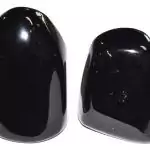
- Material: Black obsidian, natural volcanic glass (mineraloid, not a true crystal)
- Weight: Approximately 0.3 lbs (~136g)
- Form: Free shape, natural, each piece is unique
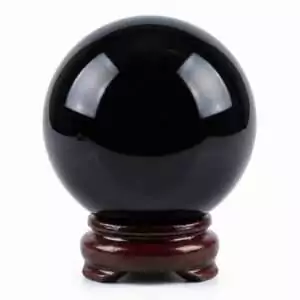
- Color: Deep jet black with a glassy, reflective surface
- Hardness: 5 to 5.5 on the Mohs scale
The stone that isn’t a stone
I want to be upfront about what you’re holding: black obsidian is volcanic glass, not a crystal. It forms when felsic lava erupts and cools so rapidly that there’s no time for any crystal lattice to grow. The result is a frozen, amorphous glass, technically a mineraloid, rich in silicon dioxide with iron and magnesium giving it that deep jet-black color. It has no internal structure, just solid, smooth, light-absorbing glass. That’s what makes its surface so dark and reflective.
The folk tradition around obsidian runs deep. Aztec priests used polished obsidian mirrors, called tezcatl, in rituals associated with Tezcatlipoca, the deity whose name translates as “Smoking Mirror.” They viewed the reflective surface as a portal, a place where the boundary between the living world and other realms became thin. When Spanish forces arrived in the early 16th century, these mirrors began traveling to Europe. By the 1580s, John Dee, astrologer to Elizabeth I, was using an Aztec obsidian mirror alongside his scryer Edward Kelley to conduct what he believed were communications with angels. That mirror now lives in the British Museum.
In grounding and protection work today, black obsidian is one of the more popular choices. Its density and its darkness both carry symbolic weight in that context. A free shape like this one, natural and uncarved, gives you the material in its most direct form. You’re not getting a shaped object; you’re getting the glass itself. Each piece will look different, sit differently in your hand, and have its own surface character. That’s the point.
How to work with black obsidian
Three ways to start working with a black obsidian free shape.
- Cleanse and charge the stone
Hold the obsidian under cool running water for thirty seconds, then set it on a windowsill overnight in moonlight. Its volcanic glass surface doesn't absorb water, so a quick rinse won't harm it. Moonlight is a gentle reset.
- Set your intention before use
Sit quietly with the stone in your non-dominant hand. Close your eyes and state aloud what you're calling in, whether protection, grounding, or clarity. Repeating it three times is a common practice in folk tradition and helps focus the mind.
- Use it for mirror work or grounding
Place the flat, reflective side up in low candlelight and soften your gaze into it. This is how obsidian mirrors were used historically for scrying. Alternatively, hold it at the base of your spine or place it near your feet to anchor your energy.
The Tarot Fellow Standard
I stock this piece because the supplier’s quality has been consistent over multiple orders. The color is true black with that characteristic glassy sheen, not the grayish or matte finish you sometimes see with lower-grade pieces. The weight range holds close to the listed approximate, so what you see in the specs is what you’re getting in the box.
A practical note: obsidian is natural glass, and it fractures like glass. It won’t crumble, but if you drop it on tile or hardwood from any height, it can chip or crack along a conchoidal fracture line. That’s not a defect, it’s the nature of the material. Store it wrapped when you’re not using it, and it’ll hold up well.
If you’re building out a divination or protection setup, you might also want to browse my scrying tools collection or explore the rest of my free shapes for other natural-form pieces.
Frequently asked questions
Black obsidian isn't a crystal in the mineralogical sense. It's volcanic glass, a mineraloid formed when felsic lava cools so fast that no crystal structure can grow. It has no repeating atomic lattice, just frozen glass.
A free shape is a piece that hasn't been carved into a specific form like a sphere, tower, or egg. It's natural or minimally shaped, so every piece looks different. You're getting the stone as it came, not a cut-to-order form.
Aztec priests used polished obsidian mirrors to commune with Tezcatlipoca, the Smoking Mirror deity. John Dee used an Aztec obsidian mirror for his angel workings in the 1580s. The dark reflective surface is a classic soft-gaze focus.
Obsidian is natural glass and will chip or crack if dropped on hard floors. Store it wrapped in cloth when not in use. It won't be damaged by brief rinsing, but skip long soaks. Moonlight or sound work well for energetic clearing.

Reviews
There are no reviews yet