
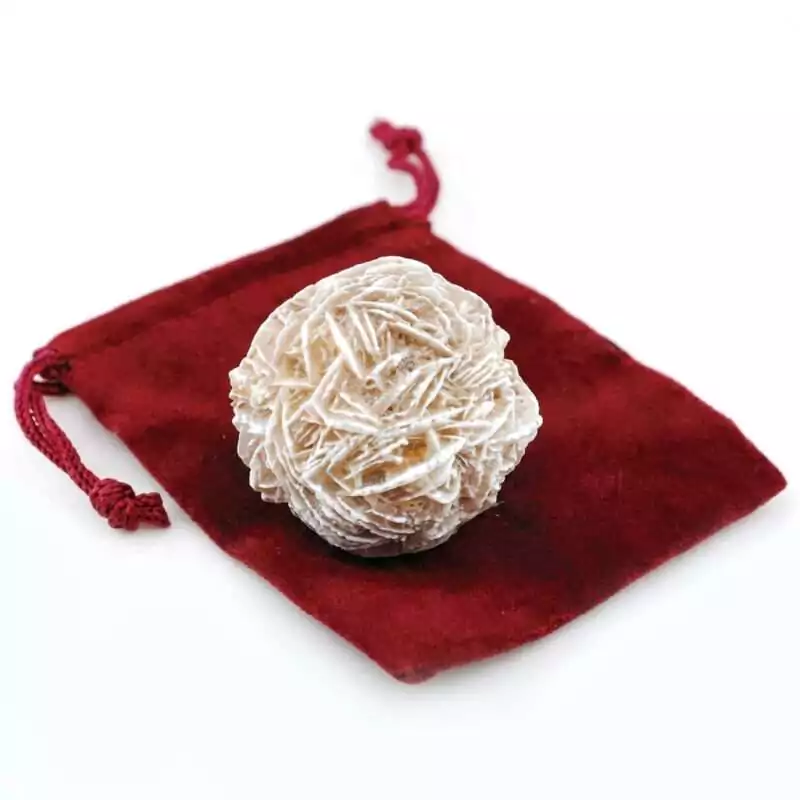


Quick Specs
- Material: Desert rose selenite (gypsum, CaSO4 with 2H2O) — occasionally barite in some origin regions
- Formation process: Evaporite — mineral-rich water deposits selenite or barite crystals as it evaporates in arid conditions
- Origin regions: Sahara Desert, Mexico, Morocco; also found in Oklahoma and other semi-arid basins
- Shape: Rosette cluster of flat, petal-like blades; each piece is naturally unique in size and petal count
- Primary use: Protection, grounding, clearing stagnant energy
- Set includes: Desert rose specimen with instruction card
A Stone That Takes Millions of Years to Bloom
I find desert rose to be one of the most visually honest stones in the shop. It looks like what it is: something that formed slowly, under pressure, in conditions that didn’t offer much. In arid desert environments, shallow groundwater saturated with calcium sulfate works its way upward through sandy sediment. As that water evaporates, it leaves behind flat, bladed crystals of selenite (chemically CaSO4 with 2H2O, the same gypsum in your walls). The crystals grow outward from a central point, trapping sand grains in each layer. Over thousands to millions of years, that slow patient process produces the rosette shape. No two pieces are identical because no two pockets of sand or water are identical.
In crystal work, selenite has a long association with clarity and energetic clearing. Desert rose specifically carries grounding associations alongside that — likely because of its connection to the earth itself, the sand embedded in its structure, the way it forms at the soil line rather than deep underground. Practitioners across several traditions use it at thresholds and in room corners to deflect stagnant or disruptive energy. It’s also used in protection work as a stabilizing anchor, something to settle a space rather than simply clear it.
This set pairs the desert rose specimen with instructions so you’re not left guessing. Whether you’re new to crystal work or just adding to an established practice, the included guide walks you through placement, intent-setting, and care. It’s a solid entry point into selenite work with enough grounding in the geology to make it feel real.
How to Use Your Desert Rose Protection Set
Three simple steps to set up and maintain your desert rose protection practice.
- Set your space
Find a quiet spot and hold your desert rose in both hands for a moment. Take a breath and let the weight of the stone settle you before you begin.
- Place with intention
Set the desert rose at the threshold, corner, or center of the space you want to protect. Visualize stagnant or unwanted energy dissolving as the stone sits in place.
- Return and refresh
Check in weekly. Give the stone a dry dusting if needed. Set it in moonlight overnight every few weeks to keep its energy clear and steady.
The Tarot Fellow Standard
I stock desert rose because the pieces I receive are consistently well-formed with visible petal structure and natural sand inclusions — not artificially shaped, not dyed, not coated. The supplier I use has been consistent on quality over many orders. That matters to me more than a polished sales pitch: I’m looking at whether the next flat looks like the last one, and it does.
One honest note on care: desert rose is selenite, and selenite dissolves in water. Don’t soak it, don’t clean it with damp cloths, and keep it away from humid windowsills. The sand inclusions also mean the surface can shed fine grit — that’s natural, not damage. Handle it with that in mind and it’ll hold up fine. If a petal chips, that’s also normal for selenite; it’s a soft mineral (Mohs 2) and not built for rough handling.
If this set sparks your interest in selenite more broadly, browse the full selenite collection for wands, sticks, and other forms. You can also explore the wider protection and cleansing collection for stones, herbs, and tools that pair well with desert rose work.
Frequently Asked Questions
Desert rose is a form of selenite (gypsum, CaSO4 with 2H2O) when made of gypsite. Some are barite. Both grow in the same arid environments and share the rosette shape.
No. Selenite-based desert rose is water-soluble over time. Keep it dry. Clean it with a soft dry cloth only. Water will degrade the surface.
A brief moonlight rest or a pass through incense smoke is enough. Desert rose is gentle and does not need aggressive cleansing methods.
Growth conditions vary, so no two pieces form the same way. Petal count, size, and color differ with each stone. Expect natural variation in what you receive.





Reviews
There are no reviews yet