
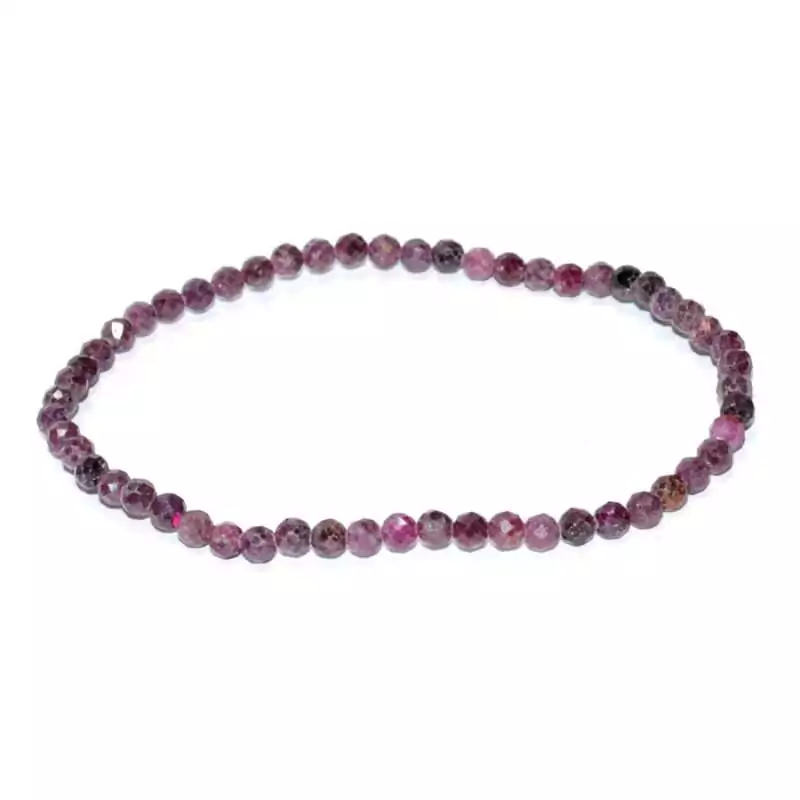
Quick Specs
- Stone: Ruby
- Bead Size: 3mm
- Shape: Round, faceted
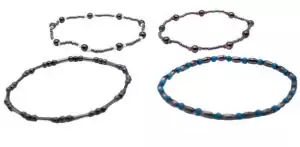
- Color: Raspberry, plum and burgundy with dark brown beads
- Mohs Hardness: 9
- Closure: None, one continuous loop of beads
Faceted Ruby in 3mm Beads
Ruby is the red variety of corundum, aluminum oxide with a trace of chromium, and the chromium is what gives the stone its red, with more chromium producing a stronger color. Gem references describe the color as running from pinkish red to blood red and on to dark reddish-brown, and iron in the crystal can make a ruby darker and less vivid. This strand sits in the deeper part of that range. The beads read as raspberry, plum and burgundy, with a few that look nearly black-brown, and a bright magenta bead stands out here and there. Each 3mm bead is cut with tiny flat facets, so the surface breaks the light into small sparks. Corundum rates 9 on the Mohs scale, second only to diamond among natural gems, and it has no cleavage. Ruby that is opaque or full of inclusions is far less valuable as a cut gem, and lower-quality ruby rough is used for beads and carvings. A bead strand shows the stone’s red in a slim, wearable form, and the color holds up at a small scale.
In modern crystal practice, ruby is associated with the root chakra and with vitality, courage and passion. Those links belong to crystal lore, which took the chakra scheme from Hindu and Buddhist traditions, and you can take them as symbolism. A strand of deep red beads makes a handy cue on days that ask something of you: a presentation, a hard call, the first morning of a new routine. On a day that asks something of you, a bracelet this size is quiet enough for a meeting and present enough to touch under the table. At 3mm the bracelet is slim enough to wear every day, to layer under a sleeve, or to stack beside gold, silver or a row of paler strands that let the red stand out. Ruby is tough and wears well, though a hard knock can still chip or fracture a stone, so ordinary care is enough to keep a bracelet like this in good shape. Wear it alone for a thin line of wine red, or let it share the wrist with a pale stone, where the dark beads set the tone.
Practical Ritual Applications
Wear the bracelet on a day you want to carry some extra nerve: an interview, a performance, a difficult conversation. Touch a bead before you begin, and let the red remind you of the courage you already have. On an altar, circle a red candle with the strand for a ritual about passion or drive, or lay it beside a Tarot spread you have pulled about a bold step. A small dish of the bracelet and a handwritten goal makes a desk-sized focus point. For other stones in the same fine sizes, my 4mm and 6mm beaded bracelets collection offers strands in many colors that stack neatly with it. Take the bracelet off before heavy work, so the beads stay clear of hard knocks.
How to Wear and Care for Your Ruby Bracelet
Three steps cover looking over the beads, setting a purpose, and cleaning a strung strand.
- Look the beads over in daylight
Hold the bracelet near a window and turn it slowly. Find the brightest raspberry bead and the darkest brown one, and watch how the facets flash. Iron and inclusions can make a ruby bead look darker or hazier. Pick a word for what you want it to stand for, such as nerve or drive.
- Wear it as a courage cue
Put on the bracelet, rest your thumb on a bead and take three slow breaths. In crystal practice ruby is tied to the root chakra and to courage and vitality, so you can say your word quietly as you breathe out. Touch the same bead whenever the day asks for a steadier hand, and the bracelet becomes a habit marker.
- Wipe it by hand and store it apart
Wipe the beads with a soft cloth dampened with warm water and a drop of mild detergent, using a soft brush for the facets, then dry the strand right away. Keep it out of water, since moisture can weaken the stringing, and skip mechanical cleaners for strands with included beads. Store it in a pouch away from other jewelry.
The Tarot Fellow Standard
I stock this bracelet because it gives ruby’s color a small, wearable form: faceted 3mm beads in deep raspberry and plum, strung with nothing added. The small facets give each bead plenty of sparkle, and the dark tones keep the strand easy to wear with most clothes. The root chakra link is modern crystal lore, and I offer it as symbolism. Beads vary from strand to strand, as stone does. For more ways to carry crystals, my crystal and stone jewelry collection gathers bracelets, pendants, rings and earrings in one place.
Frequently Asked Questions
Both are corundum, aluminum oxide, and they differ mainly in color. Ruby is the red variety, colored by trace chromium, and sapphire covers the other colors of gem corundum. Ruby and sapphire share the same hardness, 9 on the Mohs scale, and the same crystal structure.
Heat treatment is the most common ruby treatment. It improves color and can clear some inclusions, and the trade accepts it when disclosed. Fracture filling with lead glass or polymer exists as well, and it is a less accepted practice that lowers value. Gem references advise assuming a ruby has been heated unless it is documented as unheated.
Iron in the crystal can make a ruby darker and less intense. Fine needle-like inclusions of rutile, called silk, can also give a stone a hazy look. Opaque or heavily included ruby is far less valuable as a cut gem, so it is often used for cabochons, carvings and beads.
Myanmar's Mogok region has long been the premium source, known for the red called pigeon's blood. Other sources include Sri Lanka, Thailand, Cambodia, Madagascar, Tanzania, Vietnam and Mozambique, and Mozambique's Montepuez mine is now described as the world's most productive source of gem-quality ruby. The most renowned rubies form in marble, and others are found in basalt rocks.

Reviews
There are no reviews yet