
Quick Specs
- Stone: Rhodochrosite
- Bead Size: 3mm
- Shape: Round, faceted
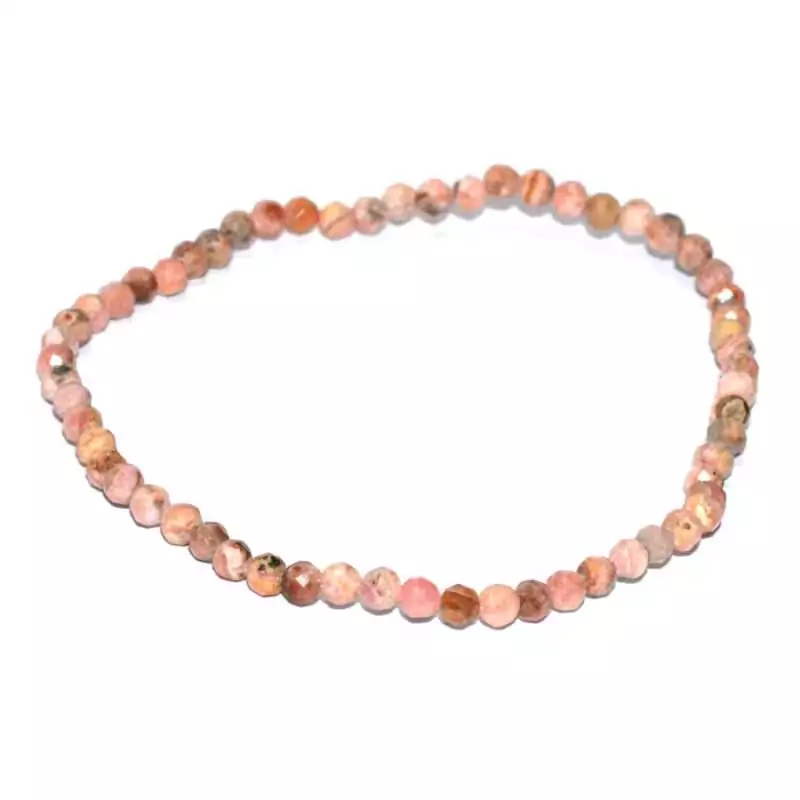
- Color: Salmon pink, peach and tan with brown flecks
- Mohs Hardness: 3.5 to 4
- Closure: None, one continuous loop of beads
Faceted Rhodochrosite in 3mm Beads
Rhodochrosite is a manganese carbonate, MnCO3, and its range runs from pale pink and rose red to orange-red, tan and brown, depending on the impurities in the stone. Calcium and iron can replace part of the manganese, and those swaps shift the color. The beads on this strand cover the soft end of that range: salmon pink, peach and tan, with brown flecks and a few darker spots, and no two beads share the same mix. With no clasp, the loop carries those colors unbroken all the way around. Each bead is cut with small flat facets, so the surface breaks the light into tiny flashes. At 3mm the beads are very small, and the strand draws a thin line of color around the wrist. Rhodochrosite rates 3.5 to 4 on the Mohs scale and cleaves perfectly in three directions. Those traits make large faceted rhodochrosite gems mostly a collector’s item, and pink faceting crystals come from Colorado’s Sweet Home Mine. A strand of small faceted beads brings that sparkle to a size made for a bracelet. Some opaque rhodochrosite in the trade is impregnated with wax, plastic or resin to stabilize it.
In modern crystal practice, rhodochrosite is associated with the heart chakra, a link that comes from crystal lore built on the Hindu and Buddhist chakra scheme. You can take it as symbolism, the warm blush of the stone standing in for the part of the body people mean when they talk about feeling. The 3mm size changes how the bracelet wears. It slips under a cuff, sits beside a watch without competing with it, and stacks with other thin strands in a way a chunkier bead would crowd. The facets keep the strand lively, since the peach and pink beads shift in tone each time your wrist turns. If you want one small object to mark a period in your life, a fine bracelet like this suits that job: you notice it when you look for it, and the rest of the time it keeps you company without asking for attention. Rhodochrosite is soft, so a strand like this suits quiet days at a desk or a table better than heavy lifting.
Practical Ritual Applications
Wear the bracelet as a quiet marker for a month of kindness practice: write one line each night about something you did gently, for yourself or for someone else, and touch a bead before you start. Set it on a small plate with a pink candle during a ritual about love in any form. Layer it with two or three thin strands for a stack that shifts color through the day. A saucer beside your Tarot deck keeps it close at hand when you read for yourself. For other strands in the same bead family, my stone and crystal beaded bracelets collection shows how different stones look in small and large sizes. Slip the bracelet off before washing dishes, lifting or any activity that could knock the beads against a hard surface.
How to Wear and Care for Your Rhodochrosite Bracelet
Three steps cover looking over the beads, wearing a fine strand, and caring for a soft stone.
- Look the facets over in daylight
Hold the bracelet near a window and turn it slowly. Find the pinkest bead and the tannest one, and notice the brown flecks that sit inside some of them. Check each facet edge for a chip, because rhodochrosite is soft and cleaves along flat planes. If you find one, keep that bracelet for gentle wear.
- Wear it as a thin marker
Put it on after perfume or hair spray has dried, since cosmetics can leave a film on small facets. With the bracelet on, take one slow breath and name something you want to treat kindly this week. In crystal practice rhodochrosite is tied to the heart chakra and to self-love, so one gentle thought is plenty.
- Clean it lightly and store it apart
Wipe the beads with a soft brush or a cloth dampened with warm water and a drop of mild detergent, and dry them at once. Keep the strand out of water, and skip acid-based or mechanical cleaners. Store it separately from harder stones in a soft pouch so nothing scratches the facets.
The Tarot Fellow Standard
I stock this bracelet because it shows rhodochrosite in its most delicate form: tiny faceted beads in pale pink, peach and tan, with nothing added to the strand. The facets give a small stone a lot of light, and the size suits anyone who wears thin jewelry or stacks several strands. The heart chakra link is modern crystal lore, and I offer it as symbolism. Because the beads vary, expect a different mix of pink and tan from one strand to the next. For more wrist pieces, my bracelets and anklets collection brings together beaded strands, chains and charm styles.
Frequently Asked Questions
Inca Rose began as a trade name. After miners found stalactitic rhodochrosite at Capillitas, in Catamarca Province, Argentina, jewelers in Buenos Aires marketed the banded material as rosa del Inca and related names, and the English form became Inca rose. Legislators in Argentina designated it the country's national stone in 2002.
They are two different minerals that overlap in pink. Rhodochrosite is a manganese carbonate rated 3.5 to 4 on the Mohs scale, with perfect cleavage, and it can run to orange-red, tan and brown. Rose quartz is silicon dioxide, a variety of quartz, rated 7 with no cleavage. Its color runs from light to medium pink, sometimes with violet or orange tints, and it is usually opaque to translucent.
Rhodochrosite forms in veins alongside other manganese minerals. Notable sources include Argentina, Colorado in the United States, South Africa's Kalahari manganese fields, Peru, Mexico, China and Germany. Colorado is known for large, intensely colored crystals, South Africa for blood-red ones, and Argentina for banded stalactitic material.

Reviews
There are no reviews yet