
Quick Specs
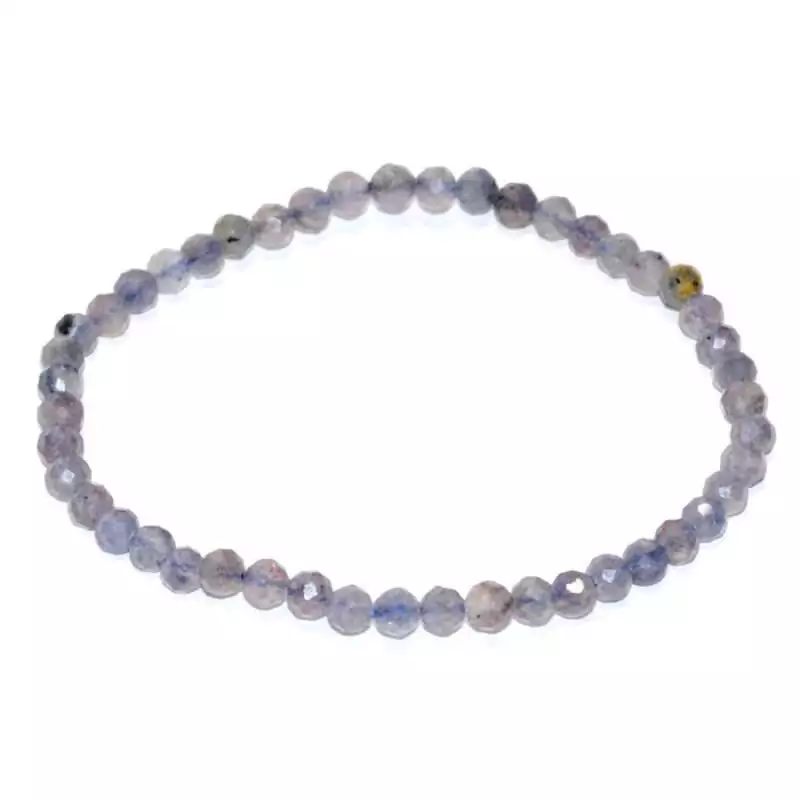
- Stone: Iolite
- Bead Size: 4mm
- Shape: Round, faceted
- Color: Soft blue-gray to lavender, with a few dark or yellow-brown flecks
- Closure: None, one continuous loop of beads
Faceted Iolite in a 4mm Strand
Iolite takes its name from ios, the Greek word for violet, and its color comes from iron in the crystal. The stone is a silicate of magnesium, iron and aluminum, and it has a trait few gems share: strong pleochroism, which ties the color you see to the direction you view it from. Because of that, a strand of small faceted iolite beads rarely looks uniform. Lavender beads sit beside blue-gray ones, and turning your wrist changes which look wins. Faceting cuts small flat planes into each 4mm bead, and every plane reflects light separately, so the surface reads as a fine glint more than a single shine. Iolite rates 7 to 7.5 on the Mohs scale, the same neighborhood as quartz, and gem references list it as untreated or rarely treated. In nature it forms in metamorphic rocks, and much gem material is recovered from river gravels once weathering has freed the durable crystals. India, Sri Lanka, Tanzania and Brazil are among the places it is mined.
In modern crystal practice, iolite is associated with the third eye chakra and with vision and intuition, and some guides call it the stone of vision. That is modern crystal lore, which took the chakra scheme from Hindu and Buddhist tantric traditions, and you can read it as symbolism. A 4mm strand suits that quiet theme because it sits slim on the wrist and keeps a low profile. The blue-gray and lavender palette is cool and low in contrast, so it pairs easily with silver, black sleeves and other narrow bracelets. Among the beads, the palest read as smoky gray-blue, the deepest lean toward a dusty violet, and the flecked ones add a little texture to the line. The faceting gives the strand a fine, glinting quality that catches lamplight when you turn a page or shuffle a deck. The beads run in one unbroken loop with no clasp, which keeps the line of the strand smooth from the first bead to the last. At this size there is room beside it for a second or third bracelet without crowding the wrist.
Practical Ritual Applications
Wear the bracelet on days you read, write or pull cards, and let the facets be a small prompt to look again: turn your wrist and watch single beads move from lavender to blue-gray. If you keep a dream or reading journal, lay the strand beside the notebook while you write. On an altar it can circle a small bowl or rest in front of a violet or blue candle. At a reading table, a dish near your cards gives it a place that stays in view. The 4mm size suits stacking, and my 4mm and 6mm beaded bracelets collection holds other slim strands that sit evenly beside this one. Take it off for lifting, gardening and sports so the small facets stay clear of knocks.
How to Wear and Care for Your Iolite Bracelet
Three steps cover watching the color shift, building a small habit, and protecting the beads.
- Turn the beads in daylight
Hold the bracelet near a window and rotate your wrist slowly. Watch single beads move between lavender, blue-gray and a paler, almost clear look as the angle changes. Pick the bead you like best and use it as your starting point whenever you touch the strand.
- Anchor a small daily habit
Put the bracelet on and rest your thumb on one bead for three slow breaths before you read, write or meditate. In crystal practice iolite is linked with vision and intuition, so name one question you are carrying that day. After a few weeks the strand works as a cue, and the bead under your thumb brings the question back to mind.
- Protect the beads between wears
Lay the bracelet flat in a pouch or box when you take it off. GIA notes that iolite has distinct cleavage in one direction and only fair toughness, so a hard knock against a counter or doorframe can break a bead. Remove the bracelet for gardening, lifting and sports, and keep it away from boiling water and steam.
The Tarot Fellow Standard
I stock this bracelet because it shows iolite at its smallest and simplest: 4mm beads, a faceted cut and one stone throughout. The color shifts that make iolite interesting are easy to see on a strand like this, and the shades vary because the stone does. The third eye associations belong to modern crystal lore, a framework borrowed from Hindu and Buddhist traditions, and I offer them as symbolism. For more jewelry made from stones, browse my crystal and stone jewelry collection, which gathers the shop’s jewelry made from stone.
Frequently Asked Questions
Iolite is strongly pleochroic, which means it shows different colors when you look at it along different directions of the crystal. GIA lists light violet, dark violet and yellow-brown for violet iolite, and colorless to yellow, blue-gray and dark violet for bluish iolite. Cutters orient the stone so the best blue-violet shows face-up. In a strand of small faceted beads, each bead sits at its own angle, so shades vary along the loop.
Brief contact with warm water is fine. A crystal encyclopedia rates iolite as safe for water, and a bead retailer's care guide describes cleaning it with warm water and mild dish soap, using a soft brush for grime or makeup residue, then patting it dry. That guide advises avoiding boiling, ultrasonic and steam cleaning, since heat and sudden temperature changes can damage the stone, and putting jewelry on after hairspray and perfume.
Yes. Cordierite is the name mineralogists use, and iolite is the name used for the gem-quality material, which runs from light to deep blue, often with a violet tinge. Both names describe one mineral. Iolite has also been called water sapphire, a nickname for its blue color.


Reviews
There are no reviews yet