

Quick Specs
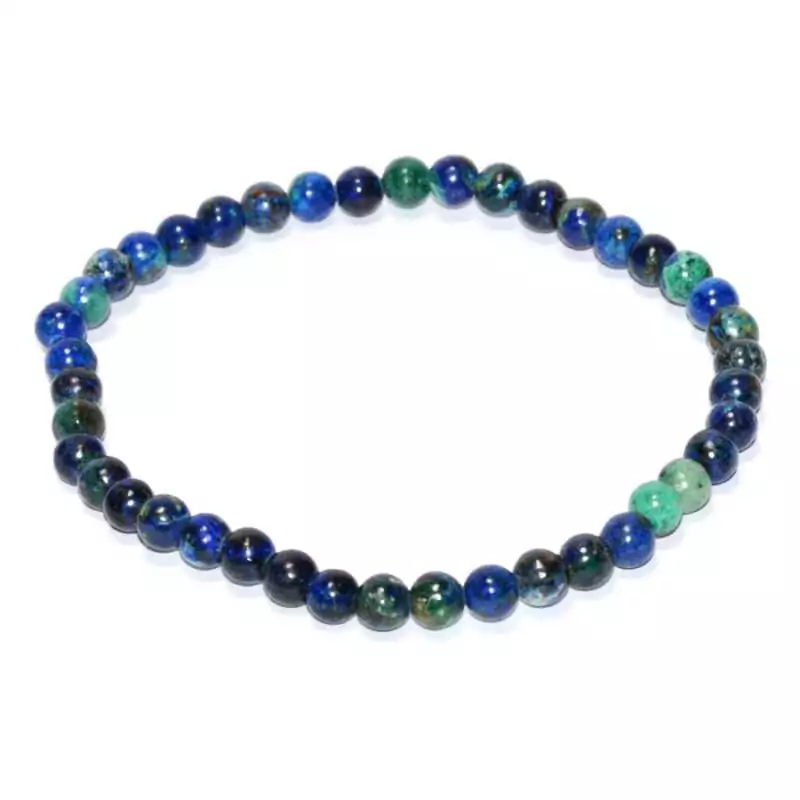
- Stone: Azurite
- Bead Size: 4mm
- Shape: Round, smooth
- Finish: Polished
- Color: Royal blue with green and teal patches
- Mohs Hardness: 3.5 to 4
- Closure: None, one continuous loop of beads
Deep Blue Azurite in Small Round Beads
Azurite is a basic copper carbonate, and its copper content gives it the deep azure blue that the name recalls, which Geology.com describes as a characteristic deep blue to violet-blue. The color runs from light to dark blue, and the beads in this bracelet sit in the royal-blue range, with patches of green and teal on several and a few dark, flecked beads that read as nearly black. Azurite forms as a secondary mineral where carbon-dioxide-rich water reacts with copper ores underground, and it often occurs mixed with green malachite, banded or intergrown, so blue-and-green beads are a familiar look for the stone. At 4mm each bead is small and smooth, polished to a glossy surface that deepens the blue. Azurite is soft, rating 3.5 to 4 on the Mohs scale, and Gem Society describes it as brittle with perfect cleavage, a stone to wear on occasions that suit delicate jewelry. The blue loses depth slowly with long exposure to light, air and heat, so a bracelet like this one rewards gentle handling and a dark place to rest.
Crystal guides link azurite with the third eye chakra, the point between the eyebrows in the seven-chakra scheme, and with insight and intuition. Those associations belong to modern crystal practice, which borrowed the chakra scheme from Hindu and Buddhist traditions, and they work as symbolism: a deep blue to look at when you want to turn inward. The patches of green and teal add a second theme to the strand, the color of water and deep forest beside the blue of a night sky. The deep blue beads set the base of the palette, and the green and teal ones punctuate it at irregular intervals. Dark blue beads set off silver and white gold, and the green patches pick up the tones of turquoise and jade pieces you may already wear. At 4mm the beads sit close to the wrist and fit easily under a cuff, so the bracelet can act as a private marker for a reading, a journal session or a quiet evening. Its softness suits gentle, seated use.
Practical Ritual Applications
Wear the bracelet on an evening you plan to spend inward: journaling, dream notes, a quiet reading with your cards. Before you begin, look for the greenest bead and use it as your starting point. Hold the strand between your palms for three breaths, then set it beside your notebook so the blue stays in view. On a small altar it can rest on a dark blue or black cloth next to an indigo candle. Between uses, keep it in a pouch where it stays dry and out of strong light. A small dish lined with soft cloth makes a good resting place on a nightstand, away from the window. For other bracelets built around the third eye and other chakras, my chakra stone bracelets collection shows more strands grouped by chakra.
How to Wear and Care for Your Azurite Bracelet
Three steps cover looking at the pattern, wearing the bracelet for quiet time, and keeping a soft copper stone dry.
- Study the pattern in daylight
Hold the bracelet near a window and turn it slowly. Pick out the deepest blue bead, the greenest bead and the darkest, flecked one. The mix of blue and green is a familiar look for azurite. Choose one bead as your marker, and hold one question in mind while you wear it.
- Wear it for a quiet session
Put the bracelet on when you sit down to journal, meditate or read, and rest your thumb on the marker bead. In crystal practice azurite is tied to the third eye chakra and to intuition, so the bead serves as a cue to turn your attention inward. Take the bracelet off when the session ends and put it away dry.
- Keep it dry and out of the mouth
Azurite is a copper mineral, so keep the beads out of the mouth. Wipe the bracelet with a soft dry cloth after wearing. If it needs more, use a cloth dampened with mild soap and water and dry it completely right away, and never soak it. Keep it away from perfume, cleaners, acids, hot windowsills and strong sun, and store it in a soft pouch.
The Tarot Fellow Standard
I stock this bracelet for its color: azurite in small polished round beads, royal blue with patches of green and teal. Azurite is soft, a stone for gentle wear and careful storage. The third eye and intuition links are modern crystal lore, and I offer them as symbolism to take or leave. Each bracelet differs in how much green and how many dark beads it carries, so the strand you receive has its own pattern. For more crystal jewelry, my crystal and stone jewelry collection gathers bracelets, pendants, rings and earrings by stone.
Frequently Asked Questions
Water is best avoided. Crystals.com rates azurite not water safe and advises dry cleansing methods and avoiding immersion. Gemselect says never to soak it, and allows mild soap and water only when the stone is dried completely afterward. Azurite is a soft copper carbonate, and strong light, air and heat can fade its blue over time.
Azurite often occurs together with green malachite, another copper carbonate that forms under similar conditions. The two minerals can be banded together or intergrown, and the mixed material is sold as azurite-malachite or azurmalachite. Lapidaries cut it into beads and cabochons, and the blue and green show as bands or round eyes. Blue-and-green beads are therefore a familiar look in azurite jewelry.
Azurite was ground into blue pigment as early as ancient Egypt, and Geology.com calls it the most important blue pigment used in Europe during the Middle Ages and the Renaissance. Wikipedia notes its use in Egyptian and Greek works and by medieval painters. Synthetic pigments began replacing it in the 18th century.




Reviews
There are no reviews yet