
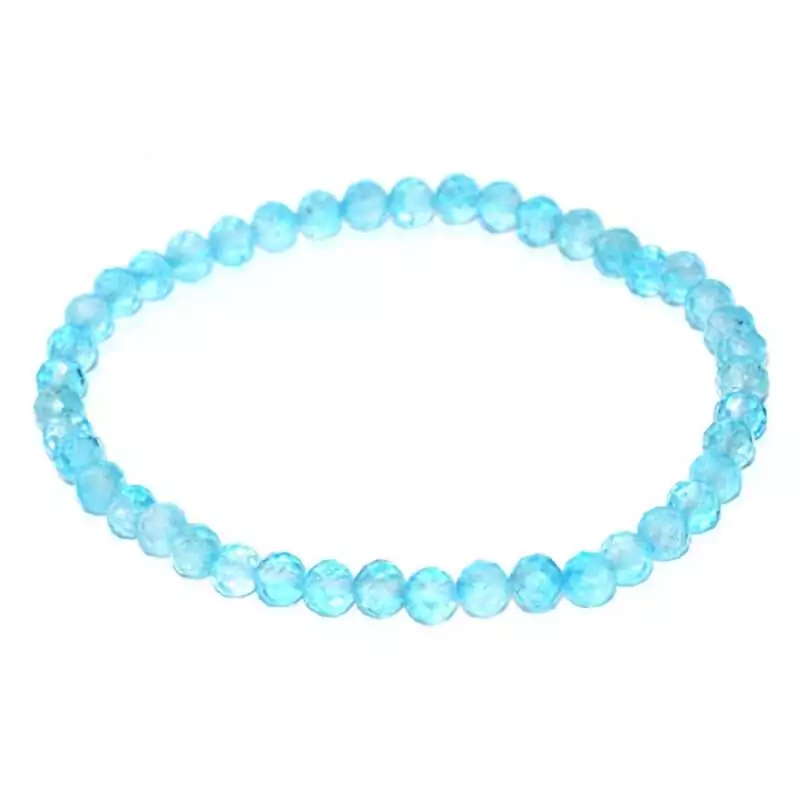
Quick Specs
- Stone: Blue topaz
- Bead Size: 4mm
- Shape: Round, faceted
- Color: Light sky blue
- Finish: Polished facets
- Hardness: 8 on the Mohs scale
- Closure: None, one continuous loop of beads
Blue Topaz in 4mm Faceted Beads
Topaz is an aluminum fluorosilicate, Al2SiO4(F,OH)2, and it sits at 8 on the Mohs scale, among the hardest minerals used in jewelry. Crystals form in brown, yellow, orange, pink, red and pale blue, and colorless topaz is plentiful. Blue is the color most people picture for topaz, and GIA points out that this blue is hardly ever natural: colorless topaz is irradiated and heated until it turns blue. These beads carry that color as a light sky blue, with a few leaning toward a paler, icier shade. Each one is 4mm across and cut with small flat facets, so the strand flashes in daylight and shifts between lighter and deeper blue as your wrist turns. The beads run in one closed loop with no clasp, so the pattern of facets continues all the way around. Topaz has perfect cleavage in one direction, which means a hard blow along that plane can split a bead, and GIA rates its toughness as poor even though its hardness is high. GIA also notes that topaz crystals are typically elongated with grooves parallel to their lengths, which is why gem cutters commonly shape them into long ovals and pears. Take the bracelet off before heavy work or sports.
In modern crystal practice, blue topaz is associated with the throat chakra and with speaking clearly. That chakra scheme entered Western crystal lore from Hindu and Buddhist traditions, and you can take it as symbolism, a color-coded cue for the parts of your day that involve talking. A 4mm bracelet makes a good cue because it sits where your eyes land each time you type, gesture or lift a cup. Topaz carries a calendar link as well: GIA names topaz, along with citrine, as a November birthstone, so a bracelet in this stone suits a November birthday. The light blue sits well beside silver-toned metal, denim, white and gray, and the slim bead size layers with other 4mm and 6mm strands without crowding the wrist. Because the strand is a closed loop of small beads, it sits flat against the skin, and the facets turn the blue into light that moves across the beads as you do. A stack of three thin bracelets in different blues and greens reads as one soft band of color, and a strand of faceted topaz gives that band a point of sparkle.
Practical Ritual Applications
Wear the bracelet on days you’ll be speaking: a meeting, a phone call you’ve been putting off, a reading you’re giving at a table. Touch one bead before you begin as a cue to slow down and say what you mean. On a shelf or altar, the bracelet can circle a small bowl of water or lie in front of a blue candle, where the facets pick up the flame light. At a desk, a dish beside the keyboard keeps the blue in view while you write. For a November birthday, it pairs with a card and a white or blue candle. If you like thin strands, my 4mm and 6mm beaded bracelets collection holds more stones in these slim sizes, so you can build a stack.
How to Wear and Care for Your Blue Topaz Bracelet
Three steps cover looking over the beads, using the bracelet as a cue, and keeping the stone safe.
- Turn the beads in daylight
Hold the bracelet near a window and turn it slowly so each facet catches the light. Look for the paler beads and the deeper ones; that spread is the natural variation in the strand. Then decide what you want the bracelet to mark, such as clear speech on busy days or a habit of pausing before you answer, and put it into one short sentence.
- Pair it with a pause
Put the bracelet on and rest your thumb on one bead for a slow breath before you speak, write or send a message. In crystal practice blue topaz is tied to the throat chakra and to expressing yourself, so the bead becomes a cue to say what you've decided to say. Use the same bead each day, and within a few weeks the gesture turns into a habit.
- Clean it gently and keep it cool
Wipe the beads with a soft cloth dampened with warm soapy water, then dry them. GIA recommends warm soapy water for topaz and steers away from steam and ultrasonic cleaners, and heat or a sudden temperature change can break the stone, so keep the bracelet clear of radiators, hot cars and boiling water. Store it flat in a pouch where nothing heavy can press on it.
The Tarot Fellow Standard
I stock this bracelet because 4mm faceted beads give topaz a bright look in a slim, easy-to-layer strand. Blue topaz gets its color from irradiation and heat in nearly every case, and the stone itself is among the hardest used in jewelry and shows a clean light blue. The throat chakra link is modern crystal lore, and I offer it as symbolism for anyone who likes a color cue at the wrist. For more bracelets and other stone jewelry, browse my crystal and stone jewelry collection.
Frequently Asked Questions
Topaz is allochromatic, which means impurities or flaws in the crystal structure create its colors, and colorless topaz is plentiful. GIA explains that blue topaz owes its color to treatment almost every time: colorless crystals are irradiated and then heated. Minerals.net adds that deep blue topaz rarely occurs in nature and forms from lighter stones through irradiation and heat. Wikipedia notes that trace impurities can make natural topaz pale blue.
Warm, soapy water works best for topaz, according to GIA, and steam or ultrasonic cleaners are best avoided. High heat or a sudden temperature change can crack the stone. Topaz also has perfect cleavage in one direction, so a hard blow can split a bead even though the mineral ranks 8 on the Mohs scale. Wipe the beads with a soft cloth, dry them, and store the bracelet away from knocks.
Yes. GIA lists topaz and citrine as the two birthstones for November. Topaz grows in a wide range of colors, including brown, yellow, orange, pink, red and blue, and two color varieties carry trade names: imperial topaz is a medium reddish orange to orange-red, and sherry topaz is yellowish brown to orange.
GIA calls topaz color generally stable to light. The fading it mentions applies to yellow-to-brown, reddish brown and dark brown topaz after prolonged heat or sun exposure. High heat is a separate matter, since heat or a sudden temperature change can break the stone. Keep the bracelet off a hot dashboard, a radiator or a sunny sill for hours, and store it in a pouch between wears.


Reviews
There are no reviews yet