
Quick Specs
- Style: Mixed stone bracelet
- Bead Size: 4mm
- Shape: Round, smooth
- Colors: Lilac, deep violet, mint, rose pink, blue
- Fit: Kids size
- Closure: None, one continuous loop of beads
A Scatter of Small Mixed-Stone Beads
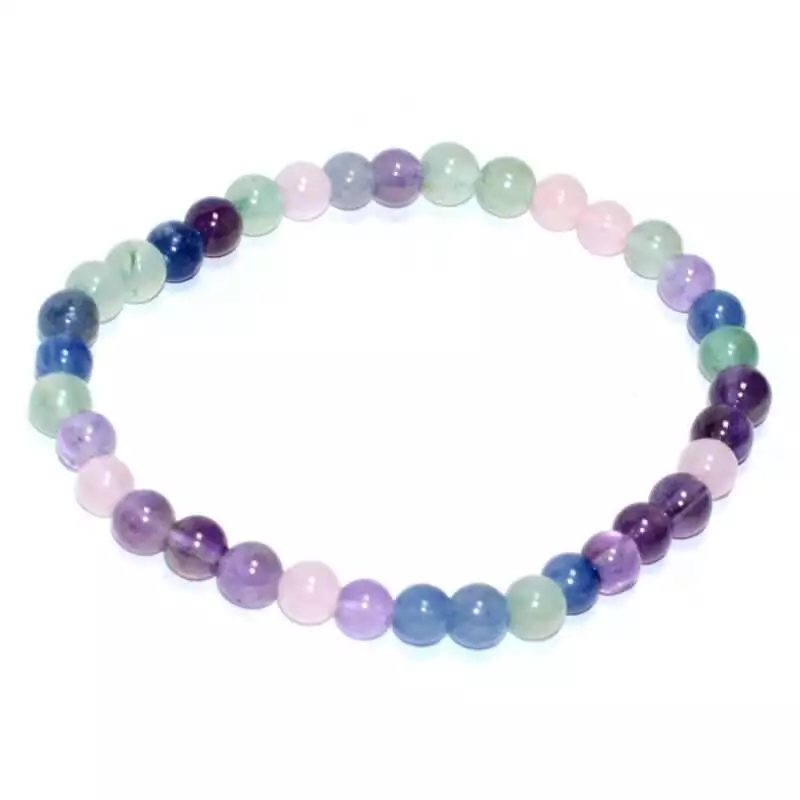
The strand is a scatter of small round beads in lilac, deep violet, mint, rose pink and blue, each 4mm across, which is about 5/32 of an inch. The colors fall in an irregular order around the loop: a pale mint bead beside a soft rose one, two blues together, then a run of lilac with a single deep violet bead among them. Several beads are translucent and look glassy where light passes through, and every surface is smooth and glossy. Others are softer and milkier, so clear and cloudy beads share the loop. A mixed-stone strand combines more than one material, and each stone has its own hardness. The Mohs scale, introduced in 1812 by the German geologist and mineralogist Friedrich Mohs, ranks scratch resistance from talc at 1 to diamond at 10, and a harder material can scratch a softer one. In a strand of mixed stones, the beads therefore sit at different points on that scale. A kids size loop is made smaller than an adult bracelet, and at 4mm the beads keep the strand slim enough to sit beside a watch or a hair tie.
Mixed colors give a child plenty to look at. The strand works as a small color chart: lilac, violet, mint, rose and blue, each with a few beads to find and name. A child can turn the loop slowly and say each color aloud, count how many mint beads there are, or match the bracelet to the crayons, paint or leaves nearby. A child who likes rocks can compare the beads with a pebble collection, sorting by color and by how shiny each one is, and then sorting again by size. The soft palette sits easily with school clothes and party dresses alike, and it looks at home against summer whites and pastels. Because the loop has no clasp, no hardware sits against the skin. From a distance the beads read as a thin line of color, and up close each one shows its own tint, which gives a child something new to find each time they look. It suits a birthday gift or a keepsake for the first day of school.
Practical Ritual Applications
Turn the bracelet into a color hunt on a walk: name a bead, then find that color in a flower, a leaf or a pebble. At home, lay it on a windowsill next to a child’s rock or shell collection and sort the collection by the bracelet’s colors. For a birthday, wrap it with a card that lists the five colors and invites the child to find each one. If you share crystals with a child, the bracelet is an easy piece to hold while you read a book about rocks together. For other slim strands, my 4mm and 6mm beaded bracelets collection shows more small beads in other stones and colors. An adult should supervise any play with the bracelet.
How to Wear and Care for Your Mixed Stones Bracelet
These steps cover fit, a color game, and small-parts care for a child's bracelet.
- Check the fit before the first wearing
An adult should try the loop on the child's wrist first. It should sit comfortably without pinching and come off easily. Look over the beads and the strand for cracks, gaps or loose beads, and repeat the check every few weeks. Treat any bead that shows a crack as a reason to stop wearing the bracelet.
- Play the color game
Turn the loop slowly and name the colors in order: lilac, violet, mint, rose, blue. Then pick one color for the day and look for it around the room or outdoors. Counting the beads of one color gives a child something to do with the bracelet, and the irregular order means there is a new pattern to notice each time.
- Supervise and keep it clean
Beads this small are small parts, so an adult should supervise, and the bracelet comes off for swimming, sports and sleep. Wipe it with a soft dry cloth and store it flat in a pouch, since harder stones and other jewelry can scratch softer beads. Keep it away from harsh chemicals, abrasive surfaces and hard knocks.
The Tarot Fellow Standard
I stock this bracelet as a small, colorful first piece: 4mm beads in a kids size, with five soft colors scattered around one loop. The mix keeps the strand playful and easy to match with clothes. Small beads call for an adult’s eye, so I suggest it for children old enough to wear a bracelet without mouthing it. If your child enjoys finding new colors in a mix, my mixed and assorted variety collection has more stones that come in many colors at once.
Frequently Asked Questions
I would not give it to a child under three or to any child who mouths objects. A 4mm bead is far smaller than the 1.25 inch wide test cylinder that approximates the throat of a child under three, so it counts as a small part, the kind of object behind the CPSC's rules for products meant for children under three. This bracelet is jewelry, not a toy. For older children, an adult should check the strand regularly.
I suggest saving it for calm moments and special days. Jewelers' care guides note that even durable gemstones can be damaged by harsh chemicals, abrasive surfaces and sharp blows, which active play can supply, and a strand of mixed stones holds stones of different hardness, so one bead may mark another. Take it off for sports, swimming and sleep, and check the strand afterward for cracks or loose beads.
Crystal-bracelet guides call the left wrist the receiving side, tied to calm, intuition and protection, and the right wrist the projecting side, tied to confidence, action and communication. They offer this as a flexible starting framework. For a child, the wrist that feels comfortable and keeps the bracelet away from rough play is the practical choice.
Reviews
There are no reviews yet