

Quick Specs
- Type: Top-polished natural crystal point, lapis lazuli
- Size/Quantity: Approximately 6.6 lb (approx. 3 kg), single specimen
- Best for: Altar centerpiece, third eye and throat chakra work, deep meditation anchor
Lapis Lazuli: Five Thousand Years of Sacred Blue Stone
Lapis lazuli has been mined from the Sar-i Sang deposit in the Badakhshan province of Afghanistan for over six thousand years, making it one of the oldest continuously sourced gemstones in human history. Ancient Egyptians ground it for pigment in the blue that colors royal and divine figures in tomb paintings, carved it into amulets, and embedded it in the funeral mask of Tutankhamun. Sumerian cylinder seals, Mesopotamian jewelry, and Minoan frescoes all confirm its reach across the ancient world as a stone of royalty, truth, and connection to divine intelligence. The golden pyrite flecks scattered through its matrix were read as stars in a night sky, earning lapis its association with the heavens across multiple distinct traditions.
In contemporary crystal healing practice, lapis lazuli is consistently placed at the third eye and throat chakras. It is worked with to sharpen intuition, support truthful communication, strengthen access to inner wisdom, and deepen the quality of meditation. Practitioners who teach active dreaming or past-life work often keep a large lapis specimen on the altar or bedside table as a focus point, citing its capacity to open psychic channels while maintaining a grounded quality that other third-eye stones sometimes lack.
The Top-Polished Point Form and What It Offers
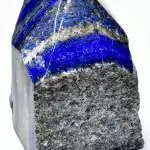
The top-polished point form is a specific finishing choice: the apex is polished to a high shine that catches and directs light, while the body and base retain their natural rough texture. This creates a visually striking piece that grounds itself in the raw material while presenting a directing tip for focused work. The polished apex can be used as a focal point during meditation, pointed toward a specific area of the body in chakra work, or oriented to a compass direction on the altar to anchor directional practice.
At approximately 6.6 pounds, this is a substantial altar piece rather than a pocket or grid stone. Specimens at this weight are uncommon in the retail market and represent a collector and advanced practitioner tier of purchase. Each piece at this scale is unique in its exact proportions, depth of color, and distribution of pyrite inclusions. Natural variation means the stone delivered will carry its own particular character within the type.
How to Use a Lapis Lazuli Point in Practice
How to work with a large lapis lazuli point for meditation, chakra work, and crystal grids.
- Position it as a meditation focal point
Place the point at the center of your altar or in front of your seated position. Rest your gaze on the polished tip to begin meditation. The deep blue draws focus inward, supporting the shift from surface thought to contemplative states.
- Use it in third eye and throat chakra work
Lay the stone near your head with the tip toward the crown during a reclining body session. Its weight at this scale makes it effective as a nearby anchor even off the body, supporting work with clarity, truth, and intuitive access.
- Pair it with complementary stones for gridwork
Lapis works well alongside sodalite for intuition, clear quartz for amplification, and moonstone for dream work. Arrange smaller tumbled versions of these around the central point to build a focused communication and visioning grid.
The Tarot Fellow Standard
Large specimen pieces earn shelf space here only when the quality justifies the commitment. This lapis point meets that bar: the color is deep and saturated, the pyrite distribution is generous, and the top-polish finish is clean and bright without masking the natural matrix. Browse my full crystals and gemstones collection for smaller lapis pieces and companion stones, and check my chakra and meditation tools for accessories that support deep stone work.
Frequently Asked Questions
Lapis lazuli is associated with the third eye and throat chakras. It supports intuition, truthful communication, and deepened meditation. Many practitioners use it for psychic development, clairvoyance, and accessing visionary states.
The primary historic and modern source is the Sar-i Sang mine in Badakhshan province, Afghanistan, which has supplied lapis for over six thousand years. Additional deposits exist in Chile, Russia, and Canada for supplementary supply.
The golden flecks are pyrite, an iron sulfide mineral that forms naturally within the lazurite matrix. Ancient cultures read them as stars and linked lapis to the heavens. High pyrite content is considered desirable in quality specimens.
Lapis is soft at 5 to 6 on the Mohs scale and should not go in salt or acid-based cleaners. Wipe with a slightly damp soft cloth to remove dust. Avoid prolonged direct sun, which fades the blue. Store away from harder stones.

Reviews
There are no reviews yet