
Quick Specs
- Type: Kyanite free-shape crystal specimen
- Size/Quantity: One piece, 0.8 to 1.0 lb
- Best for: Throat chakra, third eye activation, all-chakra alignment, communication
Kyanite: The Self-Clearing Alignment Stone
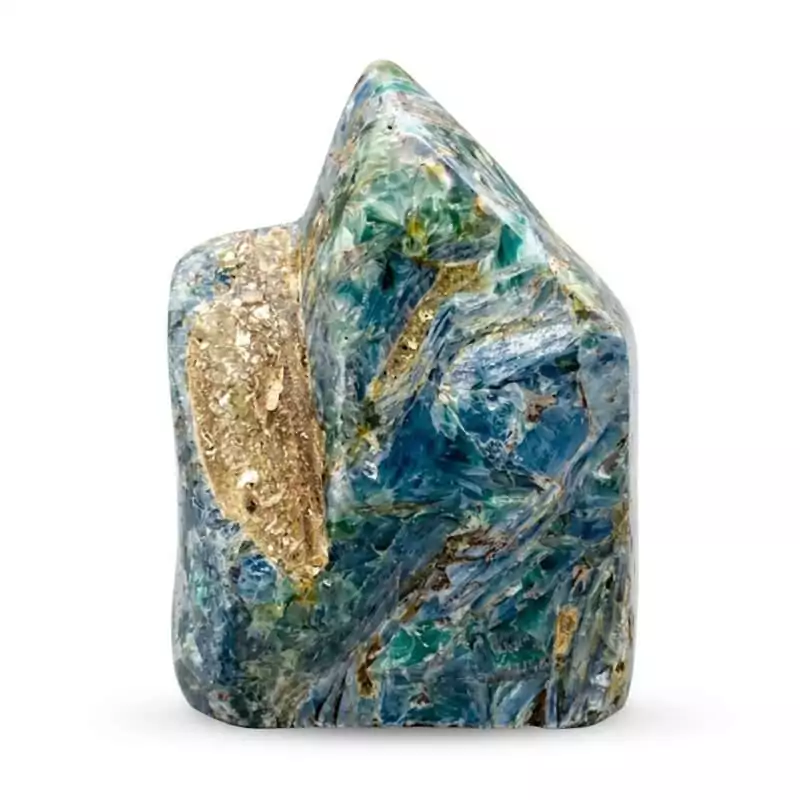
Kyanite is an aluminum silicate mineral that forms in metamorphic rock systems under sustained high pressure. It displays a characteristic bladed crystal habit, meaning the individual crystals grow as elongated, flattened forms that fan out from a central mass. The blue-green and gold coloration common in high-quality specimens reflects the layered mineral inclusions embedded within each blade. It is found in Brazil, Nepal, Myanmar, and the United States, with each source producing stones with slightly different visual properties.
In metaphysical practice, kyanite holds a distinctive position as one of the few stones practitioners consider self-clearing, meaning it does not require regular cleansing rituals to maintain its energetic state. It is primarily associated with the throat chakra and the third eye, making it a preferred stone for practitioners working on honest communication, psychic development, and spiritual attunement. Many crystal workers also use it as a full-system alignment tool, placing it along the body’s central axis during energy work to harmonize all chakra centers simultaneously.
Working with a Large Free-Shape Kyanite
At 0.8 to 1.0 pounds, this is a substantial piece with the mass to serve as a primary working stone rather than a carry piece. The free-shape form preserves the natural blade formations that give kyanite its visual character, and no two specimens are alike in silhouette or coloration. Practitioners who browse my free-shape crystal selection often add kyanite as a communication and alignment anchor alongside other free-form specimens.
Kyanite pairs naturally with labradorite for third eye work, with lapis lazuli for deepening throat chakra practice, and with selenite when the goal is full-system clearing and alignment. Its neutral blue tones make it visually adaptable on any altar setup, and its self-clearing nature means it requires less maintenance than most other working crystals in a regular practice.
How to Use Kyanite Free Shape
Follow these steps for best results.
- Target the Throat or Third Eye
Hold the kyanite piece at the throat or chest level. Focus on any communication, emotional truth, or psychic clarity goal you want to address. Kyanite does not require cleansing before use and is considered one of the few self-clearing stones.
- Use for Full Chakra Alignment
Place the kyanite free shape near a meditation seat or on the throat chakra area during a lying-down session. Its blade formation naturally fans out energy, so positioning it horizontally supports a full-range chakra alignment practice.
- Support Intuitive Writing
Use the kyanite for automatic writing or intuitive journaling by placing it beside your notebook. Practitioners report that kyanite’s association with the third eye and throat chakra encourages honest self-expression and access to inner guidance.
The Tarot Fellow Standard
Kyanite earned a permanent spot in my crystal selection because of its versatility and the low-maintenance advantage of its self-clearing nature. This size range brings real working presence to an altar or body-layout session. For broader crystal practice tools, explore my crystals and gemstones collection for pairing options and companion stones.
Frequently Asked Questions
Kyanite is best known for the throat and third eye chakras. It supports honest communication, psychic clarity, and spiritual attunement. Many practitioners also use it for all-chakra alignment, as it is said to work across the full energetic system.
Kyanite is one of the few minerals believed to never accumulate negative energy and therefore does not require clearing. Most practitioners still periodically set it in moonlight or beside selenite as a matter of ritual habit and care.
Kyanite is a silicate mineral with a distinctive bladed crystal structure. It forms in metamorphic rocks under high pressure. The blue-green-gold coloration seen in free-shape specimens comes from trace mineral inclusions layered within the blades.
Each free-shape piece in this 0.8 to 1.0 pound range is a unique natural specimen. Blade formation, coloring, and silhouette vary between pieces. No two are identical, and any gold shimmer present is a characteristic of the mineral itself.



Reviews
There are no reviews yet