
Quick Specs
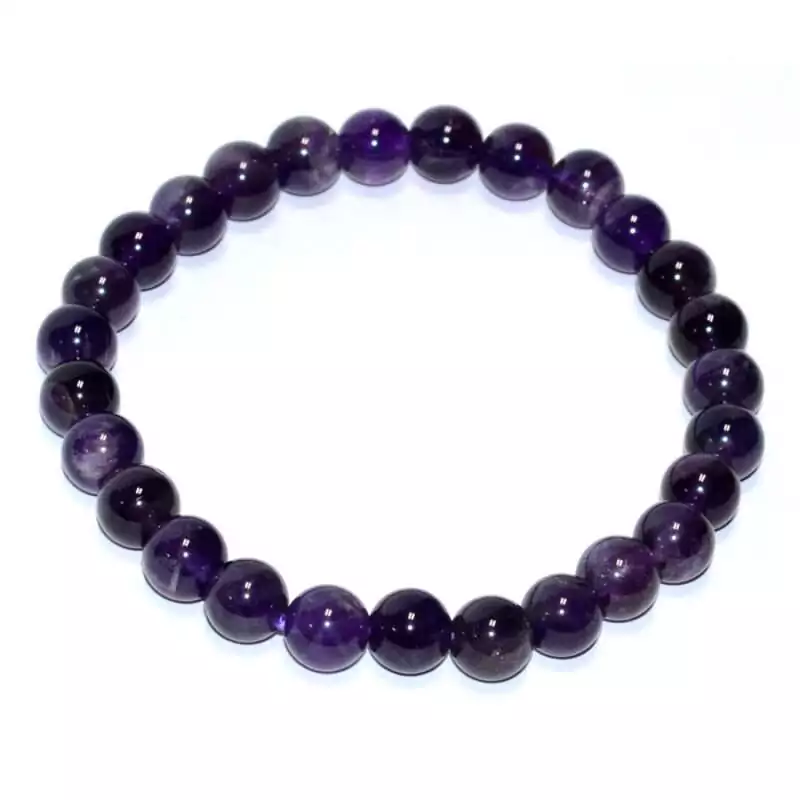
- Stone: Amethyst
- Bead Size: 8mm
- Shape: Round
- Finish: Polished, glossy
- Color: Deep violet with lighter lavender zones
- Closure: None, one continuous loop of beads
Amethyst in 8mm Beads
Amethyst is quartz, silicon dioxide like every other variety of that mineral, with its violet traced to iron in the crystal and natural radiation acting on it. That origin shows in the beads. Amethyst often carries color zoning, bands or patches where the purple runs deeper or thinner, so one bead on this bracelet can look nearly black-violet while the next fades to lavender at its edge. Dealers describe the full range as light lilac to deep royal purple, and these beads sit toward the deep end. The variation comes from the stone, not from a mismatch in the strand. Polishing gives the beads a glossy surface, and at 8mm each bead is large enough to show its own depth of color. Quartz rates 7 on the Mohs scale, durable enough for jewelry that gets daily wear, though a hard knock can still fracture it. Brazil, Uruguay and Zambia are among the places amethyst is mined. The bracelet keeps to one material in one bead size, which leaves the color alone to do the work, from the first bead to the last.
In modern crystal practice, amethyst is linked with the crown chakra, the seventh and highest point in the chakra scheme, and with peace, calm and meditation. Those links belong to modern crystal lore, which took the chakra idea from Hindu and Buddhist traditions, and you can take them as symbolism. People use symbolism like that the way they use any small ritual object: as a cue. A bracelet sits where your eyes land whenever you type, write or reach for something, which makes it an easy prompt to pause, take a breath and return to the intention you set. The 8mm size gives the bracelet visual weight. A strand of larger beads reads as a deliberate band of purple that you can spot from across a table, where a 4mm strand reads as a thin line of color. If you already wear metal bracelets, the deep violet sits well beside silver or black, and it stacks with paler stones that leave it the darkest thing on your wrist.
Practical Ritual Applications
Wear the bracelet as a marker for a stretch of time you want to treat differently: a week of daily meditation, a month of dream journaling, or the days before a decision. When you sit down to read, write or meditate, slip it off and set it beside your notebook or cards so the violet stays in view. On a small altar it can lie in front of a purple candle or circle a bowl of salt. At a desk, a dish beside the keyboard gives it a place where you’ll see it between tasks. If you want a stack, my 8mm beaded bracelets collection holds other stones in the same bead size, so the strands line up evenly on the wrist.
How to Wear and Care for Your Amethyst Bracelet
Three steps cover choosing a purpose, wearing it with a habit, and keeping the color.
- Look the beads over in daylight
Hold the bracelet near a window and turn it slowly. Find the darkest bead and the palest one; that spread is the color zoning typical of amethyst. Then decide what you want the bracelet to mark, whether that is a daily pause, a meditation habit or a goal, and put it into one sentence you can remember.
- Pair it with a short daily pause
Put the bracelet on and take three slow breaths with your thumb resting on one bead. In crystal practice amethyst is tied to calm and the crown chakra, so you can use the same bead each morning as a cue. Over a few weeks the bracelet becomes a habit marker, and the sentence you chose in step one comes back to mind when you see it.
- Protect the color and clean it gently
Between wears, store the bracelet flat in a pouch or box, away from windows and heaters. When it needs a wipe, use a soft cloth dampened with mild soapy water, then dry it right away. Take it off for heavy work or sports, because a hard knock against a counter or doorframe can fracture a bead.
The Tarot Fellow Standard
I stock this bracelet because it shows amethyst in its simplest form: one stone, one bead size, a polished round shape and nothing added. That makes it easy to see what the stone looks like by itself, from the deepest violet bead to the palest in the same strand. The crown chakra link is modern crystal lore, and the bracelet is a way to carry a color and a cue. Beads vary because the stone does, so expect a mix of dark and light. To compare other stones, browse my crystals, stones and gemstones collection, where amethyst sits beside the rest of the shop’s stones.
Frequently Asked Questions
It can, slowly. Amethyst may fade when it is overexposed to strong light, and some amethyst from a few localities lightens more than others after long exposure. Extreme heat is a separate risk, because heating turns amethyst yellow, orange or brown. For a bracelet, that means a sunny windowsill, a hot dashboard and a day on a beach towel are poor places to leave it. Keep it in a pouch or box away from windows between wears.
Amethyst commonly shows color zoning, which means uneven color or distinct bands of darker and lighter purple inside the same crystal. The most intense color usually sits near the crystal's tips, so beads drilled from different parts of the material differ, from deep violet to pale lavender. A strand with a mix of tones is typical of the stone, and it is the reason no two amethyst bracelets look identical.
Crystal-bracelet convention treats the left wrist as the receiving side and the right as the projecting side, and amethyst, which crystal guides link with calm and intuition, is usually worn on the left. Guides offer this as a flexible framework rather than a rule, so the wrist that feels comfortable is a perfectly good choice.
The name comes from the Greek amethystos, meaning not intoxicated, and ancient Greeks believed the stone guarded its owner against drunkenness. Drinking vessels were carved from it in the hope of keeping the drinker sober. Gem writers call it one of the most enduring bits of folklore about the stone.


Reviews
There are no reviews yet