
Quick Specs
- Stones: Obsidian and hematite
- Bead Size: 8mm
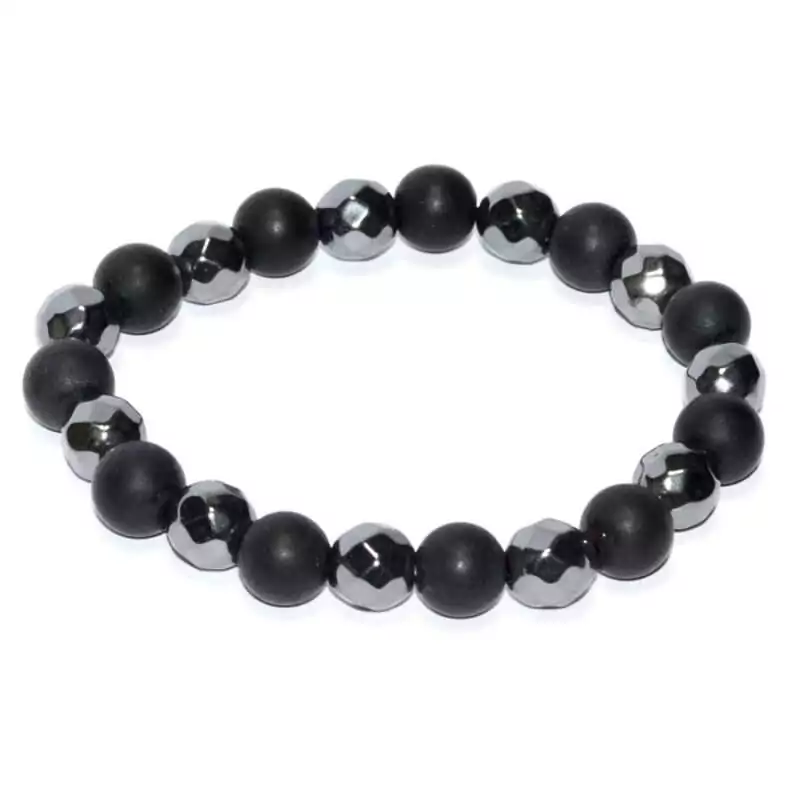
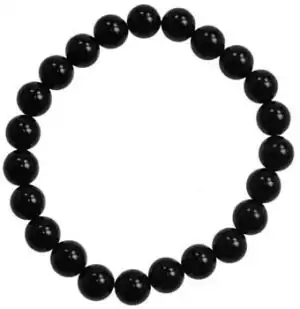
- Layout: Alternating matte black rounds and faceted gray beads
- Finish: Matte obsidian, faceted metallic hematite
- Color: Black and metallic gray
- Closure: None, one continuous loop of beads
Matte Obsidian and Faceted Hematite in 8mm Beads
Two stones alternate on this strand, and each has its own surface. The obsidian beads are round, 8mm and matte black, with a flat, velvety finish that takes in the light. Obsidian is volcanic glass, mostly silicon dioxide, formed when silica-rich lava cools so quickly that crystals barely grow, and it rates about 5 to 6 on the Mohs scale. Between them sit faceted beads of hematite, cut with many small flat faces that flash like polished steel. Hematite is iron oxide, Fe2O3, a major ore of iron, black to steel gray with a metallic luster and blood red only in very thin slivers. Both stones are brittle. Each bead measures just under a third of an inch across. The obsidian absorbs light and the hematite throws it back, and that difference is the main subject of the bracelet. The strand runs in a steady rhythm of one matte bead and one bright faceted bead around the whole loop, so the eye keeps moving between dull and shine. Each faceted bead shifts from near-black to bright silver as your wrist turns.
Crystal guides treat obsidian and hematite as a matched pair: each is tied to grounding and protection, and each sits at the root chakra, the base of the seven-chakra scheme. The chakra idea comes from Hindu and Buddhist traditions, and the stone pairings are modern lore, offered here as symbolism. The shared theme makes the pairing easy to explain: two dark stones with one idea behind them. The strand is a study in texture. Matte black reads quiet and the faceted beads read bright, so the bracelet works with a black T-shirt or a white shirt, and it sits well beside a steel watch or a leather cuff. At 8mm the beads are large enough for the facets to show clearly, and the alternating layout keeps each bright bead apart from the next, so every facet gets its own space to catch the light. Dark stones suit stacking, since the strand layers with a thin chain bracelet or a woven cord, and the faceted beads pick up any silver tones nearby. The loop has no clasp, so no hardware catches on a sleeve.
Practical Ritual Applications
Wear the bracelet on days that call for a steady head: a hard meeting, a long drive, a busy market stall. Touch a matte bead and then a faceted bead before you begin, and let the contrast between dull and bright be your cue to slow down. On an altar, lay it on a dark cloth in front of a black candle, with the facets turned toward the flame so they catch its light. If you sit to meditate, rest the bracelet in your open palm for the first few breaths. For more strands in this bead size, my 8mm beaded bracelets collection holds other stones that line up evenly on the wrist. Set the bracelet down gently, since both stones are brittle.
How to Wear and Care for Your Obsidian and Hematite Bracelet
Three steps cover a first look, a grounding habit, and gentle cleaning for two brittle stones.
- Look at the two surfaces together
Hold the bracelet near a window and turn it slowly. Watch the faceted beads flick between dark gray and bright silver while the matte beads stay flat black. After the first few wears, check the edges of the facets and the beads for chips, and stop wearing the bracelet if a bead cracks.
- Pair it with a grounding habit
Put the bracelet on, press both feet to the floor and take three slow breaths. Slide your thumb from a matte bead to a faceted one, dull to bright. In crystal practice both stones are tied to grounding, so the movement becomes a cue to settle your attention before a task. Repeat it at the same time each day and the cue grows familiar.
- Clean it gently and store it apart
Wipe the beads with a soft cloth, damp with a little mild soapy water if needed, and dry them at once. Skip ultrasonic and steam cleaners and harsh chemicals, and avoid long soaks, since dealers say prolonged water can dull hematite's luster. Store the bracelet in a pouch, away from harder stones that could scratch the facets.
The Tarot Fellow Standard
I stock this bracelet for its play of texture: matte obsidian and faceted hematite, one after the other, in a strand with no clasp and nothing added. Both stones link to grounding in modern crystal lore, and I offer that as symbolism you can take or leave. The two surfaces make the strand easy to read from across a table, and since both stones are brittle, I recommend it to anyone who will set it down gently. For more stones tied to the same theme, browse my grounding and earth energy stones.
Frequently Asked Questions
Only faintly. Natural hematite responds very weakly to magnets, and Wikipedia notes that an ordinary magnet barely attracts it. Strongly magnetic beads sold as magnetic hematite are a man-made material called hematine, which the International Gem Society says contains no hematite at all. Fire Mountain Gems likewise treats strong magnetism as a sign of the synthetic material.
Use a soft cloth, mild soapy water and warm water, then dry the beads right away. The International Gem Society advises against mechanical cleaning systems such as ultrasonic and steam for both stones. Dealer care guides add that harsh chemicals are best avoided and that prolonged water exposure can dull hematite's luster. Store the strand away from harder stones, because hematite and obsidian are both brittle.
The name comes from the Greek word for blood. Hematite's powder is red to reddish-brown even when the stone itself is steel gray or black, and gem references call that red streak a key identifying clue. Some specimens are also red. The metallic gray of these faceted beads is the stone's surface color, and the red shows in the powder.
Crystal-bracelet guides call the left wrist the receiving side, tied to calm, intuition and protection, and the right wrist the projecting side, tied to confidence, action and communication. They offer this as a flexible starting framework. Obsidian is listed among the stones for protection, so some guides would suggest the left wrist, and the wrist that feels comfortable is a perfectly good choice.
Reviews
There are no reviews yet