
Quick Specs
- Type: Bottle pendant necklace
- Pendant: Heart-shaped glass bottle with cork stopper, about 1 by 1 1/4 inches
- Fill: Amethyst chips
- Cord: Black satin, 24 inches
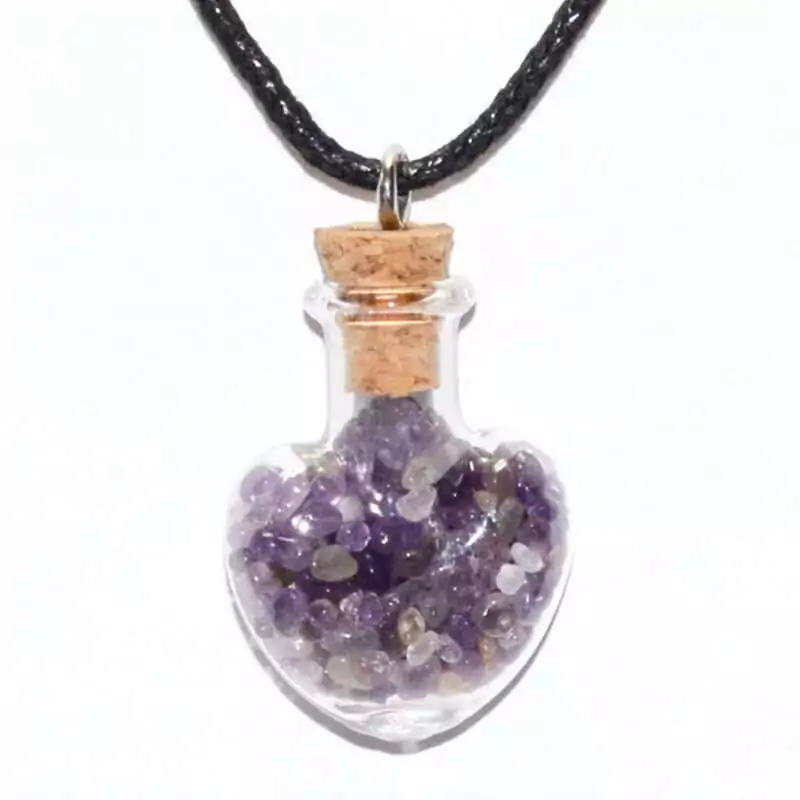
A Heart-Shaped Bottle Filled With Amethyst Chips
The pendant is a heart-shaped glass bottle with a short neck closed by a cork stopper, and a small metal ring at the top of the cork takes the cord. The glass is clear, so you can see every chip. The heart sits point-down, so the chips pile loosely through its curved lower half and leave an empty space under the cork. They run in tones from deep violet through lilac to pale gray and clear, so the bottle reads as a blend of colors. Chips are small, irregular fragments of stone with no set shape, and they slide and catch the light whenever you tilt the bottle or move. Amethyst is quartz, silicon dioxide, and it rates 7 on the Mohs scale. The tan cork and the clear glass catch the light at the top of the pendant while the chips hold the color below, and the black satin cord sets off the violet.
Amethyst is the violet variety of quartz. In nature it grows as six-sided columnar crystals capped with a pyramid-shaped point, and it also lines the inside of geodes. Iron impurities in the crystal, acted on by natural radiation, produce the color, and the color usually forms in angular zones of darker and lighter violet, which is why a handful of chips holds so many tones. Shades range from light lilac to deep royal purple, and from cool bluish to reddish purple. The name comes from the Greek amethystos, meaning “not intoxicated.” Ancient Greeks believed the stone guarded its wearer from drunkenness, and the name records that belief. Ancient Egyptians used amethyst as a gemstone, so a violet stone in a pendant has a very long precedent. Brazil, Uruguay, and Zambia are among the largest sources today. In a bottle, the chips show the range of the material, from the saturated pieces to the nearly colorless ones, in one small heart.
Practical Ritual Applications
Wear it where the bottle shows against a dark top, or hang it from a bedpost, a mirror, or an altar hook when you aren’t wearing it. On an altar, the corked heart can stand in a small dish beside a purple candle in its own holder; tilt it now and then to watch the chips slide and settle. Some people hold a bottle like this in the palm during a short meditation and let the small weight of the chips serve as a focus. It pairs well with other pieces from my crystal and gemstone pendants if you like layering lengths. As a gift, it suits a February birthday, since amethyst is the traditional birthstone for that month.
How to Wear and Care for the Amethyst Heart Bottle Necklace
Three steps cover checking the bottle, wearing it safely, and storing it.
- Check the Bottle
Look the pendant over in good light before you wear it. Make sure the cork sits snug in the neck and the small metal ring on top is firm, then tilt the bottle gently to watch the chips slide. Glass can chip at the rim if it's knocked against a hard surface, so hold the pendant by the body of the heart rather than by the neck.
- Wear It Safely
The bottle is glass and holds small loose chips, so keep it away from young children and don't hand it over as a toy. Take the necklace off for sports, sleep, and any activity where the bottle could be struck or the cord could catch. Wear it under a collar or outside a jacket, where the glass won't knock against buttons or a zipper.
- Store It Flat or Hung
Wipe the glass with a soft, dry cloth. Between wearings, lay the necklace flat in a box or hang it from a hook so the cord doesn't knot and the bottle doesn't roll, and keep it away from heat and long direct sun. Keep it out of a bag where keys or other jewelry can scratch the glass or crack the neck.
The Tarot Fellow Standard
I stock this necklace because it puts the stone in plain view: a clear glass heart, a cork stopper, and a pile of amethyst chips in several shades. It shows how varied amethyst’s color can be. Because the bottle is glass and the chips are loose, it is an adult piece. The meanings crystal practice attaches to amethyst are themes for your own reflection, and how you use them is yours to decide. Browse my chakra and Reiki collection for more stones to wear or place on an altar.
Frequently Asked Questions
Amethyst can fade. Wikipedia notes that prolonged light exposure fades it, and a crystal encyclopedia advises protecting it from direct sunlight. Prolonged is the key word in both: the concern is long, repeated exposure, such as a bottle left for weeks on a sunny windowsill. A shelf, a box, or a hook out of full sun is the safer place to keep the bottle between wearings.
Crystal guides link amethyst with the crown chakra, and some also with the third eye, along with themes of meditation and intuition. These pairings come from modern crystal practice, so treat them as themes for reflection. The chakras come from Indian traditions, where different texts count different numbers of centers, and the familiar seven-color scheme is a modern Western arrangement.
Heating can. Amethyst that is heated turns yellow-orange, yellow-brown, or dark brown, and the heated material is often sold as citrine. Both are quartz, so only the color differs. Heating part of a crystal can leave violet and yellow together in one stone, which is called ametrine. Dealers use this treatment on purpose, and the result is the same mineral in a different color.

Reviews
There are no reviews yet