
Quick Specs
- Type: Bottle pendant necklace
- Pendant: Heart-shaped glass bottle with cork stopper, about 1 by 1 1/4 inches
- Fill: Garnet chips
- Color: Wine red, rose and amber-brown
- Cord: Black satin, 24 inches
A Glass Heart Filled With Garnet Chips
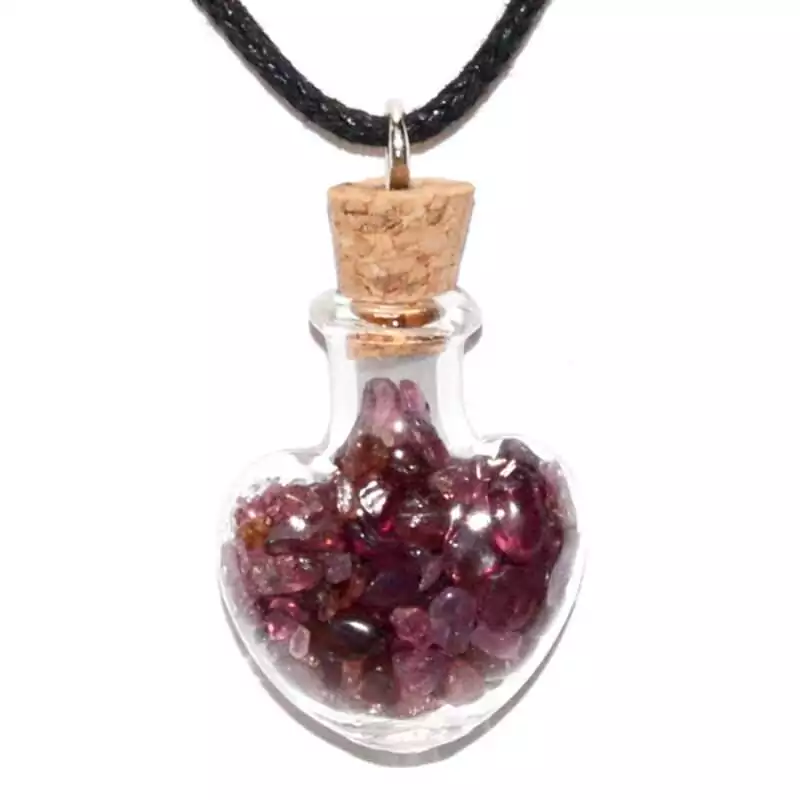
The bottle is a clear glass heart with a short neck, and a tan cork closes the top. A small metal ring is set into the cork and holds the black cord. The heart sits point-down, so the chips gather in the curved lower half and leave a pocket of open glass under the cork. Most of them are a deep wine red that turns nearly black where several overlap, and others run pink or rose, with a few pieces in amber-brown. Many are translucent, so the light that comes through the glass lights them from behind. Chips are small, irregular fragments with no set shape, and they slide against each other when you tilt the bottle. The whole pendant is about 1 inch wide and 1 1/4 inches tall, small enough to sit lightly on a 24 inch cord. Some chips have flat, glossy faces that catch the light like tiny windows, and the ring on the cork is silver-toned. Near the point of the heart the chips pack tightly, and toward the neck they thin out into single pieces.
Garnet is the name of a group of related silicate minerals, and GIA lists five species that matter in jewelry: pyrope, almandine, spessartine, grossular and andradite. Many garnets are mixtures of two or more species, so shades can differ from one piece to the next. Fire Mountain Gems describes almandine as deep wine red, pyrope as pale pink to medium red and hessonite as orange to orange-brown. Fire Mountain Gems says garnets form in metamorphic and igneous rocks under very high temperature and pressure, and GIA says red garnet occurs in metamorphic rocks on every continent. It rates about 6.5 to 7.5 on the Mohs scale, depending on the type, and GIA says it is stable to light. Garnet has a long history as a gem, and Wikipedia traces its use to the Bronze Age. It is the birthstone for January. In modern crystal practice, red garnet is linked with the root chakra and with grounding and stability. Those links belong to crystal lore, and you can take them as themes for reflection.
Wearing and Displaying the Garnet Heart
Wear the heart on its 24 inch cord for a January birthday or for any day you like a splash of deep red near your collar. Between wearings, hang it from a mirror frame or a bedpost, or stand it in a small dish on a desk, where the light through the glass shows the chips. On an altar, the corked heart can sit beside a red or white candle as a small stone display. If you’re giving it as a gift, the corked bottle fits in a card or a small box. Layer it over a plain neckline, where the red is the only strong color in view. For more stones to wear at the neck, browse my crystal energy pendants.
How to Wear and Care for the Garnet Heart Bottle Necklace
Three steps cover checking the bottle, wearing it, and keeping it clean.
- Check the Cork and Ring
Hold the heart up to a window and turn it slowly. Check that the cork sits snug in the neck and the metal ring on top is firm. Tilt the bottle to let the chips slide, and notice where the darkest ones settle. Hold the pendant by the body of the heart, since glass can chip at a thin neck or rim if it's knocked against a hard surface.
- Wear It Safely
The bottle is glass and holds small loose chips, so keep it away from young children. Take the necklace off for sports, sleep and any task where the glass could be struck or the cord could catch. GIA advises avoiding hard blows with garnet, and the same care protects the bottle.
- Wipe and Store It
Wipe the glass with a soft dry cloth. GIA calls warm soapy water always safe for garnets and recommends against steam cleaning, so keep the sealed bottle away from steamers. Between wearings, lay the necklace flat in a box or hang it from a hook so the cord stays smooth and the heart stays upright.
The Tarot Fellow Standard
I stock this necklace because the bottle makes garnet easy to look at: a clear glass heart, a cork stopper and a pile of chips in several shades of red. Every chip takes the light a little differently, so the bottle shifts from dark wine to bright rose as you move. The root chakra link is modern crystal lore, and I offer it as a theme for your own reflection. For more stones linked with steadiness, browse my balance, grounding and stability stones.
Frequently Asked Questions
Red is the most familiar garnet color, and Wikipedia says reddish shades are the most common. Garnets also occur in orange, yellow, green, purple and even blue. GIA lists green demantoid, orange spessartine and purple-red rhodolite as named examples, and Fire Mountain Gems lists orange-brown hessonite and colorless garnet. A bottle of chips in several reds, pinks and browns reflects that range.
Yes. GIA calls garnet the January birthstone, Wikipedia says the same for the United States, and Fire Mountain Gems lists it as the official birthstone of January. Fire Mountain Gems adds that garnet is believed to signify protection, friendship, trust, commitment and love.
Crystal guides link red garnet with the root chakra, the base of the spine in the modern Western scheme, along with grounding, stability and security. Astrology.com calls garnet primarily associated with the root chakra and ties orange garnet to the sacral chakra and green garnet to the heart chakra. The seven-chakra color scheme is largely a modern Western arrangement built on older Indian ideas.


Reviews
There are no reviews yet