
Quick Specs
- Type: Stone pendant
- Stone: Amphibole quartz (quartz with amphibole inclusions)
- Size: About 1/4 to 1/2 inch wide and 1/2 to 1 inch tall
- Color: Translucent orange to salmon-red with paler zones
- Finish: Smooth
- Hanger: Silver-toned bail
- Mohs Hardness: 7
A Smooth Orange-Red Quartz With Amphibole Inclusions
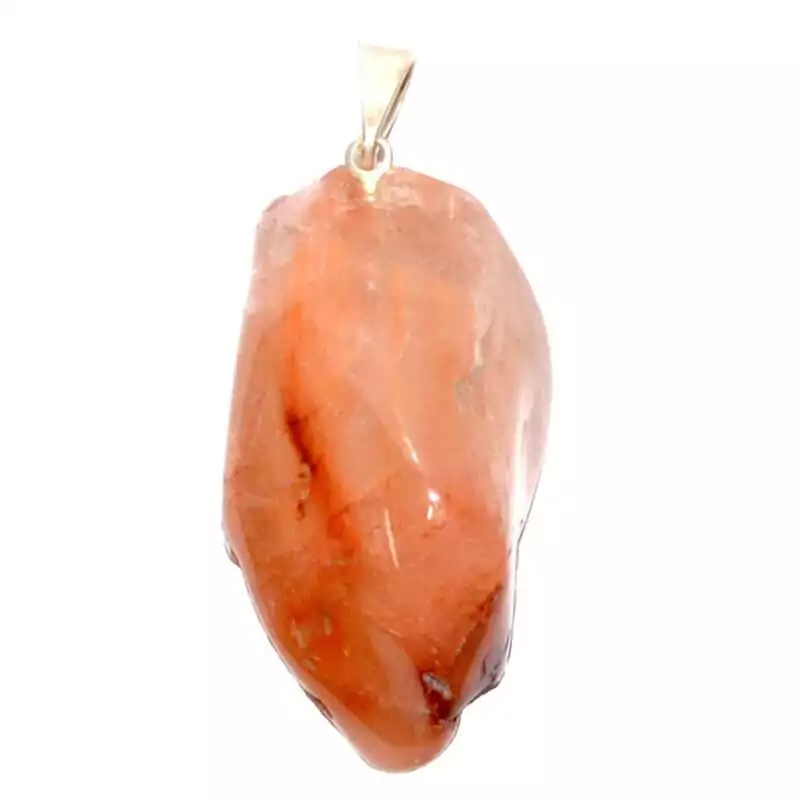
The pendant is an elongated stone with a smooth, softly glossy surface. Sizes run from about 1/4 to 1/2 inch wide and 1/2 to 1 inch tall, and each stone has its own outline and markings. This one reads as a warm peach through the center, with deeper orange-red patches toward the edges. A paler, cloudy pink-white zone sits near the top and fades gradually into the peach, and the stone is translucent. A thin highlight runs down the right edge where the light meets the glossy surface. The color deepens toward the lower end, where a dark red-brown streak runs along the left side. Fine pale lines run through the middle, and a few small dark specks sit near the lower end, beside a small rough patch that breaks the smooth surface. A silver-toned bail, a flat strip folded into a loop, joins the top through a tiny ring and takes a chain or cord. The outline is rounded at both ends and a little broader toward the bottom than at the bail, like a smooth pebble, and the stone hangs with its long side vertical.
Amphibole quartz is quartz that contains visible inclusions from the amphibole group. Wikipedia describes amphiboles as a group of silicate minerals that form prism or needlelike crystals, and says they can be green, black, colorless, white, yellow, blue or brown. Skyjems names hornblende, actinolite and tremolite among the amphiboles found in quartz, and says the color of the stone comes from the inclusions, with the host quartz colorless to faintly smoky. Quartz is silicon dioxide and rates 7 on the Mohs scale. It has no true cleavage, and Wikipedia ranks quartz as the second most abundant mineral group in Earth’s crust. Fire Mountain Gems says quartz can be icy clear or carry inclusions, veils and bubbles, and the Gem Society notes that natural quartz may show two- and three-phase inclusions, negative crystals and zebra stripes. In modern crystal practice, quartz is linked with the crown chakra, the seventh and highest chakra in the modern Western scheme. That link is crystal lore, and you can take it as a theme for reflection.
Practical Ritual Applications
Thread a chain from my neck chains, cords and cages through the bail and wear the stone at the collarbone, where its warm color shows against a neutral top. At home, hang the pendant from a lamp or a curtain hook between wearings, where daylight can reach the stone. On a desk, set it near a window beside a notebook, where light passes through the translucent color. On an altar, it can rest on a cloth beside a candle in its own holder, a safe distance from the flame. Layer it with a longer pendant for two lengths, or tuck it into a card or a small box as a gift for someone who likes to look closely at minerals.
How to Wear and Care for the Amphibole Quartz Pendant
Three steps cover looking the stone over, wearing it, and cleaning it.
- Look the Stone Over
Hold the pendant up to a window and turn it so light passes through from different angles. Find the pale lines, the cloudy zone near the top and the darker specks toward the lower end, and see where the orange deepens. Every stone has its own pattern, so this look tells you which side you would like to face outward when you wear it.
- Thread It and Wear It
Slide your chain or cord through the silver-toned bail and let the stone hang. The Gem Society rates quartz as very good for wear, and Fire Mountain Gems notes that gemstones of higher hardness can still scratch it. Keep the pendant clear of other pendants on the same chain so the smooth surface stays glossy.
- Clean and Store It
Fire Mountain Gems recommends warm soapy water and a soft brush for cleaning quartz, and it advises keeping household chemicals away from jewelry. Dry the stone and the bail right away. Between wearings, store the pendant in a fabric-lined box or wrapped in a soft cloth, apart from harder stones.
The Tarot Fellow Standard
I stock this pendant because amphibole quartz carries its own interior: warm color, cloudy zones and fine lines, hung from a plain silver-toned bail so the stone stays the focus. At about 1/4 to 1/2 inch wide, it hangs light, and every stone has a pattern of its own. The crown chakra link is modern crystal lore, and I offer it as a theme for your own reflection. If you would like to compare quartz with other stones, browse my crystals, stones and gemstones collection.
Frequently Asked Questions
Amphiboles are a group of silicate minerals that form prism or needlelike crystals, according to Wikipedia. Hornblende is widespread in igneous and metamorphic rocks, actinolite often forms radiating needles, and tremolite forms in limestones through contact metamorphism. Skyjems lists hornblende, actinolite and tremolite as the amphiboles seen as inclusions in quartz, in dark green to black, pale green and white to colorless tones.
Quartz rates 7 on the Mohs scale and has no true cleavage. The Gem Society gives quartz a wearability rating of very good, and Fire Mountain Gems says it can still be scratched by gemstones of higher hardness. Fire Mountain Gems also advises avoiding household chemicals on quartz jewelry and storing it in a fabric-lined box or a soft cloth.
Fire Mountain Gems links quartz crystal with the crown chakra, and astrology.com ties clear quartz mainly to the crown chakra at the top of the head. These pairings describe quartz in general and come from modern crystal practice, so take them as themes for reflection.

Reviews
There are no reviews yet