

Quick Specs
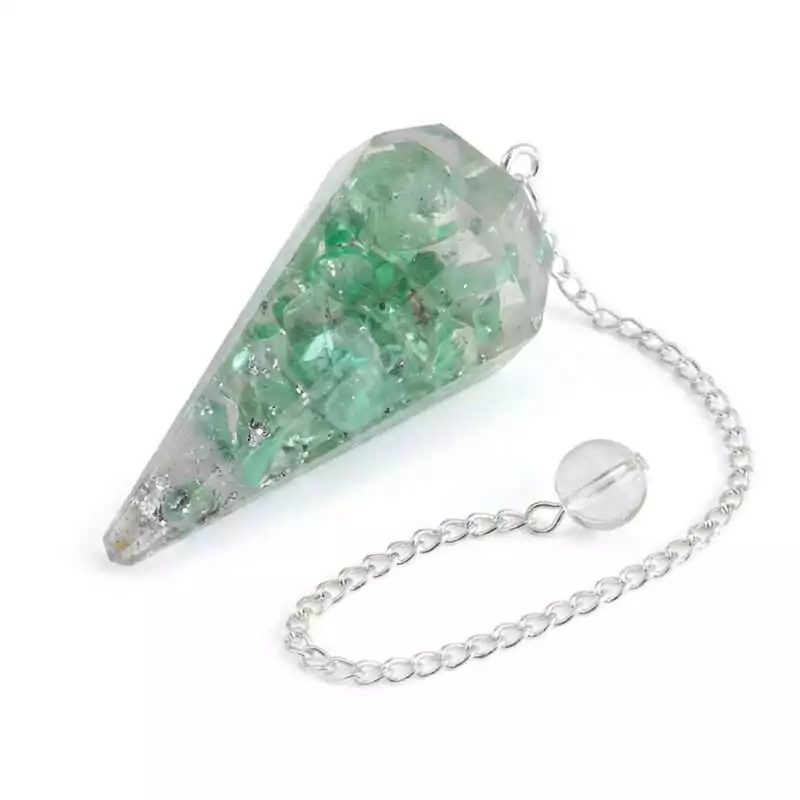
- Stone: Apatite (blue)
- Composition: Orgone matrix: metal shavings, polyester resin, and quartz crystal
- Shape: 6-sided (hexagonal) point
- Use: Pendulum divination and dowsing
The Stone, the Shape, and the Science Behind It
Apatite gets its name from the Greek apatao, meaning “to deceive,” because mineralogists kept mistaking it for other stones. That’s a bit of an irony for a mineral so distinctly itself. Chemically it’s a calcium phosphate, Ca5(PO4)3, and it shows up in blue, green, and yellow varieties. Blue apatite is the one with the reputation, associated in crystal traditions with the throat chakra, communication, and mental focus. Those associations are cultural layering built over centuries, not geology, but the stone itself is real, the color is real, and it’s got a quiet pull to it that I keep noticing when I handle the blue material.
The pendulum is cast in an orgone matrix: metal shavings, polyester resin, and a quartz inclusion layered together. The orgone concept comes from Wilhelm Reich, a psychiatrist who proposed in the 1930s and 1940s that a universal life energy could be accumulated by alternating organic and inorganic layers. His theory was never verified by mainstream science and remains outside accepted physics. What you’re actually holding is a resin-cast tool with real mineral content. The quartz is piezoelectric, meaning it generates a small charge under mechanical pressure. The metal shavings are a real inorganic layer. Whether those materials do anything beyond their physical properties is a question nobody has settled with evidence.
The 6-sided point shape is a practical choice for pendulum work. Hexagonal symmetry gives you a balanced hang, and the tapered tip makes swing direction easy to read at a glance. I stock this because it’s a solid entry point into pendulum divination, not because of any claims about energy fields. If you want a focused, well-made dowsing tool with good crystal content, this is a reasonable choice.
How to Use an Apatite Orgone Pendulum
A simple three-step practice for getting started with pendulum divination.
- Calibrate Your Responses
Hold the chain between your thumb and forefinger, letting the point hang freely. Rest your elbow on a flat surface. Breathe slowly and ask the pendulum to show you a yes response, then a no response.
- Ask One Clear Question
Ask only one clear yes-or-no question at a time. Hold the intention in your mind without speaking it aloud. Watch for the pendulum's movement to shift direction.
- Record and Close
Note the swing pattern in a journal so your readings stay consistent over time. When finished, thank the tool and set it down. Cleanse with moonlight or loose herbs between sessions.
The Tarot Fellow Standard
I carry this pendulum because the orgone casting quality is consistent and the apatite inclusion is visible and genuine rather than surface-dyed filler material. The resin is well-finished with no air pockets or rough seams on the pieces I’ve inspected, and the 6-sided point holds its shape cleanly. That’s the bar I care about: honest materials and reliable construction, not marketing claims about energy fields.
One practical note: the pendulum arrives without a printed chart or mat. If you’re new to dowsing, a simple printed yes-or-no chart under the pendulum will help you get oriented. I carry other pendulums and pendulum mats separately if you want to put together a starter kit. For a broader look at the stone side of things, the orgone crystal collection has additional formats worth comparing.
Frequently Asked Questions
Orgone is Wilhelm Reich's 1930s theory of a universal life energy he believed accumulated in layered organic and inorganic materials. Mainstream science does not accept this. The resin, metal shavings, and quartz inside are real physical components.
Blue apatite is a calcium phosphate mineral, Ca5(PO4)3, that has long been associated with mental clarity, communication, and the throat chakra in crystal traditions. These associations are cultural and not medical claims.
A 6-sided point pendulum is balanced and symmetrical, making it a popular choice for dowsing. The flat facets allow you to hold and read the swing direction easily. Other shapes work too – this one is a practical starting point.
Pendulums are not a substitute for professional advice of any kind. They are a focus tool that can help you slow down and access your own intuition. Use them as a reflective practice, not a decision-making authority.


Responds to questions well, the chain gets kinks easily however. Overall nice though