


Quick Specs
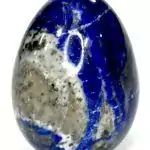
- Type: Polished crystal egg, deep blue lapis lazuli
- Size: 2″
- Size/Quantity: 2 inches, one egg
- Best for: Third eye activation, truth work, meditation holding piece, altar display
Lapis Lazuli Egg: Royal Blue from the Ancient World
Lapis lazuli is a metamorphic rock composed primarily of lazurite, with calcite and pyrite inclusions that produce its characteristic golden flecks on a deep royal blue ground. The stone has been mined in the Badakhshan province of Afghanistan for more than 6,500 years, making its sources among the oldest continuously worked stone deposits in human history; these polished pieces are imported and distributed via Pakistan. Ancient Egyptians ground lapis into pigment for ultramarine blue, carved it into protective amulets, and inlaid it into the funeral masks of pharaohs including Tutankhamun. In Mesopotamia, lapis was associated with the goddess Inanna and appeared in cylinder seals, jewelry, and votive offerings throughout Sumerian and Babylonian culture.
The metaphysical associations of lapis lazuli are among the most consistent of any stone across traditions: truth, wisdom, intellectual clarity, and the opening of inner vision. The Egyptians understood it as a stone of the sky and the divine, while the Greco-Roman tradition associated its blue with Jupiter and the higher mind. In contemporary chakra practice, lapis works across the third eye and throat chakras simultaneously, supporting both the perception of inner truth and the confidence to speak it. The egg form adds the symbolism of potential and renewal, making this piece well suited to meditations on new cycles of spiritual development.
Using a Lapis Lazuli Egg in Practice
The 2-inch egg is a natural holding piece for meditation, sitting comfortably in a cupped hand with its smooth polished surface making sustained contact pleasant. Practitioners working with tarot, journaling, or any form of reflective inquiry use it as a table companion, holding the egg during readings or writing sessions to support clear, honest perception. Find additional third eye and meditation tools in my chakra and meditation collection.
The egg will show natural variation in the ratio of blue to white calcite and in the density of pyrite flecking. A piece with more calcite veining is not lower quality: the calcite is intrinsic to lapis lazuli as a rock rather than a single mineral. The deep, even blue associated with premium lapis comes from a higher lazurite concentration, and the best specimens show the golden pyrite scattered through that blue ground as a night sky scatters stars. Because lapis contains pyrite, it is not recommended for extended water immersion, as pyrite can oxidize and alter the surface over time.
How to Use a Lapis Lazuli Egg
Three ways to use a polished lapis lazuli egg in meditation, chakra, and altar practice.
- Hold During Meditation or Reading
Sit quietly and hold the lapis egg in your non-dominant hand, letting its weight and smoothness anchor your attention. Focus on the intention of clear inner perception. This is effective before tarot readings or journaling.
- Place on Third Eye or Throat in Lying Practice
During lying-down chakra meditation, rest the egg gently on your forehead at the third eye point or hold it at your throat. The egg shape fits curved body surfaces. Keep it in place for five to ten minutes while breathing.
- Display and Cleanse
Display the egg on a dedicated altar stand or velvet pad. Cleanse monthly by holding it in frankincense or sandalwood smoke for thirty to sixty seconds. Avoid prolonged water immersion, as pyrite inclusions can oxidize.
The Tarot Fellow Standard
I carry the lapis lazuli egg because it is one of the most historically meaningful stones available in a form that is genuinely pleasant to work with. Lapis earns every claim made about it: it has been valued by kings, priests, and scholars across six millennia for its association with truth and inner vision. The egg form makes it ergonomic as a holding piece, and the 2-inch size provides real visual presence on an altar without being unwieldy. Browse additional crystal eggs and hearts in my eggs and hearts crystal collection.
Frequently Asked Questions
Genuine lapis lazuli shows natural white calcite veining and golden pyrite flecks within the blue matrix. Dyed imitations like sodalite or howlite lack pyrite entirely. Scratching gently on an inconspicuous area leaves a blue streak on real lapis.
White areas in lapis lazuli are calcite, one of the three natural minerals that form genuine lapis as a rock. They are authenticity markers, not flaws. Higher lazurite concentration produces more intense blue in the stone.
Smoke cleansing with frankincense, sandalwood, or sage is the preferred method for lapis lazuli. Avoid prolonged water immersion because pyrite inclusions can oxidize. Brief rinsing is safe for quick surface cleaning.
Brief sunlight exposure is acceptable, but extended direct sunlight can gradually fade the deep blue of lapis over months of repeated exposure. Moonlight or indoor lamp charging is a safer alternative for regular use.


Reviews
There are no reviews yet