

Quick Specs
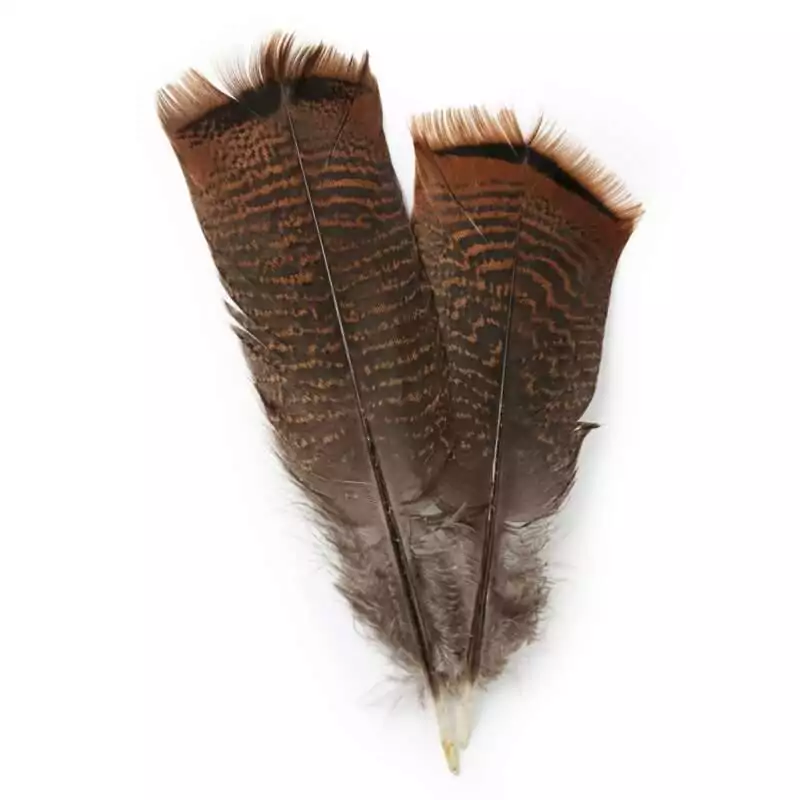
- Type: Natural turkey feather (upper tail covert / pre-tail)
- Color: Bronze iridescent
- Best for: Smudging, altar display, crafting, feather fan construction
- Legality: Fully legal to sell and possess in the United States (not covered by the Migratory Bird Treaty Act)
Turkey Feather Smudging and Altar Use
The turkey is one of the most important birds in North American ecological and cultural history, a native species that has provided food, tools, and material for ceremonial use among many Indigenous nations for thousands of years. Turkey feathers, large and durable, appear in regalia, headdresses, prayer sticks, and smudging tools across a wide range of traditions. In the context of modern spiritual practice, turkey feathers are the most commonly available natural feather for smudging work, valued for their broad surface area and the way they move smoke smoothly without creating chaotic air currents that scatter ash. Their role as a smudging tool reflects the same practical logic that made them useful in pre-contact North America: they are sturdy, flexible, and large enough to do real work.
The symbolism of the turkey in many traditions centers on abundance, harvest, gratitude, and community. The turkey’s role as a consistent provider, a bird that shares itself generously with those who hunt it, places it in a category of animals associated with sustenance and generosity rather than power or aggression. Using a turkey feather on an altar or in smoke ceremony work connects to this energy in a general symbolic sense. It is worth noting that specific ceremonial protocols belong to specific nations and communities; this feather is offered for broad spiritual and practical use, not as a substitute for tradition-specific ceremonial items.
What “Pre-tail” Means and Why It Matters for Smudging
“Pre-tail” refers to the upper tail covert feathers, the feathers found just in front of the main tail fan on the bird. These covert feathers are distinctly different from the long primary flight feathers and from the broad fan tail feathers. They are broader and more paddle-shaped than flight primaries, with a softer, more flexible quill that makes them easier to hold and maneuver during smudging without fatigue. The bronze coloring describes the natural iridescence of this feather section: the barbule structure of turkey feathers reflects light in shifting copper, gold, and green tones depending on the angle, which accounts for the characteristic bronzed look in good lighting. No dye or treatment is responsible for this effect; it is a structural property of the feather itself.
This feather is natural and unadorned, distinguishing it from leather-wrapped smudging feathers with a handle, which are designed differently for extended-use fans. This one is suited for single-feather smudging, altar display, or as a component in a homemade feather fan. If you’re building out a complete smoke clearing setup, browse my sage and smudge sticks collection to pair with this feather.
Legality of Turkey Feathers vs. Protected Bird Feathers
Turkey feathers are completely legal to buy, sell, and possess in the United States. The Migratory Bird Treaty Act, which makes it illegal to possess feathers from eagles, hawks, owls, ravens, and hundreds of other protected species, does not cover turkeys. Wild turkeys (Meleagris gallopavo) are classified as a game bird and a non-migratory species, and are regulated under different hunting and wildlife statutes rather than the Migratory Bird Treaty Act. This is a meaningful distinction for practitioners who want to work with natural bird feathers without any legal ambiguity. Eagle feathers and hawk feathers, which carry deep spiritual significance in many Indigenous traditions, are legally restricted and culturally specific in ways that make them unavailable through general retail. Turkey feathers fill that practical gap for most spiritual and altar uses.
How to Use a Turkey Feather for Smudging
A basic method for using a natural turkey feather in smoke clearing and smudging practice.
- Light Your Smudge and Position the Feather
Hold the feather at the base with your dominant hand, keeping your grip relaxed so the quill is not squeezed. Light your smudge bundle and allow it to catch, then gently fan the smoke using broad, sweeping strokes of the feather.
- Direct the Smoke
Direct the smoke along the body from feet upward, or around the perimeter of a room moving clockwise. The broader, softer pre-tail covert feathers move smoke gently and evenly without scattering ash from the smudge bundle.
- Store and Maintain the Feather
After use, lay the feather flat in a dry location away from direct sunlight. If it takes on the smoke scent over time, place it near an open window for a few hours to air out. Store flat or upright in a vase, not bent.
The Tarot Fellow Standard
I carry this feather because legality and practicality both matter in altar supply, and turkey feathers deliver on both. This is a natural covert feather with genuine iridescent coloring, sized and shaped right for smudging or altar display, with no legal question attached. For those building out an altar space with feathers, shells, and ritual burners, browse my altar supplies collection for the full range of what I stock for building and maintaining a working altar.
Frequently Asked Questions
Turkey feathers are not covered by the Migratory Bird Treaty Act, which applies only to migratory species. Turkeys are a non-migratory game bird, so buying, selling, and possessing turkey feathers is fully legal in the United States.
Pre-tail refers to the upper tail covert feathers, found just in front of the tail fan. They are broader and softer than primary flight feathers, with a flatter, more paddle-like shape that makes them well suited for fanning smoke during smudging.
Turkey feathers are practical for smudging because their broad surface area moves smoke well. Eagle and hawk feathers carry deep significance in many Indigenous traditions and are federally protected, making turkey the widely available alternative.
Bronze coloring in turkey feathers is a structural iridescence, not a dye. The feather barbules reflect light differently depending on angle, producing a shifting copper and gold sheen. No treatment is applied; this is natural to the bird.


Reviews
There are no reviews yet