
Quick Specs
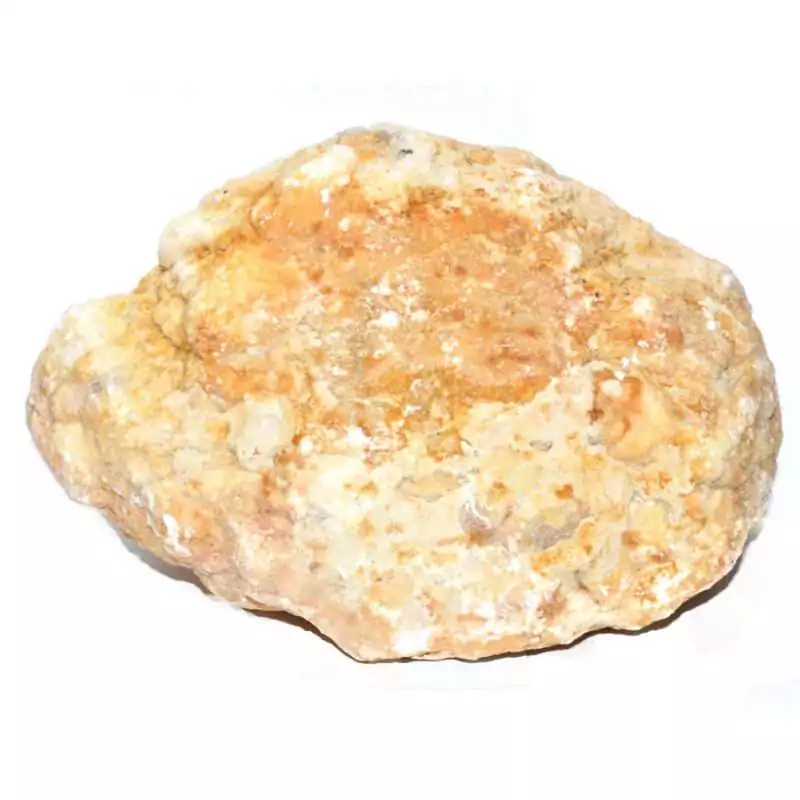
- Type: Crackable (unopened) geode
- Material: Quartz geode
- Origin: Morocco
- Size: 4 to 7 inches, sold individually in varying sizes
- Exterior: Rough, knobbly rock in cream, tan and pale orange
Crackable Geode: A Sealed Stone That Opens Into Two Halves
A geode is a hollow, roughly rounded rock whose cavity has been lined with minerals. The cavity starts as a gas bubble in volcanic rock, a pocket in sedimentary rock, or a space left when something dissolved away. Then water carrying dissolved minerals seeps in and deposits them on the inner wall, layer after layer. Quartz is a common lining, and so are calcite, gypsum and barite. This geode is sold unopened, between 4 and 7 inches across, so the outside is all you see: a rough, knobbly rock in cream, tan and pale orange, with pale patches where the surface is whiter. Moroccan geodes of this kind are a familiar break-your-own item, and most have a hollow center with crystals. Geodes run from nearly spherical to teardrop-shaped, lens-shaped or irregular, and unopened ones have long been sold at rock shows so buyers can crack, break or cut them open. Because the lining forms out of sight, the stone keeps its contents hidden until the moment you crack it.
The lining forms in stages. Fast crystallization of quartz builds an agate or chalcedony layer against the wall, and slower growth later produces distinct crystals that point toward the hollow center. A coating of fine crystals on a cavity wall is called a druse, and dealers often call it druzy. That glittering coating lines many geodes. Geodes built of resistant material such as quartz can remain at the surface after the softer rock around them has weathered away, which is one way they end up loose and ready to collect. Some large geodes hold several interconnected pockets. Each geode takes a different path, so every one is its own small surprise, with its own pattern, color and crystal size. Once broken in half, a geode gives you two halves that you can display side by side or give to a friend, and two geodes of similar size can look quite different on the outside.
Practical Ritual Applications
Treat the opening as a small event: pick a day, invite someone who likes surprises, and write down what you expect to find before you strike. If you keep a shadow work journal, a geode makes a tidy symbol for uncovering what stays hidden: crack it open, then write what you see and how it compares with what you expected. Display the halves on a windowsill or an altar, with the crystal sides facing the light. You can also leave the geode whole as a collector’s piece on a shelf, to open on a later day. After you open it, a tea light set between the two halves makes a small candlelit display. Keep the halves together on a tray so you can show the pair to visitors. For more crystal specimens in this style, browse my geodes, clusters and druse collection.
How to Crack Open a Geode
Three steps for opening a geode safely and showing off the halves.
- Set Up a Safe Work Area
Choose a solid surface outdoors or in a garage, such as a concrete floor or a sturdy workbench. Put on safety goggles and gloves, and keep children and pets back. Set the geode in a bag or sock, or wrap it in a thick cloth, so rock chips stay in one place. Have a hammer or rock pick within reach, and clear the area of anything breakable.
- Strike Firmly Toward the Center
Hold the wrapped geode steady on the surface and strike it firmly with the hammer, aiming for the center. If it stays closed, turn it a quarter turn and strike again. Unwrap it slowly over the cloth, since small fragments of rock may drop out. Pick up each half carefully and look at the crystals inside.
- Brush and Display the Halves
Brush loose rock dust off with a soft brush and set the halves on a shelf, a windowsill or a small stand, crystal side up. Keep them where nobody will knock them. If you want to compare the two halves, place them next to each other so the pattern lines up. Keep spare fragments in a small dish so they stay off the floor.
The Tarot Fellow Standard
I stock this geode for people who like to find things out for themselves, and for the ones who enjoy giving that experience to someone else. It arrives as a plain, rough stone, and the interesting part is yours to open. At 4 to 7 inches it is a substantial piece, big enough to make a halved display with some presence on a shelf, and it works as a gift for a friend who enjoys rocks, collecting or a good surprise. Each pair of halves is its own. If you like specimens, browse my crystal and mineral specimens.
Frequently Asked Questions
A geode is hollow, with crystals or mineral layers lining the cavity. A rock that is solid inside is classified as a nodule or, in some cases, a thunderegg. A geode that has filled completely with mineral over time is more properly called a nodule as well.
Brazil, Uruguay, Namibia and Mexico are major commercial sources. In the United States, geodes are common in Indiana, Iowa, Missouri, western Illinois, Kentucky and Utah, and the Mendip Hills in England have abundant geodes known locally as potato stones. Moroccan quartz geodes are widely sold as break-your-own stones and as opened specimens with fine druzy crystals.
Break-your-own geodes are sold for ages 8 and up, with adult supervision. Retailers recommend impact safety goggles, and gloves are also advised. Small parts are a choking hazard for children under 3, so keep them well away from the work area.



Reviews
There are no reviews yet