

Quick Specs
- Type: Figurine based on a Minoan original
- Height: 10 inches
- Material: Hand-painted resin
- Colors: Black, yellow, orange, and cream
- Pose: Arms raised, a snake in each hand
The Knossos Figurines Behind the Statue
The statue draws on two faience figurines that excavators working for Arthur Evans found in 1903 at the Minoan palace of Knossos on Crete. They lay in stone-lined pits that Evans called the Temple Repositories, and they date to about 1600 BCE, near the end of the palace period. Faience is a glassy ceramic made from crushed quartz paste, and it gave the originals bright color and a lustrous surface. Evans took them for votive objects from a shrine, though the shrine he reconstructed joined pieces found in more than one deposit. Both figures came out of the ground badly broken. Each wears an elaborate dress that leaves the breasts bare, and each has snakes twining around her arms or gripped in her raised hands. The larger of the two wears a tall cylindrical crown with a snake’s head rearing at the top. Evans called that one the Snake Goddess, and the pair became icons of Minoan Crete almost at once. Both now stand in the Heraklion Archaeological Museum, and replicas of them have been on show at the Ashmolean Museum in Oxford since the early twentieth century.
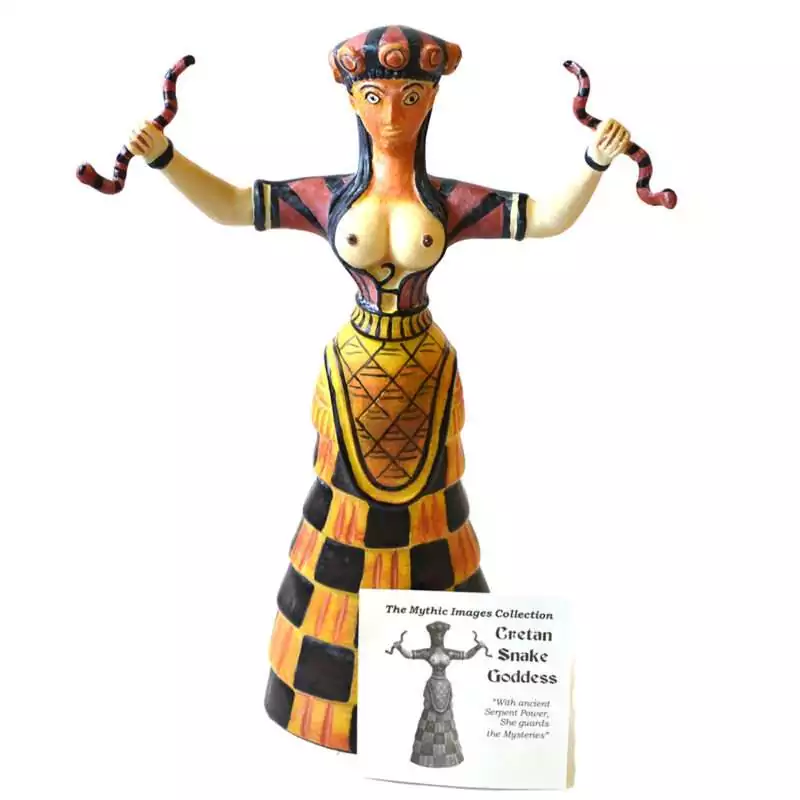
This resin figure keeps the pose and dress of the figurines and paints them boldly. A tall crown banded in black and red-orange sits above a long face with wide-set eyes, and black hair falls down both sides of her chest and back. Her skirt flares in tiers: a fringed apron with a diamond pattern runs down the front, and a black-and-yellow check fills the lower skirt. Her arms and hands are painted cream, and the snakes are striped red-orange and black, so they stand out against the dark sleeves. Because the arms and snakes reach out from the body, she reads clearly from across a room. Scholars read the originals in several ways. Some have read the figures as fertility images because of the emphasized breasts, and the scholar Martin Nilsson saw the snake in Minoan religion as a protector of the house. Over the last century, artists, writers, feminists, and modern Pagans have each adopted her for their own purposes. You can bring any of those readings to her, or keep her as a sculpture of a Bronze Age island culture.
Display and Ritual Uses
On a goddess altar she can stand as an image of the Goddess in the Minoan style. On a shelf of ancient art, she sits well beside other replicas from the Mediterranean world. If your interest is history, she opens a conversation about Bronze Age Crete, Arthur Evans, and how museums restore what they find. A small stack of books on Crete or Greek myth makes a natural companion, with her as the one colorful piece among the spines. A plain or dark backdrop shows off her painted colors, and a spot near a window lets the black, orange, and yellow of the skirt read in daylight. Pair her with other figures from my gods and goddesses collection, or leave her as the one bold piece on a shelf.
How to Display and Care for the Cretan Snake Goddess Statue
Three steps for setting her up and keeping her paint in good shape.
- Give Her Room
Choose a flat, stable surface with clear space on both sides, since her raised arms and snakes make her wider at the top than at the base. Keep her away from edges and out of reach of pets and small children. The thin arms and snakes are the most exposed parts, so a spot where nobody reaches past her is best.
- Lift Her by the Body
Move her with one hand under the base and the other steadying the skirt, and never lift her by an arm or a snake. Those thin parts carry her weight poorly and can snap under a grip. If you pack her away, wrap her in a soft cloth first and leave the arms free of pressure.
- Dust the Paint Gently
Use a soft, dry brush on the crown, the face, and the pattern of the skirt, and skip water and cleaning sprays, which can dull hand-painted color. Keep her out of long direct sun, which fades painted surfaces over time. A small card beside her naming the original and the museum that keeps it helps guests understand what they're looking at.
The Tarot Fellow Standard
I stock this figure because the Minoan snake goddess is one of the best-known images from the ancient Mediterranean, and a painted replica works two ways: as an altar image for people who honor the Goddess and as a display piece for anyone drawn to Bronze Age Crete. The crown bands, the diamond apron, and the checked skirt are all picked out by hand in color, which gives her presence on a shelf or an altar. The debate over what the originals meant is part of her story, and it makes her more interesting. If you’re building a shelf of goddess figures, browse my statues collection for more.
Frequently Asked Questions
Scholars don't agree. Arthur Evans called the larger Knossos figurine the Snake Goddess and the smaller one a priestess, and later researchers have argued that both show priestesses, both show the same deity, or two different deities. Minoan art often blurs the line between a goddess and a person acting for her. Archaeologists have found few comparable images, so a snake goddess plays little part in current thinking about Minoan religion.
Nobody knows. Snake Goddess is a modern label that Evans gave the larger figurine. Minoan Linear A writing is still undeciphered, and until after the Mycenaean conquest around 1450 BCE there are no currently understood names for Minoan deities. One scholar tentatively links the Linear A word a-sa-sa-ra-me, which seems to accompany goddesses, with a Hittite word for mistress, but that remains a hypothesis.
The figures belong to Minoan Crete: the Minoans built their palaces there before the Mycenaean Greeks took over around 1450 BCE, and the Greek myths reached writing centuries later. A few Cretan names survive in Greek myth, but none can be tied to the snake goddess figures. Martin Nilsson proposed that Athena, who is closely associated with snakes, descends from a Minoan snake goddess, and scholars still debate how far Minoan religion shaped later Greek religion.
A great deal. The smaller figurine was found without a head, so Evans's restorers supplied one, together with a headdress that joins a crown fragment to a small cat found as separate pieces. The Royal Ontario Museum calls the face pure reconstruction. The larger figure lacked everything below the waist, one arm, and part of its crown, and its lower skirt was restored from other figurines and plaques. Evans has since been criticised for overstating his restorations.
Reviews
There are no reviews yet