
Quick Specs
- Type: Mini altar and tealight or votive candle holder
- Diameter: 5 1/4 inches
- Material: Cast resin, hand finished
- Finish: Bronze-toned
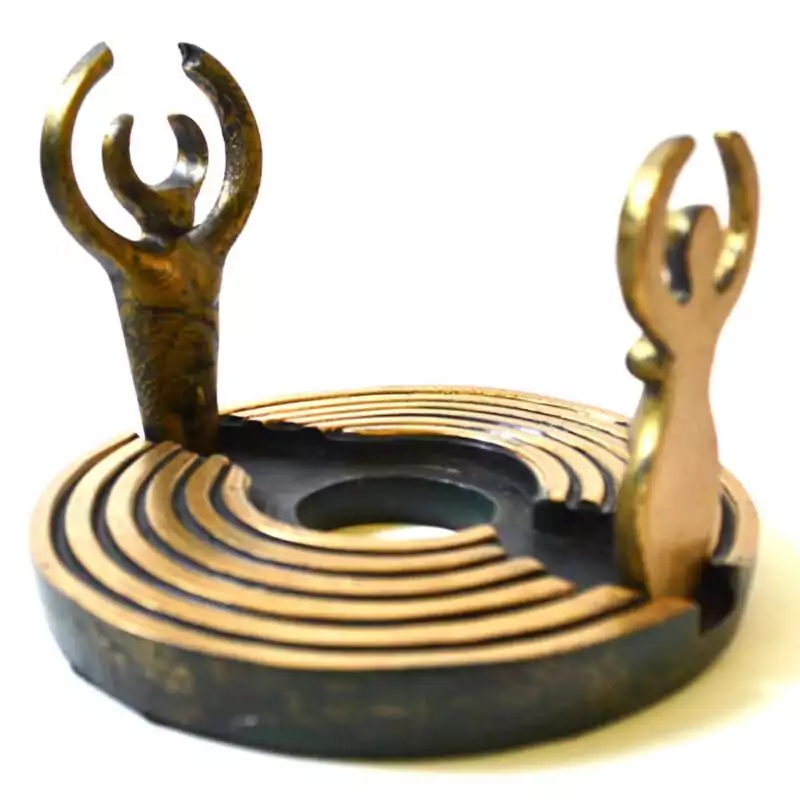
- Design: Labyrinth path that traces the God and Goddess
- Figures: Two removable figures: the Goddess and the God
- Candle: Tealight or votive
A Labyrinth Path That Draws the God and Goddess
The Dearinth is a variation on the ancient labyrinth: one path that circles in toward the center, doubling back on itself through nine circuits, and leads out again along that same route. That route also traces the outlines of the God and Goddess, so the pattern and the figures are a single design. Labyrinths of this kind have been laid out in many places over several thousand years, and they’re often read as symbolic journeys, a path of pilgrimage or initiation. People walk full-size ones today as a form of active meditation, and a well-known medieval example is the pavement labyrinth in Chartres Cathedral. At this size you walk yours with a fingertip, so set it on a table or shelf within easy reach of your hand. Start at the outer edge, follow the recessed groove inward, pause at the center, where the candle goes, and trace your way back out along the same groove. The bronze-toned finish catches the light on the raised ridges and settles darker in the grooves between them, so the pattern reads clearly even when no candle is lit.
Turn the altar one way and the Goddess comes forward, her arms raised in a crescent in the posture of drawing down the Moon. Turn it around and the God takes her place. His arms also reach to the sky, and with them he holds her in his embrace. The design pairs the Goddess as Mother Earth with the God as Father Sky: Earth reaches up to embrace Sky while Sky reaches down to embrace Earth, a sacred marriage of heaven and earth. A goddess and a god together will be familiar from Wicca and from much of modern Paganism, where the female divine holds a prominent place. Both figures are removable and stand upright in recesses in the base, which leaves a round cavity in the center for a tealight or votive candle. They are cut-out silhouettes, simple in outline, so you’re free to call them by whatever names your own practice uses for them. Take them out, and the labyrinth stands on its own as a small relief sculpture.
Practical Ritual Applications
Use it as the central piece of a small altar, or as the focus of a full moon working, since the Goddess figure already stands in that pose. At Beltane, some Wiccans enact a ritual union of the May Lord and May Lady, and the embrace between these two figures suits that theme. Light a candle in the center and set the altar a short distance from a wall, and the light throws the silhouettes of the God and Goddess onto the surface behind them, turning a dim room into a small shadow display. Add more light around it with a holder from my tealight holders collection. If you share an altar, it also gives both the Goddess and the God a place.
How to Set Up and Use the Dearinth Mini Altar
Three steps from the empty base to a lit altar.
- Stand the Figures in the Base
Set the Goddess and the God upright in their recesses in the base, turning the altar so the figure you want to honor faces forward. The Goddess shows from one side and the God from the other. The round cavity in the center stays open for the candle.
- Trace the Path
Before lighting anything, trace the recessed path with a fingertip from the outer edge to the center and back out again. It's one route through nine circuits. You can slow your breathing and hold an intention on the way in, then release it on the way out.
- Light a Tealight or Votive
Place a tealight or votive candle in the center and light it. Set the altar a short distance from a wall so the figures' shadows fall across it. Keep the flame clear of paper, fabric, and the figures, never leave it burning unattended, and let it go out before you move the altar. An LED tealight gives the same glow with no flame.
The Tarot Fellow Standard
I stock this mini altar because it combines three useful features in one compact piece: a pattern you can trace by hand, a pair of removable figures, and a built-in place for a candle. It suits a corner altar, a shelf, or a shared space where both the Goddess and the God are honored. An altar piece supports your own practice, alongside any teacher, coven, or initiation your tradition uses. Browse my altar supplies collection for candles, bowls, and tools to build out the rest of the altar.
Frequently Asked Questions
A maze is a branching puzzle with choices of path and direction, and it's possible to get lost in one. A unicursal labyrinth has a single path to the center and the same route back out, so it presents no navigational challenge. That's why labyrinths are used for walking meditation. The Dearinth is a labyrinth: its one recessed path never branches.
Wicca is typically duotheistic, honoring a goddess and a god, traditionally conceived as the Triple Goddess, in her maiden, mother, and crone aspects, and the Horned God, who is associated with animals and the natural world. Names, forms, and emphasis vary between traditions and individuals. Wicca was introduced to the public in 1954. Many covens initiate their members, so the way into the religion runs through people and teaching.
Drawing down the Moon, also called drawing down the Goddess, is a central ritual in contemporary Wiccan traditions. In a coven, a High Priestess enters a trance and the Goddess is invited to speak through her. Solitary practitioners perform variations alone, typically at the full moon, standing in the Goddess pose with arms raised overhead. The name likely echoes ancient Greek accounts of Thessalian witches said to control the moon.



Reviews
There are no reviews yet