
Quick Specs
- Type: Earth goddess statue
- Height: 4 inches
- Material: Painted resin
- Pose: Seated cross-legged
- Colors: Green figure with a blue, green, and white Earth
- Details: Leaf-and-cone hair, carved sea creatures, small winged figure
Gaia as the Living Earth
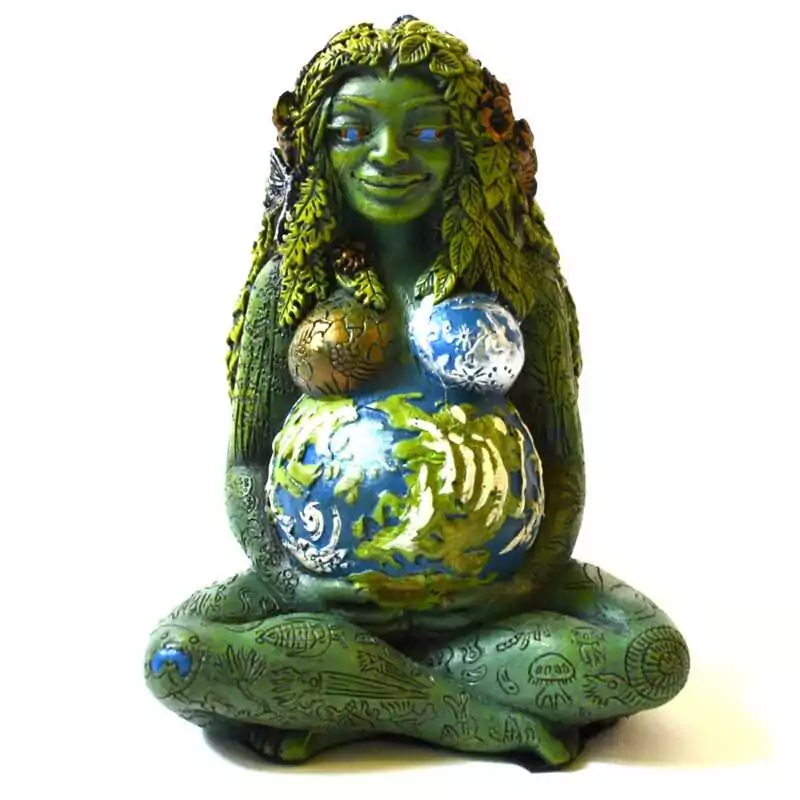
Every part of this figure carries a picture of the planet. Gaia sits cross-legged with a small smile and blue eyes, her skin painted green, and her hair is a thick mass of leaves, pine cones, and blossoms with a tiny silver winged figure caught at one side. Against her belly she cradles the Earth, painted in blue oceans, green and tan continents, and white swirls of cloud. Two smaller spheres rest above it, one bronze with a cracked surface and one blue and silver. The carving continues across the rest of her body. Sea creatures, among them a jellyfish and a coiled shell, are cut into her crossed legs, and fine patterns run down her arms. The whole figure fits in one hand, and the detail comes through best when you hold her close or set her at eye level. The leaves, the clouds, and the sea creatures each get their own color, so the figure reads at a glance even though it is small. She looks like a portrait of a living planet. Green runs through the figure and the globe alike, in her skin, the leaves, and the painted continents.
Gaia comes from Greek myth, and her name, also spelled Gaea, is the Greek word for earth or land. In Hesiod’s Theogony, written around 700 BCE, she is the primordial goddess who arises after Chaos as the earth itself. On her own she bears Uranus, the mountains, and Pontus, and with Uranus she has the twelve Titans and the Cyclopes. In Hesiod she is also an active character: she plots against Uranus and later helps Zeus overthrow his father, Cronus. The Romans knew her counterpart as Terra. In the twentieth century her name moved into science as well, when a hypothesis about a self-regulating Earth borrowed it, and modern Pagans took her up as an Earth goddess. This statue belongs to that modern strand. It gives the planet a face and then fills her body with the story of life on it, which is why the carved creatures matter. Hesiod calls her wide-bosomed, the everlasting seat of the immortals, and this figure shifts that picture: she holds the globe against her body.
Where She Fits
Set her on a desk or windowsill near a plant, where leaf and statue echo each other. On an altar she can stand for Earth, whether you read Earth as a place, a body, or a goddess. Her small size lets her share a crowded surface with candles, a bowl, and a few stones. You can also change what surrounds her as the year turns: a fallen leaf in autumn, a sprig of green in spring, a pinch of soil in a small dish. Wrapped in a soft cloth, she also travels well in a bag, so a desk at work or a travel altar can have its own Earth figure. Keep any arrangement low and simple, so the painted Earth stays visible. Add a few stones from my grounding and earth energy stones collection to round out the scene.
How to Display and Care for the Millennial Gaia Statue
Three steps for placing her, building a small Earth scene, and keeping the paint clean.
- Set Her at Eye Level
Put her on a shelf, desk, or altar where you can see her from the front at about eye level. The carving on her legs and the continents on the globe are small, and they read best at close range. At this size she's easy to knock over with a sleeve, so keep her toward the back of the shelf on a flat, stable surface.
- Build a Small Earth Scene
Gather one or two natural items to set beside her, such as a leaf, a stone, a pine cone, or a sprig of greenery. Rotate them with the seasons so the scene changes through the year. Keep the objects low and leave a clear space in front of her, so the painted Earth in her arms stays the focal point.
- Dust and Handle Gently
A soft paintbrush reaches between the leaves and cones of her hair, and a cotton swab, used dry, clears dust from the carved legs. Wrap her in a soft cloth if she travels, and keep her away from keys and other hard objects in a bag. Long direct sun can fade painted surfaces, so a shaded shelf keeps the green and blue true.
The Tarot Fellow Standard
I stock this small Millennial Gaia because it takes a familiar Greek goddess and gives her a form that makes sense to a modern reader: a green Earth mother who holds the planet and carries its history on her body. At this size she works for people who share rooms or move often, and she pairs easily with whatever else you already keep on a shelf. A figure like this supports your own practice alongside any teacher or community your tradition uses. Browse my statues collection for more goddess figures.
Frequently Asked Questions
English speakers say Gaia as GAY-uh or GYE-uh, and both are standard. The variant spelling Gaea is usually said JEE-uh. The ancient Greek form, Gaîa, contained a diphthong and sounded closer to GYE-ah, with the stress on the first syllable. Pronunciations differ across languages, so you'll hear all of these in practice.
No. The Titans are her children. In Hesiod's Theogony she arises after Chaos as a primordial deity, and she bears Uranus (Sky), the mountains, and Pontus (Sea) on her own. With Uranus she has the twelve Titans, the Cyclopes, and the hundred-handed Hecatoncheires, and the Olympian gods descend from her through the Titans. With Tartarus she bears the monster Typhon.
Mostly in local rites alongside other gods, since she had no festivals of her own in classical times. Pausanias describes an enclosure of Ge Olympia in Athens where wheat mixed with honey was thrown into a crack in the floor every year. Near Marathon a pregnant cow was sacrificed to Ge, and on Mykonos black lambs went to Zeus Chthonios and Ge Chthonia. Tradition also made her the first holder of the oracle at Delphi.
It's a scientific proposal that living organisms and their surroundings on Earth form a self-regulating system that helps maintain conditions for life. James Lovelock formulated it in the 1970s and, at the novelist William Golding's suggestion, named it after Gaia. Many scientists consider it weakly supported. Lovelock has said that because it carries a goddess's name and was championed by many non-scientists, people interpreted it as a neo-Pagan religion.


Reviews
There are no reviews yet