
Quick Specs
- Type: Round wall plaque
- Diameter: 11 1/4 inches
- Finish: Bronze-toned
- Relief: Raised, sculpted figures and knotwork
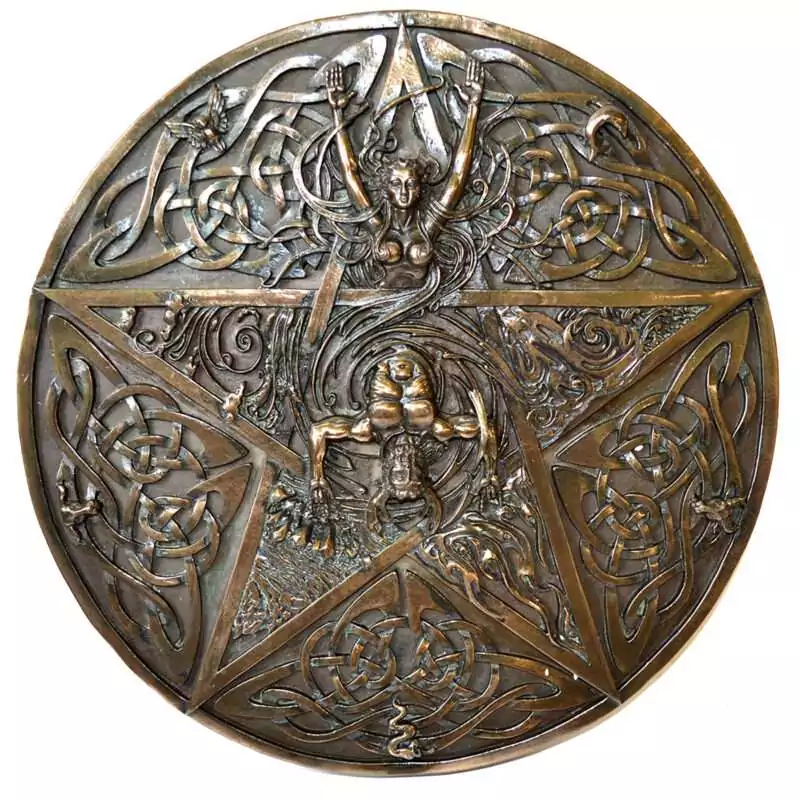
- Design: Pentacle with the Goddess at the top point and the Horned God at the center
- Border: Celtic knotwork around the star
A Pentacle That Holds Both Deities
The plaque is a medallion with a plain circular rim, and its relief is deep enough to throw shadows of its own. A five-pointed star runs from edge to edge. At the top point the Goddess rises with both arms lifted, her hair streaming down into curling lines that fill the upper star. Her face is small and finely modeled, and it draws the eye first. Below her, in the central pentagon, the Horned God is shown head-down, bearded and horned, with his arms flung wide. Around his hands, crystal-like shapes and wave-like lines hint at stone and water. Celtic knotwork loops and interlaces through the fields that surround the star, and small animals nestle among the knots: a bird at the upper left, a serpent at the bottom, and small creatures at the sides. The bronze is bright on the high edges and darker in the hollows, so the knotwork reads as bands of metal laid over a shadowed ground. Because every part of the circle is filled, the plaque rewards a long look at close range and still reads as a clean star from across a room.
The Horned God and the Goddess are the two primary deities of Wicca and of some related forms of modern Paganism. The Goddess is often pictured as a triple goddess of the Moon, and the Horned God as a figure of nature, the wild, and the hunt, her consort and her equal. Depictions vary, but the Horned God always wears horns or antlers, which is the one constant among them. Wiccans often speak of the Goddess in three aspects, maiden, mother, and crone. Wicca has initiatory covens, solitary practitioners, and many variations, and traditions name and picture the two deities in their own ways. A plaque like this one shows one artist’s version of the pair inside a pentacle, the five-pointed star in a circle that Wiccans and other Pagans use widely. Wiccans often read its five points as the five elements: earth, air, fire, water, and spirit. Celtic knotwork is a favorite frame for Pagan art, and here it surrounds the pair as decoration. The two figures matter to people who practice today, so hang them with care.
Practical Ritual Applications
Hang it above an altar, behind a working table, or on the wall of a room where you keep seasonal observances. Because the plaque shows both deities, it suits a wall that you update with the Wheel of the Year: bring in leaves, flowers, or grain as the seasons change, and let the plaque stay as the constant at the center. Its round shape also works as a focal point above a mantel or a bookcase, either alone or at the center of a group of smaller pieces. At this scale it covers a good patch of wall, and the raised relief shows best where light crosses it from the side. Add other pieces from my wall hangings collection to build out a larger display around it.
How to Hang and Display the Horned God and Goddess Plaque
Three steps from choosing the wall to lighting the relief.
- Choose the Wall and Mount It Securely
Pick a wall where the whole circle has clear space around it. Check the back for a hanger before you start, and fix it to a stud or use a wall anchor rated for several pounds, since a relief plaque pulls hard on a hook. Mark the spot with a level so the hanger sits true.
- Hang It With the Goddess at the Top
The star stands point-up, with the Goddess at the top point and the Horned God in the center below her. Hang it that way and check with a level that the top point sits directly above the center. Leave a few inches of bare wall around the rim so the knotwork at the edge stays clear and easy to see.
- Light the Relief From the Side
Raised relief shows best when light crosses it at an angle. Use a small lamp or an LED candle to one side and slightly above the plaque, and avoid a bright light straight on, which flattens the detail. Keep open flames and heaters well away from the plaque, and never hang it directly above a burning candle.
The Tarot Fellow Standard
I stock this plaque because it puts the Horned God and the Goddess in one frame, inside a pentacle, with enough relief and detail to hold up as a centerpiece. Wicca and related Pagan paths are living religions with their own covens, teachers, and communities, and an image on a wall is an entry point or a reference for them. If the two figures draw you toward practice, reading widely and meeting practitioners is how you learn more. Browse my gods and goddesses collection for more figures.
Frequently Asked Questions
No. In Wicca the Horned God is one of two primary deities, the consort of the Goddess, and he is associated with nature, wilderness, hunting, and the life cycle. The confusion has an old source: in 1921 Margaret Murray argued that the Church had cast the god of the witches as the Devil, and Wicca's founders built on her theory. Detractors still depict Wicca as Satanism, a characterization that Wiccans reject.
Wiccans often read the five points as the five elements: earth, air, fire, water, and aether or spirit. Some also read them as the human body, with points for the head, arms, and legs. Within Wicca, three aspects of the Goddess and two of the Horned God are sometimes mapped onto the points, though which points go with which varies. The elemental reading goes back to Renaissance writers such as Agrippa.
The knotted style grew up mostly in Christian settings. Interlace patterns began in the late Roman Empire, and true knotwork in the Celtic manner appears by the seventh century in manuscripts and stone crosses, including the Book of Kells and the Lindisfarne Gospels. Celtic art before Christian influence favored spirals, step patterns, and key patterns. Most Celtic knots are endless knots.
Practice varies by tradition. Wiccan rites typically take place in a cast circle, with prayers to the God and Goddess, and the seasonal festivals called Sabbats are the occasions most tied to the Horned God, while the moon's Esbats are tied to the Goddess. Wicca generally calls for initiation, and some Wiccans practice alone as solitaries. A coven or an experienced teacher is the best guide to how a particular tradition does it.
Reviews
There are no reviews yet