

Quick Specs
- Type: Deity statue
- Deity: Bastet (Bast), Egyptian cat goddess
- Height: 11 inches
- Best for: Kemetic practice, Egyptian-inspired Wicca, home protection altar, devotional work
Bastet Statue for Egyptian Devotional Practice
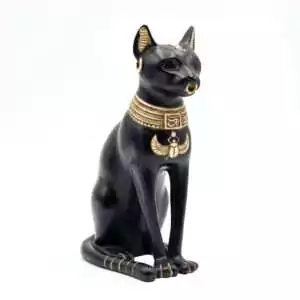
Bastet, also written Bast, is one of the oldest deities in the Egyptian pantheon, with evidence of her worship dating to the Second Dynasty, roughly 2890 BCE. She appears in her earliest form as a fierce lioness, associated with the sun god Ra as his protective daughter and a guardian of Lower Egypt. Over several centuries, her iconography shifted: by the Third Intermediate Period, around the 10th century BCE, she was increasingly depicted as a domestic cat or as a cat-headed woman, her fierce warrior aspect softened into a guardian of the home, a protector of women and children, and a goddess of joy, music, and dance. Her dual nature was never fully separated; she could move between her leonine war goddess aspect and her gentler domestic cat form depending on context and ritual need. This statue presents her in the cat-headed human form that dominated her later cult.
Bastet’s primary cult center was the city of Bubastis, in the southeastern Nile Delta of Lower Egypt. The Greek historian Herodotus, writing in the 5th century BCE, described the temple at Bubastis as the most beautiful he had seen in Egypt, surrounded by sacred canals and groves of trees. The annual festival of Bastet at Bubastis drew upward of 700,000 pilgrims by Herodotus’s account, and featured music, dancing, and extended celebration. Sacred cats were maintained at the temple, and an enormous cat cemetery containing thousands of mummified cats was associated with her worship. The 22nd Dynasty, founded around 945 BCE, had its seat at Bubastis, briefly making the city the capital of Egypt and Bastet one of the most prominent deities in the kingdom. Browse my statues collection for additional deity figures.
Working with Bastet in Modern Practice
In contemporary Kemeticism, the reconstructed practice of ancient Egyptian religion, Bastet holds a central place as a deity of protection, the home, and domestic life. She’s equally popular in Egyptian-inspired Wicca and eclectic pagan practice. Practitioners work with her for home protection, the safety of children and pets, and as a patroness of music and creative work. Offerings commonly associated with her include cat imagery, catnip, frankincense and myrrh incense, red wine or beer, perfume, and small jewelry. Her statue serves as the focal point of a Bastet altar, surrounded by offerings, candles, and objects personal to the practitioner’s relationship with her. The 11-inch height makes this piece a significant altar presence without being unwieldy for a home setup. For complementary altar supplies, see my altar supplies collection.
How to Use Divine Bastet Statue
How to set up and work with a Bastet devotional statue.
- Set Up a Bastet Altar
Place the statue at the center of a dedicated surface as the focal point. Add a candle in gold, red, or white, an incense burner for frankincense or myrrh, and a small bowl for offerings such as catnip, wine, or water.
- Make Regular Offerings
Bastet was honored with music, dance, scent, and drink in ancient practice. Light incense, burn a candle, and leave a small cup of wine or water. Consistency matters more than elaborate ceremony; brief daily acknowledgment builds the relationship.
- Work with Her for Home Protection
Petition Bastet for home safety, the wellbeing of children, or protection of animals. State your request clearly, leave a meaningful offering, and keep the altar clean. Regular maintenance of her space is itself a form of devotional practice.
The Tarot Fellow Standard
Bastet is among the most actively worked-with deities in modern pagan and Kemetic practice, and this 11-inch statue strikes the right balance between altar presence and practical size. The cat-headed feminine form is the iconographically appropriate representation for her later devotional cult, the version most practitioners relate to. If you’re building a dedicated Bastet altar or looking for a centerpiece figure for Egyptian-themed practice, this piece holds up to daily devotional use without being fragile or oversized.
Frequently Asked Questions
Bastet is the Egyptian goddess of protection, the home, women, children, and cats. Originally a fiercer lioness war goddess, she became associated with the domestic cat, joy, music, dance, and the protection of households and the pharaoh.
Both are lioness goddesses connected to Ra, but Sekhmet represents fierce war and destruction while Bastet represents protection and nurturing. In some traditions they are two aspects of the same deity, with Bastet as the gentler, domestic-cat form.
The Divine Bastet Statue stands 11 inches tall. It depicts Bastet in her cat-headed human form, the iconographic style that became standard during the New Kingdom and remained dominant through the late period of Egyptian religious practice.
Traditional Bastet offerings include catnip, frankincense and myrrh incense, wine or beer, perfume, candles, music, and jewelry. She was associated with pleasure, fragrance, and celebration in her cult at Bubastis in Lower Egypt.
Reviews
There are no reviews yet