
Quick Specs
- Type: Keychain with an eye charm, eye bead and blue beads
- Length of charm: About 3 inches
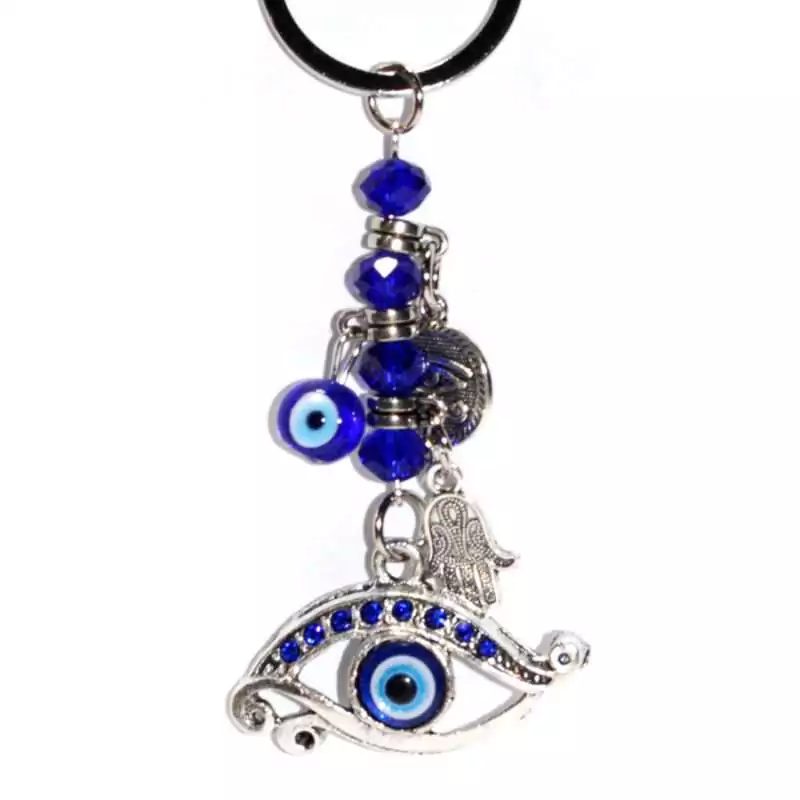
- Eye charm: Silver-toned open eye about 1 1/2 inches by 5/8 inch, with small blue stones along the upper lid and a round blue eye bead at its center
- Beads: 4 faceted deep blue beads separated by silver-toned spacer rings, plus 1 blue and white eye bead on its own loop
- Small charms: 1 silver-toned hamsa and 1 round textured silver-toned charm
An Open Eye Below a Stack of Cobalt Beads
Four faceted beads in deep cobalt blue are stacked down the strand from the key ring, each pair separated by a silver-toned spacer ring that gives the stack a banded look. To the left, a small blue and white eye bead swings from its own loop, with a pale blue ring around a black pupil. To the right, a round silver-toned charm with a textured face and a small hamsa hang from the same links, and small silver-toned rings join each piece to the next so the charms sit at different heights beside the stack. At the bottom comes the main piece, an open eye outlined in silver-toned metal, with scrolled curls at each end and a row of small blue stones set along the upper lid. A round blue eye sits where the iris would be, ringed in white and light blue around a black pupil, and the open outline frames it. The cobalt beads, the blue stones and the eye beads stay in one color family, and the silver tone ties the metal pieces together. The eye is the widest and lowest piece, so the whole strand points down toward it.
The Science Museum Group says amulets against the evil eye share an eye-shaped design, realistic or highly stylised, and are worn or carried. This keychain carries two kinds of eye. The open silver-toned eye with its lid, scrolls and stones is a drawn eye, and the round blue bead in its center and the loose bead beside the stack follow the nazar of Turkey and the mati of Greece. A University of Kansas page on the nazar says the first glance of the evil eye is said to be the most powerful, so a protective amulet should be striking in appearance. The color, the stones, the facets and the swing of the strand make this piece easy to notice. Wikipedia adds that a human eye motif is also woven into tribal kilim rugs to avert the evil gaze, so the eye appears in rugs as well as in beads and metal. The small hand among the links is a hamsa, the palm-shaped amulet popular in North Africa and the Middle East, which Wikipedia says is believed to provide defense against the evil eye.
Practical Ways to Carry It
Clip it to your keys, a bag strap or a zipper pull. The charm is about 3 inches long, so it fits a pocket-sized set of keys and swings clear of a phone when it clips to a bag. Because the eye hangs lowest, a bag clip shows it best, with the blue beads above it catching the light as you walk. At home it hangs from a drawer pull, a lamp chain or a hook by the door, where the blue stones catch daylight. The silver tone and cobalt blue go with most clothing and bags, so it works for daily carry as easily as for a small gift for a new home, a graduation or a first car. For more pieces that carry the eye, see my evil eye collection.
How to Attach and Care for the Eye Charm Keychain
Three steps cover checking the stones, choosing a spot and wiping the metal.
- Check the Stones and Links
Let the keychain hang from the ring and look along the open eye. The small blue stones on the lid should sit firmly in their settings, and each link and spacer should be closed. Give the loose eye bead and the hamsa a light tug. A link that has opened can be closed with small pliers.
- Choose Its Spot
Thread the ring onto your keys or a bag clip. The eye hangs lowest, so give it a few inches of clear space to swing without hitting a phone, a wallet or a car door. In a pocket, drop the ring in first so the eye charm rides on top of the keys.
- Wipe and Hang
Wipe the metal, the stones and the beads with a soft dry cloth to lift lint and fingerprints. Skip polishes and soaking so the small stones stay where they're set. At home, hang the keychain from a hook so the strand stays straight and the beads stay clear of the loose charms.
The Tarot Fellow Standard
I stock this keychain for its range of eyes: a drawn eye outline, a nazar-style bead and a small hamsa, all on one ring. Each comes from a living custom, the nazar from Turkey, Greece and neighboring cultures and the hamsa from Muslim and Jewish communities, and the keychain is a decorative charm that refers to them and stands in for none of them. Families who keep these customs have their own ways of giving, carrying and replacing a charm, and those ways come first. If the symbols are new to you, spend time with how those communities describe them before you decide what the eye means for you. You’ll find more to hang from a ring in my key chain and ash chamber collection.
Frequently Asked Questions
The Science Museum Group says amulets against the evil eye share an eye-shaped design, realistic or highly stylised. A University of Kansas page describes the nazar as a decoy that absorbs the negative force of the first glance, and Wikipedia says that in Greece and Turkey the amulets take the form of eyes looking back at the person giving the glance. These are folk explanations from the cultures that keep the belief, and they vary from place to place.
A University of Kansas page says people hang a nazar in their car, shop or house, pin one to a newborn's clothing and often put one on a horse, since horses are thought especially vulnerable. Wikipedia says the nazar is most frequently seen in Turkey, found in or on houses and vehicles or worn as beads. A keychain carries one with you, and customs differ between families and regions.
Turkish accounts, including a University of Kansas page, say a bead that breaks took in a particularly strong negative force, and the advice is to replace it as soon as possible. Wikipedia tells the same story: the bead stored that force and broke to protect the wearer. These are folk beliefs, and customs vary by family and region.

Reviews
There are no reviews yet