
Quick Specs
- Type: Keychain with an eye bead and a hamsa charm
- Total length: 7 1/2 inches
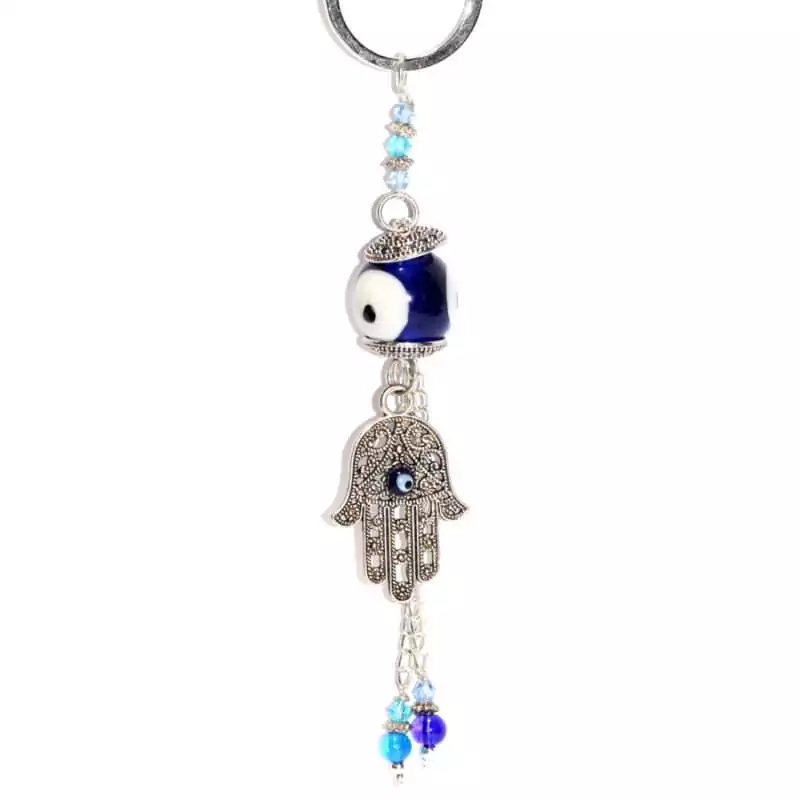
- Eye bead: Round blue and white eye bead about 1/2 inch across, capped top and bottom in silver-toned filigree
- Hamsa: Silver-toned openwork hand, about 1 3/8 inches by 1 inch at its widest, with a small eye bead set in the palm
- Top strand: Faceted light blue and aqua beads with small silver-toned spacers
- Drops: Two short chains ending in light blue, aqua and violet-blue beads
A Filigree Hamsa Below a Blue Eye Bead
A short strand of faceted light blue and aqua beads, divided by small silver-toned flower spacers, leads down from the key ring. Beneath it hangs the eye bead, a round bead in deep blue with white eye shapes around its middle, held between two silver-toned filigree caps. The hamsa follows on a short link. It is a silver-toned hand worked in lacy openwork, with scrolled patterns across the palm, a dotted texture along the edges and cut-out fingers. A tiny round bead sits in the center of the palm, deep blue with a white ring and a black pupil, so the hand carries an eye of its own. Two short chains drop from the base of the hand, each with a light blue faceted bead above and a rounded bead below, one aqua and one violet-blue. Light blue sits at the top and the bottom of the keychain, and the deep blue of the eye bead anchors the middle. The filigree and the beads share a silver and blue palette, so the pieces read as one design, and the caps around the large bead carry the same dotted, lacy texture as the hand.
The hand is called a hamsa, from khamsa, the Arabic word for five, a reference to the five fingers of the hand. The British Museum describes hand amulets of this kind as khamsas, or Hands of Fatima, in the Middle East and North Africa, and says they may have been used by Muslims or Jews to ward off the eye of envy. In Jewish use it is also called the Hand of Miriam. Wikipedia describes the hamsa as a palm-shaped amulet popular throughout North Africa and the Middle East and commonly used in jewelry and wall hangings, and says it later regained popularity as a good luck charm that now appears on necklaces, keychains and postcards. My Jewish Learning describes the symbol as an eye embedded in the palm of an open hand, which is how this charm is made. The large bead above the hand adds a second kind of eye amulet, the nazar bead of Turkey, called mati in Greece. Wikipedia adds that in Morocco and Turkey the hamsa is a common protective symbol in jewelry, home decor and art.
Practical Ways to Carry and Hang It
Thread the ring onto your keys, or clip it to a bag strap or a zipper pull where the strands can swing. My Jewish Learning describes hamsas as a familiar sight dangling from the rear-view mirrors of taxis and trucks, and at 7 1/2 inches this one can hang from a mirror or a hook beside the door as well. Give it a hand’s width of clear space so the beads can swing without knocking a dashboard, a shelf or a window. It also works as a gift for a new home, a first apartment or a new car, since the blue and silver suit nearly any bag or set of keys. For more things to carry on a ring, see my key chain and ash chamber collection.
How to Carry and Care for the Hamsa Keychain
Three steps cover checking the links, choosing where it hangs and storing it.
- Check the Links and Beads
Hold the key ring and let the keychain hang. Look at the small rings, the chain links and the filigree caps around the large eye bead, and give each bead a light tug. A link that has opened is easier to close with small pliers before the keychain goes onto your keys.
- Choose Where It Hangs
Thread the ring onto your keys, or clip it to a bag where the long drop has room to swing. At 7 1/2 inches it hangs well below most key sets, so a bag strap, a zipper pull or a hook keeps the hand clear of a phone or a car dashboard. Pick a spot you see every day, since the eye bead and the hamsa are the heart of the piece.
- Wipe and Store
Wipe the metal and the beads with a soft dry cloth when they pick up lint or fingerprints. Hang the keychain from a hook at home, or lay it flat in a pouch so the two short chains stay separate from the beaded strand above. A dry brush clears dust from the openwork of the hand.
The Tarot Fellow Standard
I stock this keychain because it brings two eye amulets, the hamsa and the nazar bead, onto one ring at a size that hangs from keys, a bag or a mirror. The hamsa belongs to living Muslim and Jewish traditions, and a keychain refers to meanings that belong to those communities. This piece is a decorative or protective charm that refers to the tradition, a reference and never a substitute for community, teachers or practice. If the hamsa is part of your family’s faith, you already know how it’s carried and honored. If it’s new to you, start by learning its names and history from the communities that keep it. For more pieces that carry the eye, see my evil eye collection.
Frequently Asked Questions
The British Museum calls such hand amulets khamsas, meaning five, or Hands of Fatima, and says they may have been used by Muslims or Jews against the eye of envy. In Jewish use it is also the Hand of Miriam, and My Jewish Learning says it carries significance for both Jews and Muslims. Wikipedia adds that Levantine Christians call it the hand of Mary. Because it belongs to living faith communities, this keychain is a decorative reference, and people within those communities are the best guides to its meaning.
Both orientations are in use. Wikipedia says fingers pointing up are read as warding off evil and fingers pointing down as bestowing blessings, and a Judaica retailer says up stands for stopping negative energy and down for inviting blessings, with both styles acceptable. On a keychain the hand hangs with its fingers down, the way a charm falls from the ring. If your family or community has its own custom, follow it.
Hamsas are used against the evil eye, a malicious stare believed to cause illness, death or general misfortune, and Wikipedia notes that they often contain an eye symbol. My Jewish Learning says Jews might have used the hamsa to invoke the hand of God, or to counteract the evil eye with the eye embedded in the palm. Wikipedia also gives an Arabic saying, khamsa fi ainek, meaning five in your eye, as an example of how the hand, the eye and the number five are tied to warding off the evil eye.

Reviews
There are no reviews yet