

Quick Specs
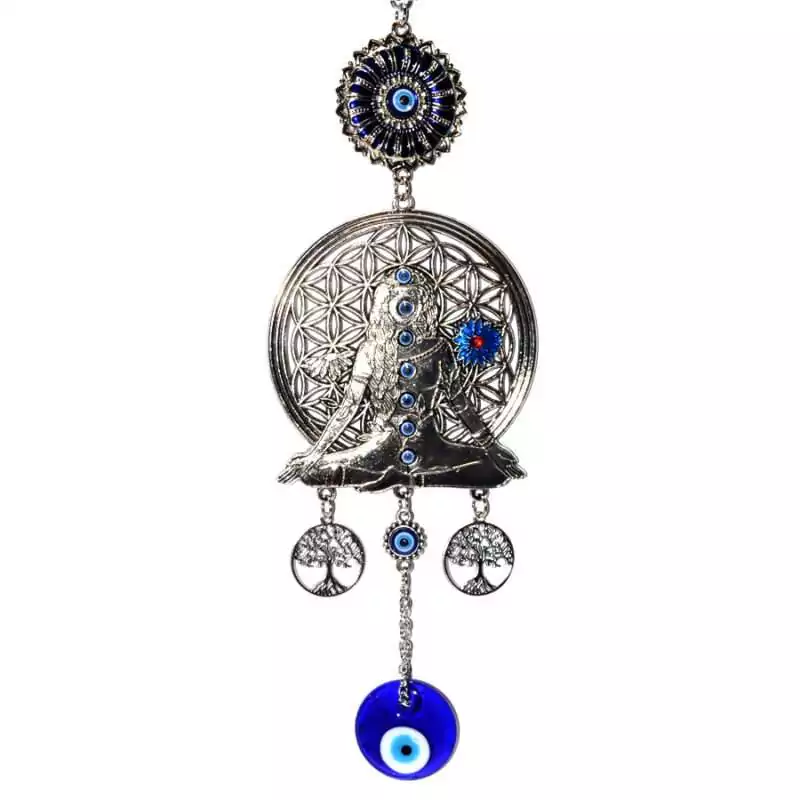
- Type: Wall hanging with a Flower of Life disc, a seated figure and eye beads
- Size: 9 1/2 by 3 1/2 inches
- Disc: Silver-toned openwork in a Flower of Life pattern
- Figure: Seated, long-haired, with a column of seven small eye beads from head to base
- Below: Two tree of life charms, a small eye flower and a round blue eye bead on a chain
A Seated Figure Before a Disc of Overlapping Circles
A large silver-toned disc forms the backdrop, its openwork cut into overlapping circles that repeat across the whole face and form a pattern of petal shapes. In front of it sits a long-haired figure with crossed legs, and a column of seven small eye beads runs down the center of the figure from the crown of the head to the base. A blue flower with a red center blooms on the right, set against the openwork. Above the disc hangs a round, scalloped medallion in deep blue and silver with an eye bead at its center. Below the figure, two small tree of life charms flank a tiny eye flower, and a chain drops from that flower to a round eye bead, deep blue with a white ring, a light blue center and a black pupil. The hanging is 9 1/2 inches long and 3 1/2 inches wide, with the disc setting most of the width. Silver dominates, the blues are confined to the beads and the flowers, and the single touch of red sits in the heart of the flower on the right.
Three motifs share this hanging. The overlapping-circles pattern behind the figure is the geometric design now called the Flower of Life. The two small charms below carry a tree of life, a sacred-tree motif found in many traditions; a museum catalogue uses the name for a stylized tree on a 9th-century BC Assyrian palace panel from Nimrud. The eye beads belong to the evil eye belief, the idea of a curse brought about by a malevolent glare, usually inspired by envy, and a museum catalogue says amulets against it are worn or carried and always include an eye motif, either realistic or highly stylised. On this piece the eye appears in the medallion above, in a column down the figure, in the small flower below and in the large bead at the end of the chain, so it recurs at every level of the hanging. The pieces share the circle as their basic shape: the overlapping circles of the disc, the round medallion, the round beads and the ring of each charm.
Practical Ways to Display It
A quiet corner suits a hanging with a seated figure: beside a reading chair, over a desk, above a bedside table or along a hallway. The disc is openwork, so a plain wall behind it lets the circles stand out, and a window lets daylight through the cutouts. Slip the chain at the top over a small nail or hook, and leave clear space below the figure so the two tree of life charms, the small flower and the long chain can swing. At 3 1/2 inches wide it has room for a neighbor on each side, such as a small mirror or a framed card. It also works as a gift for someone who likes geometric patterns. For more pieces that carry the eye, see my evil eye collection.
How to Hang and Care for the Flower of Life Hanging
Three steps cover choosing a backdrop, hanging the chain level and dusting the openwork.
- Choose a Plain Backdrop
Hold the hanging against the wall and step back. The openwork disc shows whatever is behind it, so a plain painted wall gives the overlapping circles the cleanest outline. Check that nothing near the lower edge touches the two tree charms, the small flower or the eye bead on its chain when they swing.
- Hang It Level
Set a small nail or hook into the wall and slip the top chain over it. Let the hanging settle for a minute and look at the disc. The figure should sit upright, with the column of seven eye beads running straight down its center. If the disc tilts, shift the chain along the hook until the beads line up.
- Dust the Openwork
Dust the disc, the figure and the medallion with a soft dry brush every few weeks, working into the small cutouts where dust settles. Wipe the eye beads lightly with a dry cloth. Take the hanging down before you paint or clean the wall around it, and put it back once the wall is dry.
The Tarot Fellow Standard
I stock this hanging because it combines three motifs on one slim frame: the overlapping-circles pattern, the tree of life and the eye bead. The evil eye belief is a living folk custom in Turkey, Greece and many other places, and the tree of life appears in many traditions. This hanging is a decorative reference to them, never a substitute for the customs of the people who keep them. If the evil eye is part of your family’s tradition, follow the customs you were taught. If it’s new to you, learn where it comes from before you decide what the eye means in your home. For more things to hang, see my wall hangings collection.
Frequently Asked Questions
A sacred-geometry glossary defines it as a figure of evenly spaced overlapping circles arranged in a hexagonal pattern with six-fold symmetry. Wikipedia files the design under the overlapping circles grid. On this hanging the circles are cut through a silver-toned disc, and the seated figure sits in front of them.
The pattern is older than its name. Wikipedia places the oldest known example on the threshold of an Assyrian palace, dated to the 7th or 6th century BCE, and the sacred-geometry glossary describes an alabaster palace threshold from Assyria dated to about 645 BCE. Both sources point to Assyria in roughly the 7th century BCE.
The name is modern. Wikipedia says it is commonly attributed to Drunvalo Melchizedek's 1999 book The Ancient Secret of the Flower of Life, and the glossary says the name was popularized in the late twentieth century mainly through that book, adding that historical cultures did not use it.



Reviews
There are no reviews yet