
Quick Specs
- Type: Hamsa (Hand of Fatima) evil eye wall hanging with bells
- Size: 9 3/4 by 3 inches
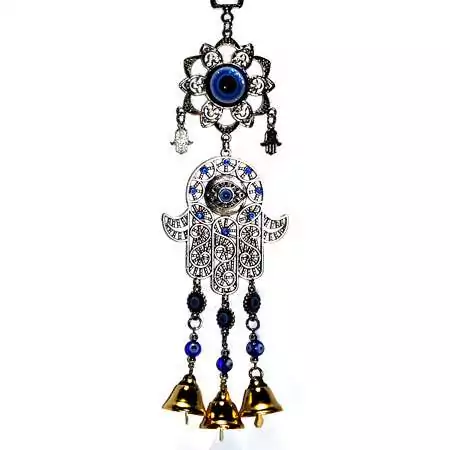
- Hamsa: Silver-toned openwork hand with a blue eye bead in the palm and small blue stones
- Top: Flower-shaped frame with a blue eye bead and two miniature hamsa charms
- Strands: Three strands with blue beads, each ending in a gold-toned bell
A Pierced Silver Hamsa With Three Gold-Toned Bells
At the top, a flower-shaped frame of silver-toned openwork holds a round blue eye bead at its center, with a tiny hamsa charm dangling from each side, one pale and one dark. Below it hangs the main hand: a silver-toned plaque of pierced scrollwork, with spirals filling the fingers, the fingers pointing up and a point curving out on each side like a thumb. In the middle of the palm a round medallion holds another blue eye bead, ringed by small blue stones. Three short strands drop from the base of the fingers, each with a round eye-patterned link and blue beads, and each ends in a gold-toned bell with a small clapper hanging beneath it. Silver on the upper pieces and gold on the bells give the hanging two metal tones, and blue runs through all three levels, from flower to palm to strands. The flower frame and the palm medallion each hold a single eye, so the eyes stack from top to bottom: flower, palm, strands. At 9 3/4 by 3 inches it’s a long, slim piece that hangs straight down a narrow wall.
The hand is called a hamsa, from khamsa, the Arabic word for five, and this hanging’s outline shows five points: three fingers and two curved side points. In English it’s often called the Hand of Fatima, and in Jewish use it’s the Hand of Miriam. Reference works describe it as popular across North Africa and the Middle East and as a protective amulet against the evil eye, an envious stare believed to bring harm. Some hamsas are drawn naturally and others symmetrically, with a second thumb in place of the little finger, and this one is symmetrical. Hamsas often carry an eye in the palm, and this one does, with more eye beads at the top and along each strand. Scholars disagree about where the symbol began. The miniature hamsa charms at the top repeat the main hand at a smaller scale, so the hanging holds three hamsas in all. In Turkey the eye amulet is the nazar boncuğu, and in Greece it’s the mati.
Where to Hang It
The bells hang free at the bottom, so choose a spot where the strands can move: beside an interior door, along a hallway or near a window that opens. At 9 3/4 inches long and 3 inches wide, the hanging fits a narrow wall between two doors, the side of a bookcase or the inside of a front entry. Set the hook high enough that the bells clear shelves and furniture, and keep a hand’s width on each side. A small nail or hook is all it needs. Hang it above the reach of small children, since the bells and beads are small. It also works as a gift for a new home. For more pieces made to hang, see my wall hangings and chimes collection.
How to Hang and Care for the Hamsa and Bells Hanging
Three steps cover checking the strands, hanging the piece and keeping it clean.
- Check the Strands and Bells
Hold the hanging by its top link and let the strands drop. Run your fingers down each of the three strands, give every bell and bead a light tug, and look at the links where the hamsa joins the flower and the strands. Close an open link with small pliers or ask a jeweler to do it before the piece goes on the wall. Check that each bell's clapper hangs freely inside it.
- Hang It at a Good Height
Set a small nail or hook at about eye level or a little above, and hang the top link from it. Let the piece settle and check that the hand faces forward with the fingers pointing up. Keep the bells clear of shelves, picture frames and furniture, since knocking against a hard edge can scratch the metal and loosen the strands.
- Dust and Wipe
Dust the hand and the flower with a soft dry brush every few weeks, working around the small stones and the charms. Wipe the bells and beads with a soft dry cloth. Skip polish and soaking so the stones stay in place. Take the hanging down before painting or wall cleaning, and store it flat in a box so the strands stay untangled.
The Tarot Fellow Standard
I stock this hanging as a decorative or protective charm that borrows from the hamsa and the nazar. The hamsa belongs to living Muslim and Jewish traditions, and it carries meaning for those communities that a wall hanging can only point toward. This piece is a reference to that tradition, an entry point and never a substitute for community, teachers or practice. If the hamsa is part of your family’s faith, you already know how it’s hung and honored. If it’s new to you, start by learning its names and history from the communities that keep it. For other eye pieces, see my evil eye collection.
Frequently Asked Questions
Both orientations are in use. Sources read fingers pointing up as warding off evil and fingers pointing down as bestowing blessings, and a Judaica retailer calls both orientations appropriate in Jewish tradition. The fingers on this hanging point up. If your family or community has its own custom for hanging a hamsa, follow that.
Bells have a long record as protective sounds. In ancient Rome, clusters of bells called tintinnabula hung at doorways and thresholds, and their jingling in the breeze was thought to repel bad spirits. Roman examples also carried charms believed to guard against the evil eye. A hamsa with bells is a design that gathers two protective symbols on one chain.
Accounts describe hamsas on doors and doorways, in homes and on vehicles, and worn as jewelry. Reference works also list them on tilework, wall hangings, door-knockers and in embroidery across the Middle East and North Africa. Customs differ between families and communities, so follow the practice you were taught if you have one.
Reviews
There are no reviews yet