
Quick Specs
- Type: Hamsa (Hand of Fatima) evil eye wall hanging
- Size: 9 by 3 1/4 inches
- Disc: Round, deep blue
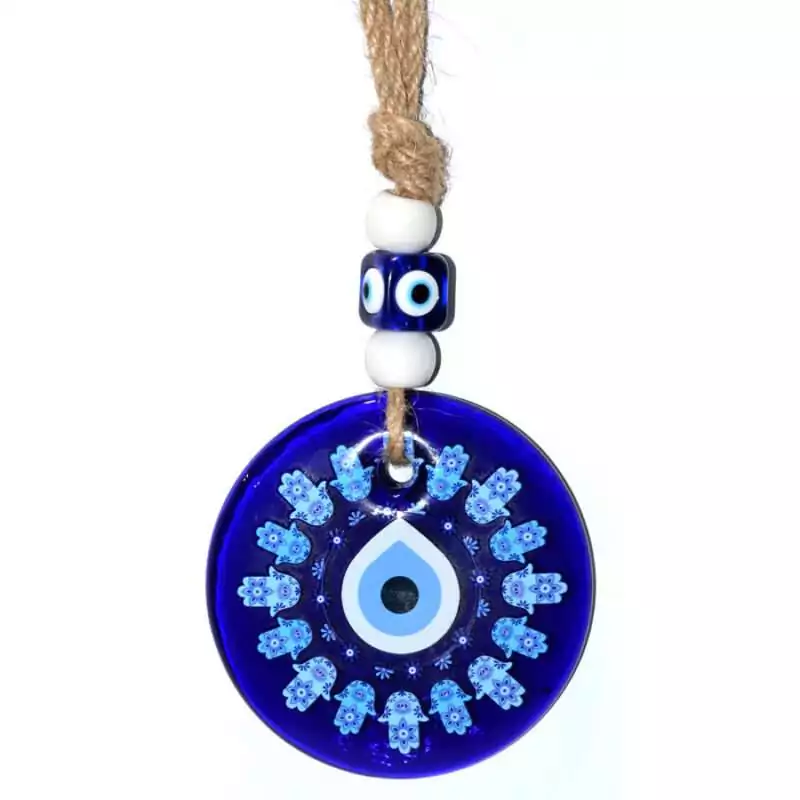
- Design: Ring of small light blue hamsas around a teardrop eye
- Cord and beads: Natural-colored twine, two white round beads and a blue cube bead with eyes
A Wheel of Small Hands Around One Eye
The disc is a deep cobalt blue, and the design sits in its center like a flower seen from above. At the middle is a teardrop eye in white, pale blue and black. A ring of tiny dark blue flowers surrounds it, and outside that ring, small light blue hamsas stand side by side around the disc like the spokes of a wheel, one hand after another all the way around. Each hand is patterned with a flower on its palm and fingers and a small eye shape near the center of the palm. The twine knots at the top and passes through a white round bead, a blue cube bead with an eye on its faces and a second white bead on its way to the hole in the disc. Between the hands and the eye the dark blue ground shows through, which lets each ring stand clear of the next, and the glossy face catches the light at the rim. Pale blue on deep blue gives the design its contrast, and the rings repeat the same circle outward from the eye: flowers, then hands, then the rim. The hanging measures 9 by 3 1/4 inches.
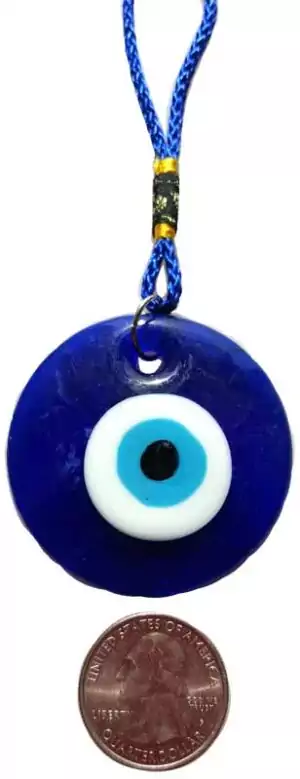
The hamsa is a hand-shaped symbol popular across North Africa and the Middle East, where reference works describe it as a protective amulet against the evil eye. It turns up in jewelry, in flat-weaving and embroidery, on door-knockers, on tilework and wall hangings, and painted on house walls and doorways. The teardrop eye in the center adds a second emblem of the same belief, the eye amulet called nazar boncuğu in Turkey and mati in Greece. The disc puts the two together, one large eye ringed by many small hands that each carry an eye of their own. Nazar beads are typically handmade glass in dark blue, white, light blue and black, the palette of the teardrop at the center of this disc, and the cube bead with eyes above it continues the theme. Hamsas are commonly shown at doors and on walls, and accounts of the nazar describe amulets hung in houses and shops, so a wall hanging suits both traditions of display, whether near a door or in a hallway.
Practical Ways to Display It
A deep blue disc with pale blue hands shows best against a light wall, so a white entry, a cream hallway or a pale door frame gives the pattern room to read. Hang it near the front door, over a doorway, in a hallway or at the end of a bookshelf. The twine hangs from a single small hook, and the flat disc sits close to the wall with the beads gathered above it. Leave a few inches clear around the disc so it can turn gently without catching a door or a frame. It also works as a gift for a new home, since a hook is all it needs. Keep the small beads out of reach of young children. For more pieces made to hang, see my wall hangings collection.
How to Hang and Care for the Hamsa Disc Hanging
Three steps cover checking the piece, hanging it and keeping it clean.
- Check the Twine and Beads
Hold the twine above the knot and let the disc hang free. Look at the knot, the two white beads and the blue cube bead, and give each a light tug. Run a finger around the edge of the disc to feel for chips, and look at the hole where the twine passes through for wear. If the twine looks frayed, replace that section before the hanging goes on the wall.
- Mount It
Set a small nail or hook into the wall at about eye level, then slip the twine over it and let the disc settle. Step back and check that the teardrop eye sits in the middle and that the disc hangs level. Choose a spot clear of door swings, shelves and frames, since a disc can chip if it knocks a hard edge.
- Dust Gently
Wipe the disc with a soft dry cloth every few weeks, and hold it by the edge while you work. Dust the twine and beads with a soft brush. Take the hanging down before any painting or wall cleaning, and store it in a drawer or box with soft paper around the disc so it stays clear of hard objects.
The Tarot Fellow Standard
I stock this hanging as a decorative or protective charm that borrows from the hamsa and the nazar. The hamsa belongs to living Muslim and Jewish traditions, and it carries meaning for those communities that a wall hanging can only point toward. This piece is a reference to that tradition, a starting point and never a substitute for community, teachers or practice. If the hamsa is part of your family’s faith, you already know how it’s hung and honored. If it’s new to you, learn its names and history from the communities that keep it. For other eye pieces, see my evil eye collection.
Frequently Asked Questions
Hamsa comes from khamsa, the Arabic word for five, which refers to the five fingers of the hand. Hebrew speakers use hamesh, also meaning five. In English the hand is often called the Hand of Fatima, and Sephardi-Mizrahi Jews call it the Hand of Miriam. Levantine Christians call it the Hand of Mary.
Both communities attach meaning to it. Reference works describe the hamsa as a protective amulet against the evil eye in Muslim and Jewish cultures, and a British Museum curator notes that such hand amulets may have been used by Muslims or Jews. It belongs to living faith communities, so this hanging is a decorative reference, and the people within those communities are the best guides to how a hamsa is used and what it means.
An eye set in the palm is common on hamsas and answers the evil eye that the hand is meant to turn aside. A Jewish source says people may have used the hamsa to invoke the hand of God, or to counter the evil eye with the eye embedded in the palm. The small hands on this disc each carry an eye shape, and the large teardrop eye at the center echoes them.
Reviews
There are no reviews yet