

Quick Specs
- Type: Evil eye wall hanging
- Size: 9 1/2 by 3 1/4 inches
- Disc: Round, deep blue, with a thin gold-colored line inside the rim
- Design: Teardrop eye ringed by S-shaped scrolls in light blue, red and white
- Cord and beads: Natural-colored twine, two white round beads and a blue cube bead with eyes
A Teardrop Eye Ringed by Curling Scrolls
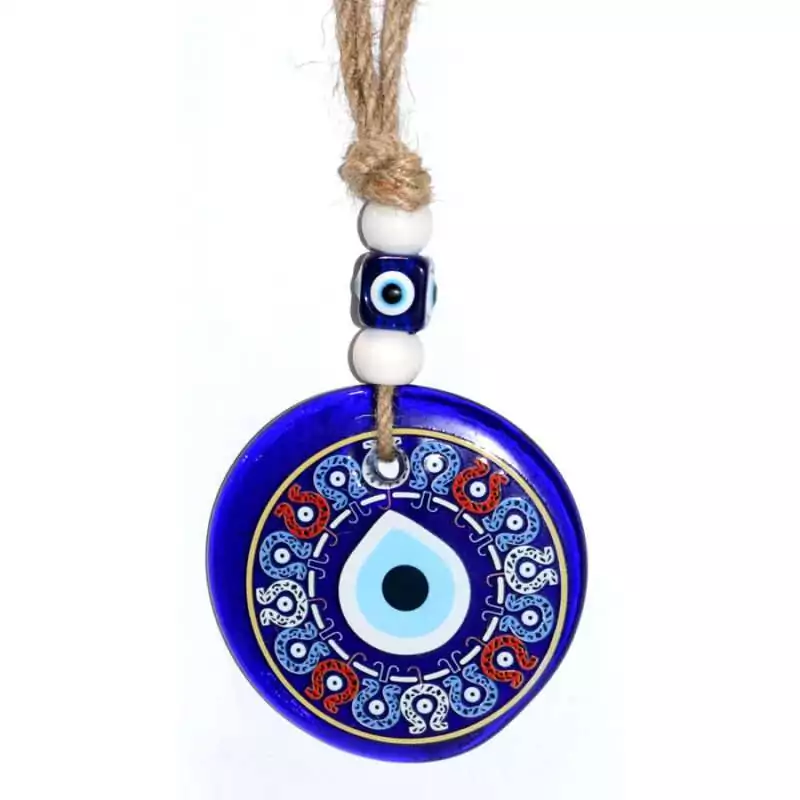
The disc is a saturated cobalt blue with a slightly uneven outline, and a thin gold-colored line runs just inside the rim. In the center sits a teardrop eye: a white outer shape, a light blue inner shape and a round black pupil. A ring of short white dashes circles the eye, and beyond it a band of S-shaped scrolls curls around the disc, each scroll speckled along its body and centered on a white dot. Most are light blue, with red and white ones spaced between them. The twine knots above the disc, then passes through a white round bead, a blue cube bead with an eye on its faces and a second white bead before it reaches the hole at the top. Against the deep blue ground, the red scrolls are the warmest notes in the design and the white ones the brightest, while the light blue scrolls echo the pale center of the teardrop. The whole piece measures 9 1/2 by 3 1/4 inches, a narrow, tall hanging with the disc at its base and the beads gathered just above it.
Traditional nazars are described as handmade glass with concentric circles or teardrop shapes in dark blue, white, light blue and black, and the teardrop here is one of those two forms, in that same palette. The small cube bead above the disc carries eyes of its own, so the hanging holds one large teardrop eye and several small ones, repeated down the twine. The belief behind the eye is the evil eye, the idea that a malevolent glare, usually inspired by envy, can bring harm, and a museum catalogue calls it culturally very widespread with a long history. In Turkey the amulet is the nazar boncuğu, and in Greece it’s the mati. Such amulets are traditionally hung or carried to guard against that glance. The red and white scrolls add decoration to the traditional blue and white, and the gold-colored line inside the rim frames the whole design. Accounts of the custom describe amulets like this hung in houses, shops and cars, and a disc of this size suits a wall or a door.
Everyday Places for the Disc
A deep blue disc stands out on a pale wall, so a white entry, a cream hallway or a light door frame shows every scroll clearly. Hang it above a desk, beside a kitchen doorway or on the back of a bedroom door, anywhere you’d like a small point of color at eye level. The twine hangs from a single hook, so a small nail is enough. The disc sits close to the wall, so leave a few inches above it for the beads and the twine. Hang it at about eye level so the scrolls are easy to see. The hanging suits a first apartment, a new office or a gift for someone who collects eye pieces. See my evil eye collection for pieces that pair well with it.
How to Hang and Care for the Teardrop Eye Hanging
Three steps cover inspecting the piece, hanging it and keeping it clean.
- Inspect Before Hanging
Hold the twine and let the disc hang. Check the knot at the top, the white beads and the blue cube bead, and give each a light tug. Run a finger along the edge of the disc to feel for chips or rough spots, and look at the hole where the twine passes through for wear. If the twine looks frayed anywhere, replace that section before you put the hanging on the wall.
- Hang It at Eye Level
Set a small nail or hook into the wall at about eye level, then hang the twine from it and let the disc settle. Check that the teardrop eye faces straight out and that the disc clears any door swing, shelf or picture frame. A disc that can knock against a hard edge may chip, so choose a quiet stretch of wall, away from busy corners and doorways.
- Keep It Clean
Wipe the disc gently with a soft dry cloth every few weeks and handle it by the edges. Dust the twine and the beads with a soft brush. Take the piece down before painting or wall cleaning, and store it in a drawer or box with soft paper around the disc so it stays clear of hard objects.
The Tarot Fellow Standard
I stock this hanging as a decorative charm that carries the teardrop eye in the traditional blue and white. The evil eye is a living folk belief in Turkey, Greece and many other places, and this piece is a reference to that belief, never a stand-in for the customs of the people who keep it. If the nazar is part of your family’s tradition, you already know how it’s gifted, hung and replaced. If it’s new to you, learn those customs before you decide what the eye means in your home. For other pieces made to hang, see my wall hangings and chimes collection.
Frequently Asked Questions
Turks say nazar, and the amulet is the nazar boncuğu. Greeks say mati, with kako mati for the curse, and Spanish speakers say mal de ojo. Pakistan also uses nazar, and Italians say malocchio. The names point to the same family of beliefs, and each culture keeps its own customs for guarding against the glance.
Reference pages list Turkey, Greece, Albania, India and Pakistan among the many places where the belief is found, and a university page adds Bosnia and Herzegovina, Azerbaijan, Iran, Bulgaria, Cyprus, Iraq and Armenia. Wider surveys place it across the Mediterranean, the Balkans, Africa, the Caribbean and Latin America.
Yes. Accounts describe the Italian cornicello, the azabache bracelet of Puerto Rico, a red string worn on the wrist and mirrors at the front door in Brazil. A red ribbon tied to a baby or a belonging is a South American custom, and in Hindu practice red chilies are circled and burned. All of these are folk practices that vary by family and region.






Reviews
There are no reviews yet