

Quick Specs
- Type: Evil eye wall hanging with crystal ball
- Length: 13 1/4 inches
- Crystal: 30mm faceted clear ball
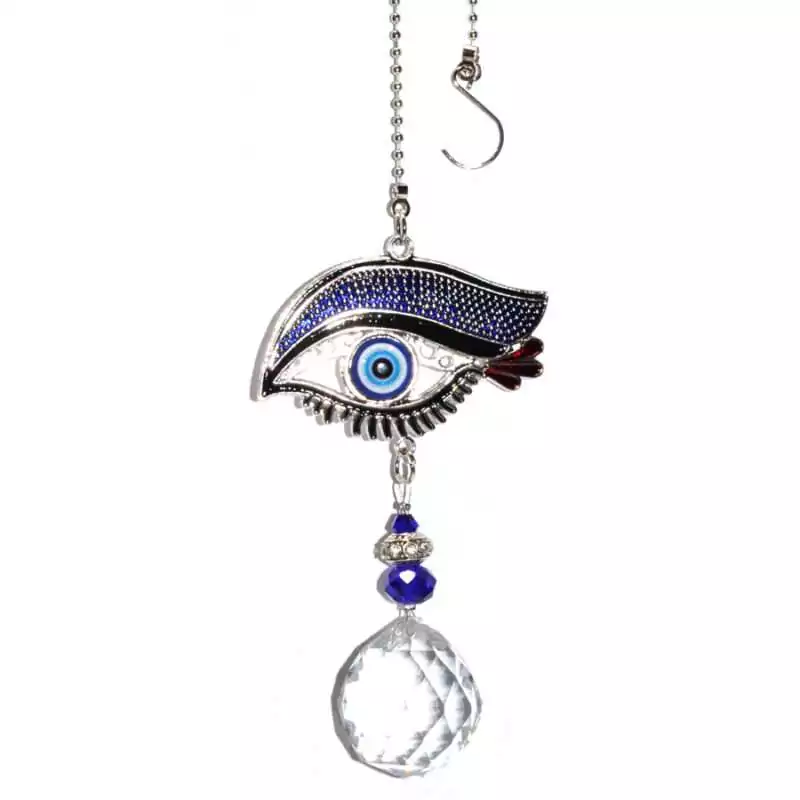
- Eye plaque: Silver-toned eye with a dark blue lid, lashes and a round blue eye bead
- Beads: Two dark blue faceted beads and a silver-toned spacer set with clear stones
- Hanger: Silver-toned ball chain with an S-hook
A Lashed Silver Eye Above a Faceted Crystal
The eye is the centerpiece: a silver-toned plaque in an almond shape, with a dark blue upper lid stippled in tiny raised dots and edged in black, and a row of curved lashes along the lower rim. A small dark red accent sits at the outer corner. In the middle, a round blue bead with a white ring and a black pupil serves as the iris, framed by fine silver openwork. A silver ball chain carries the plaque from the top, and its tone matches the plaque and the spacer, so the metal parts agree from top to bottom while the two blue beads echo the blue of the eye. Below the plaque, a small loop joins the eye to a short string of beads: a dark blue faceted bead, a silver-toned spacer set with clear stones, a larger faceted blue bead, and then a clear 30mm faceted crystal ball, the biggest piece on the strand. The ball has many flat faces that catch the light from any side. At 13 1/4 inches it’s a long, narrow hanging, with the most visual weight at the bottom and the most detail at the top.
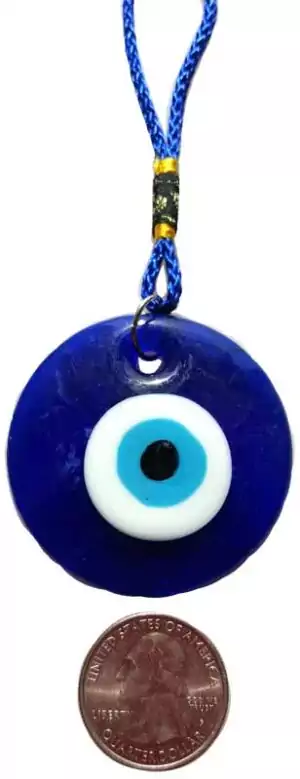
The evil eye is the belief that a malevolent glare, usually inspired by envy, can bring harm. Reference works describe it across the Mediterranean, West, Central and South Asia, Africa, the Caribbean and Latin America, and in Turkey the protective amulet is called nazar boncuğu, while in Greece it’s called mati. A museum catalogue lists glass eye beads among the commonest amulets against it, worn or carried, and accounts describe such amulets hung in houses, shops and cars. Blue holds a strong place in that custom: in Turkish belief it acts as a shield against evil and absorbs negativity, and this hanging carries blue in the lid, the eye bead and the beads below. The faceted ball suits a window, the place a suncatcher is hung to catch sunlight, and the hanging puts the eye and the ball on one chain. A lashed silver eye sits at the top, a clear faceted ball at the bottom and blue beads between them, all in a single vertical line that leads the eye from the lid down to the crystal.
Where to Hang It
Hook the chain over a nail, a curtain rod or a window latch where the ball can hang free in daylight. The same chain works in a hallway, beside a front door or on a bedroom wall, and its 13 1/4 inch length gives it room on a tall, narrow stretch of wall between two frames. Leave a few inches clear around the ball so it can turn without knocking a sill or a glass pane, and keep it clear of curtains and other fabric that could catch on the facets. It also works as a gift for a new home, since the hook is all it needs. For more pieces made to catch the light, see my wind chimes, sun catchers and dream catchers collection.
How to Hang and Care for the Eye and Crystal Hanging
Three steps cover the first check, the hanging and the upkeep.
- Check the Links and Hook
Hold the chain and let the hanging drop. Look at the loop under the eye, the beads and the wire that holds the crystal, and give each joint a light tug. Check that the S-hook is closed enough to hold the chain, and squeeze it shut gently with pliers if it has opened. A faceted ball is easier to protect before it's up than after it's fallen.
- Choose the Spot and Hang It
Pick a window frame, a curtain rod or a wall with a few inches of clear space around the ball. Hook the chain over a nail or a rod and let the strand settle until it hangs straight. Stand back to check that the eye faces you, and shift the hook a little if the plaque tilts.
- Wipe and Store
Wipe the crystal with a soft lint-free cloth to clear fingerprints and dust, and dust the plaque and chain with a soft brush. Skip sprays and soaking so the small stones in the spacer stay in place. To store the hanging, lay it flat in a box with soft paper around the ball so the chain stays untangled and the facets stay clear of hard objects.
The Tarot Fellow Standard
I stock this hanging because it joins an eye plaque and a faceted crystal on one chain, a combination that suits a window as well as a wall. The evil eye is a living folk belief in Turkey, Greece and many other places, and the eye on this piece is a decorative charm that points toward it, a reference and never a stand-in for the customs of the people who keep them. If the nazar belongs to your family’s tradition, you already know how it’s gifted, hung and replaced. If it’s new to you, learn those customs before you decide what the eye means in your home. See my evil eye collection for more pieces that carry the eye.
Frequently Asked Questions
In accounts of the nazar tradition, the amulet acts as a decoy. The first glance is considered the most powerful, so a striking eye draws that look away from the person or place, and the amulet absorbs the negative force. A museum catalogue adds that such amulets usually take an eye-shaped design, realistic or highly stylised, and are worn or carried.
Envy is the usual cause in accounts of the belief, and admiration or a compliment can have the same effect. In the Aegean and other places where light eyes are rare, people with blue or green eyes were thought able to cast the curse. In Greece, accounts say admiration can give the glance as readily as ill will. These are folk beliefs, and ideas differ from place to place.
Reference works trace the evil eye belief to antiquity, with Greek authors discussing it in ancient texts, and a museum catalogue describes it as culturally very widespread with a long history. Accounts also place it in living practice today, from Turkey and Greece to Latin America and South Asia.


Reviews
There are no reviews yet