
Quick Specs
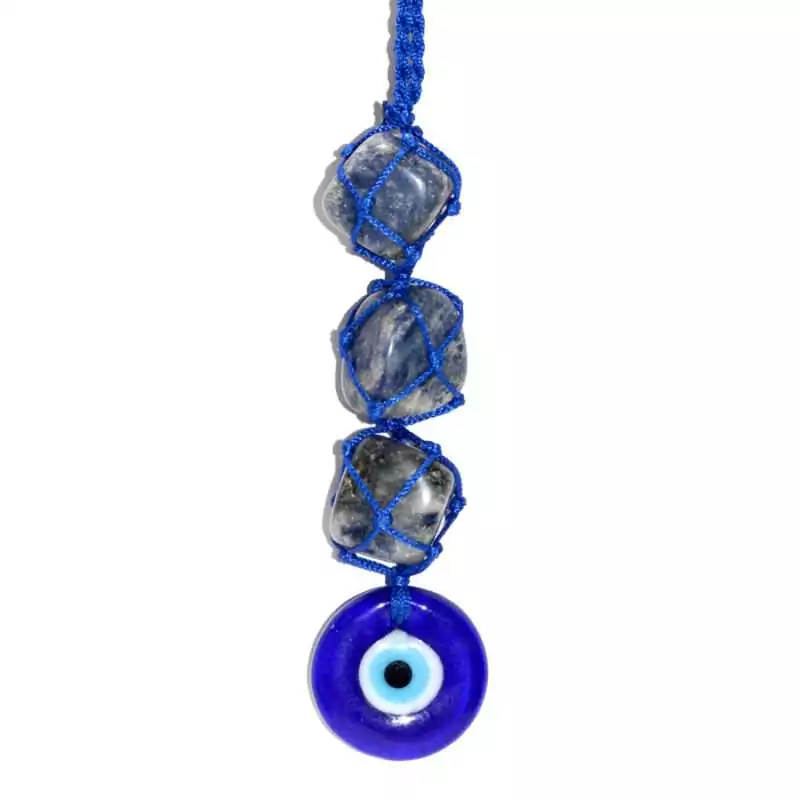
- Type: Evil eye wall hanging with stones
- Length: 9 inches
- Stones: 3 polished sodalite stones, each in a knotted blue cord net
- Stone color: Deep blue and gray with white veining
- Cord: Braided blue cord
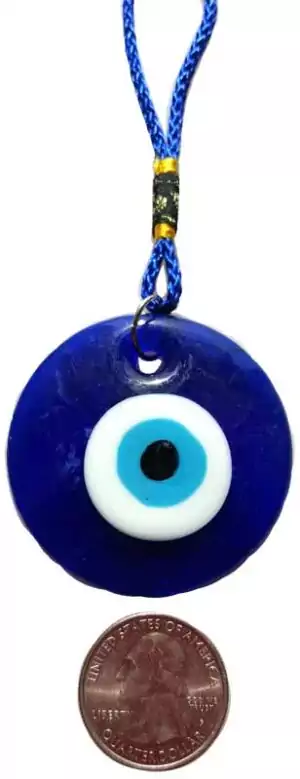
- Eye: Round blue eye with a white ring, light blue center and black pupil
Veined Blue Stones in Knotted Nets
Three chunky stones hang in a stack, and each is cradled in a net of knotted blue cord. They’re rounded, with almost square outlines, deep blue in some places and gray in others, with white veins running across their faces. Each stone shows a different mix of blue, gray and white, so no two look alike: the white veins run as thin lines on one stone and as broad patches on another, and the polished surfaces pick up the light. A round eye ends the strand, with a deep blue field, a white ring, a light blue center and a black pupil, and a braided blue cord carries everything from the top. The stones are sodalite, a mineral made of sodium, aluminum, silicon, oxygen and chlorine, rated 5.5 to 6 on the Mohs scale. Gray and deep blue make the stones the darker, heavier middle of the strand, and the bright blue eye its end. The knotted nets repeat the cord’s blue around every stone, which keeps the whole strand in one family of color.
Blue is the color most tied to the evil eye amulet. In Turkish belief blue acts as a shield against evil and absorbs negativity, and the eye at the bottom of this hanging shows the nazar’s blue and white rings around a black pupil. Sodalite brings a second blue to the strand. In modern crystal practice it’s associated with the throat chakra and the third eye, and guides sometimes call it a stone of logic joined with intuition. The stones and the eye come from different places, crystal lore and folk custom, and the hanging gathers them on one cord. The belief behind the eye is described across the Mediterranean, West Asia and many other regions, and a museum catalogue calls it culturally very widespread with a long history. The same catalogue lists glass eye beads among the commonest amulets against it, worn or carried. An amulet of this kind is traditionally hung or carried to guard against a harmful glance, and in Turkey it’s called nazar boncuğu. The pairing is a design choice, since the belief and the stone have separate histories.
Where the Hanging Looks Best
Dark stones show best against a pale background, so a white or cream wall, a light door frame or a pale window casing makes the veining easy to see. Hang it beside the entry, above a desk or on the side of a bookcase, wherever the strand has a hand’s width of clear space to swing. At 9 inches it also fits the inside of a closet door or a narrow stretch of hallway. Keep it away from radiators, stove tops and sunny window sills, since heat can fade sodalite’s color. A single hook is all it needs, which makes it an easy gift for a new home. Keep the cord clear of candle flames and incense. See my evil eye collection for more pieces made around the eye.
How to Hang and Care for the Sodalite Eye Hanging
Three steps cover the first check, the hanging and the upkeep.
- Check the Nets and Knots
Let the strand hang from your fingers and look at the nets around the three stones. Each knot should sit snug against its stone. Tug each stone lightly to check the hold, and look at the cord above the top stone and under the eye for any fraying. Retie a loose knot before you hang the piece, so a stone never slips out of its net and lands on a hard floor.
- Pick a Wall and Hang It
Choose a wall or door frame away from heat sources and set a small nail or hook at eye level or a little above. Hang the top of the cord from the hook and let the strand settle. Step back to check that it hangs straight, and leave enough room below the eye so the stones swing clear of a shelf or a door.
- Dust and Store
Household dust can scratch sodalite over time, so wipe the stones every few weeks with a soft dry cloth or a soft brush. Dust the eye and the cord the same way. Skip sprays and abrasive cleaners. To store the hanging, lay it flat in a drawer or box, apart from harder or sharper objects, so the stones and the cord stay clear of scratches and tangles.
The Tarot Fellow Standard
I stock this hanging as a decorative charm that sets three veined sodalite stones beside an eye in the traditional blue and white. The evil eye is a living folk belief in Turkey, Greece and many other places, and the people who keep it hold the knowledge of how an eye is gifted, hung and replaced. This piece is a reference to that belief, never a replacement for the community and customs behind it. If the nazar is part of your family’s custom, follow what you were taught. If it’s new to you, start by learning where it comes from. For other pieces made to hang on a wall, see my wall hangings collection.
Frequently Asked Questions
No. Sodalite is a single mineral, a sodium aluminum silicate with chlorine. Lapis lazuli is a rock made mainly of lazurite, calcite and pyrite. Gold-colored pyrite flecks point to lapis lazuli, and white veining appears in both. The two are related, since lazurite belongs to the sodalite family.
Sodalite forms in sodium-rich igneous rocks such as nepheline syenite. It was first described in 1811 at the Ilimaussaq complex in Greenland, and deposits occur in Ontario and British Columbia in Canada, Maine and Arkansas in the United States, and northern Namibia.
Accounts describe nazars hung in houses, shops and cars, pinned to a newborn's clothing and tied to horses, which are considered especially susceptible. A Palestinian-American informant adds that talismans like these go in rooms where guests visit and hang in the car. Placement varies by family and region, so follow the custom you grew up with if you have one.

Reviews
There are no reviews yet