
Quick Specs
- Type: Evil eye wall hanging with stones
- Length: 9 inches
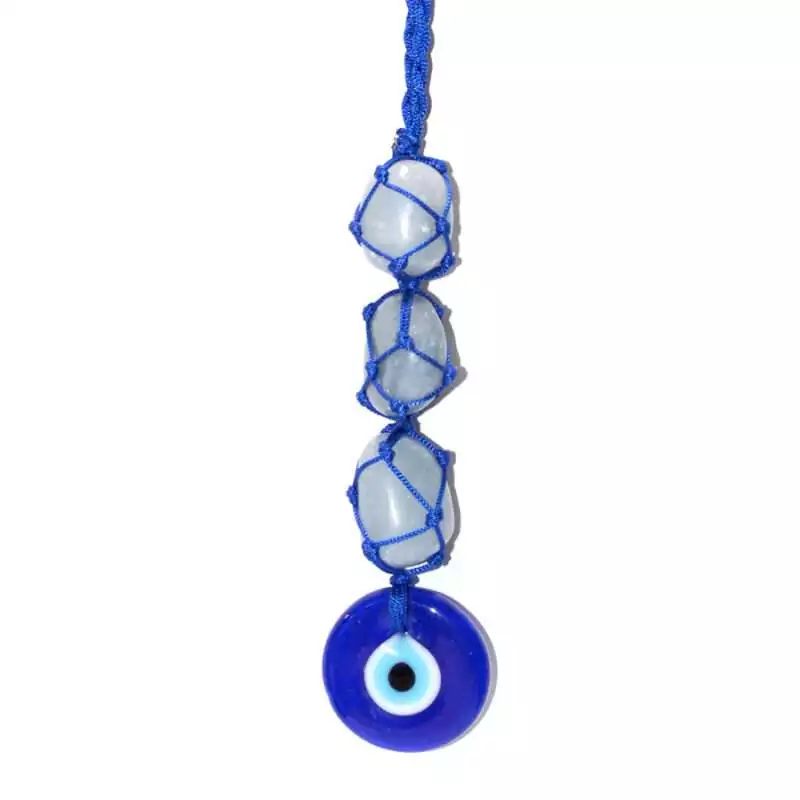
- Stones: 3 smooth angelite stones, each in a knotted blue cord net
- Cord: Braided blue cord
- Eye: Round blue eye with a white ring, light blue center and black pupil
Three Netted Stones Above a Blue Eye
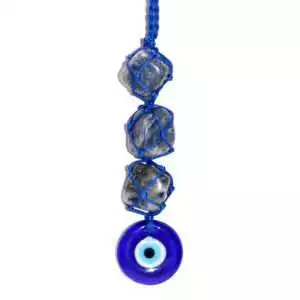
A braided blue cord runs down into three stones stacked one below the next. Each stone sits in its own net of knotted blue cord, with the knots pulled tight where the strands cross, so every stone hangs like a small lantern. The stones are pale and milky, somewhere between white and light blue, with smooth rounded faces, and each one differs a little in size and shape, and the middle stone stands tallest and narrowest of the three. A round eye closes the strand: a deep blue field with a white ring, a light blue center and a black pupil. The cord and the eye share the same deep blue, and the pale stones stand out against both. The stones are angelite, the trade name for a light blue to blue-grey variety of anhydrite, which is calcium sulfate. Angelite is soft, between 3 and 3.5 on the Mohs scale. At 9 inches the strand reads as a short column of three stones above a single eye, and the knots repeat down its length so the cord and the netting look like one piece of work.
The eye belongs to the evil eye belief, the idea that a malevolent glare, usually inspired by envy, can bring harm. Reference works place the belief across the Mediterranean, the Balkans, West, Central and South Asia, Africa, the Caribbean and Latin America. In Turkey the eye amulet is called nazar boncuğu, and in Greece it’s called mati. Traditional nazar beads are handmade glass built from rings of dark blue, white, light blue and black, and the eye on this hanging follows that sequence. A museum catalogue lists glass eye beads among the commonest amulets against the evil eye, worn or carried, and says such amulets usually take an eye-shaped design, realistic or highly stylised. Accounts of the custom describe them hung in houses, shops and cars. The stones come from crystal practice and the eye from folk custom, and the hanging gathers both on one cord. The shared blue of the cord and the eye ties the pieces together so the strand reads as one design, with the three pale stones keeping it light and the eye as the single point of deep color at the bottom.
Practical Ways to Hang It
Hang it where you’ll pass it every day: beside a front door, along a hallway, in a window frame or on a bedroom wall. At 9 inches it fits the side of a bookcase, the front of a closet door or the corner above a desk. Pick a dry, shaded wall, away from sinks, showers and cooking steam and out of long direct sun. The strand hangs straight, so leave a hand’s width on each side for it to swing clear of a door edge. It also works as a small gift for a new home or office, since a single hook is all it needs. Keep the cord away from candle flames and incense. For more pieces made to hang, see my wall hangings and chimes collection.
How to Hang and Care for the Angelite Eye Hanging
Three steps cover checking the netting, choosing a spot and keeping the stones clean.
- Check the Netting
Hold the cord at the top and let the strand hang free. Look at the knots around each stone and give every stone a light tug to see that its netting holds it snugly. If a knot looks loose, retie it before you hang the piece, since angelite is soft and a fall onto a hard floor can mark it. Check the eye at the bottom of the strand as well, and run your fingers down the cord to feel for any fraying.
- Choose a Dry Spot and Hang It
Set a small nail or hook at the height you want, on a dry wall or door frame out of long direct sun. Hang the top of the cord from the hook and let the strand settle for a minute. Check that it hangs straight and that the lowest stone and the eye clear any shelf, door edge or furniture by a few inches.
- Dust and Store
Dust the stones and the eye with a soft dry brush or a soft dry cloth every few weeks. Skip sprays, damp cloths and soaking, and pat a stone dry at once if it gets wet. When you redecorate or move, take the hanging down first and store it flat in a dry drawer or box so the cord stays untangled.
The Tarot Fellow Standard
I stock this hanging because it joins three smooth angelite stones to a blue eye on one cord, at a size that suits a door frame or a small wall. The evil eye is a living folk belief in Turkey, Greece and many other places, and the eye on this piece is a decorative charm that points toward it, a reference and never a stand-in for the customs of the people who keep them. If the nazar is part of your family’s tradition, you already know how it’s gifted, hung and replaced. If it’s new to you, learn those customs before you decide what the eye means in your home. See my evil eye collection for more pieces that carry the eye.
Frequently Asked Questions
The trade name angelite is used for a light blue to blue-grey variety of anhydrite from Peru, and Lima is listed as a significant locality. Anhydrite itself, a calcium sulfate, forms in many countries, and mineral references name Mexico, Germany, Austria and several states in the United States among them. The mineral is usually white, with gray, bluish or purple forms.
Anhydrite absorbs water and readily changes into gypsum, a more common mineral. Jewelry guides advise protecting angelite from moisture, cleaning it with a soft dry cloth and keeping it out of long sunlight or heat, which can fade it. A dry, shaded wall suits this hanging well.
Modern crystal guides link angelite with the throat chakra, and one guide adds the third eye and crown, tying the association to the stone's pale blue color. These pairings belong to modern crystal lore and vary from guide to guide. The chakra idea itself comes from Indian traditions, and the seven-color scheme took shape in twentieth-century Western writing.

Reviews
There are no reviews yet