
Quick Specs
- Format: Boxed oracle deck with guidebook
- Author: Kate Forsyth
- Illustrator: Merle Hunt
- Publisher: Rockpool Publishing
- ISBN: 9781922785428
- Published: 2025
- Box Size: 150 x 115 mm (height x width)
Inside Kate Forsyth’s Fairytale Oracle
Kate Forsyth’s Fairytale Oracle reads eleven fairytales as maps. Legends and fables are as old as language, and the deck takes that age seriously: the wisdom they carry was passed down encoded in stories of wonder and transformation. Forsyth is an Australian author whose doctoral work centered on fairy tales and whose novel Bitter Greens reinvents Rapunzel, and she sees the stories as more than entertainment: on a deeper level they explore real and difficult human dilemmas, warn of dangers and hand you tools for getting through them. The deck grows out of her own childhood fascination with the tales, which she recounts in the guidebook’s introduction. Each name plate carries the tale in small capitals, then a number and a title, then a short keyword phrase. Rapunzel’s card is 3. Ladder of Hair, Spiritual Ascension. Beauty and the Beast gives 16. Consent, The Power to Choose. The Little Mermaid gives 20. Dagger, Seize the Sword, and Bluebeard gives 23. Forbidden Chamber, Disobedience. The titles take an incident from the story and turn it into a question you can bring to your own life, so you recognize the scene first and meet the application second.
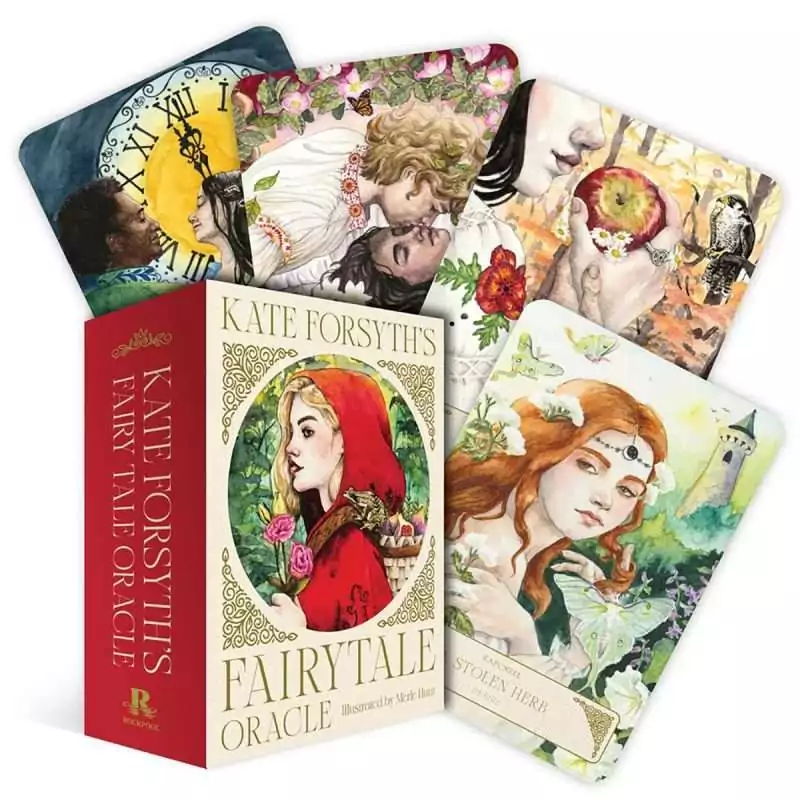
Merle Hunt paints in watercolor, working from nature and animals with plenty of colorful detail. The cover is a round vignette on a cream, linen-textured ground: a young woman in a red hood holds pink roses, a frog sits on her shoulder and a basket of figs rides at her back, all framed by gold scrollwork. Inside, the Rapunzel card shows a red-haired figure leaning from a stone tower while luna moths drift through the mist beside her. On the Beauty and the Beast card, a woman in magenta and a horned, lion-maned beast hold one another in a field of flowers. The Little Mermaid’s dagger card is a dark-haired woman with pink lotus blooms in her hair and a blade held upright before her face, a dolphin leaping behind her. Bluebeard’s card shows a woman in a blue patterned dress glancing back from a heavy red door with iron scrollwork and a skull set into the metal. The cream name plates have gold corner ornaments, and the card backs repeat that gold floral pattern, so the deck holds together visually from the first card to the last.
Practical Ritual Applications
Draw a card, then spend a few minutes with the tale before the guidebook: recall the story, find the scene on the card and ask where its turning point appears in your own week. Use the keyword phrase as a one-line writing prompt and keep the answers in a notebook; a shelf of my journals gives you somewhere to start a story log. A three-card draw works as a short tale of its own, with a beginning, a crisis and a way through. The deck takes up serious themes, so choose your cards when you are ready to look at them squarely, and read the guidebook entry slowly. Fairytales were told aloud for centuries, so try reading a card’s story aloud to yourself before you decide what it means.
How to Read with Kate Forsyth’s Fairytale Oracle
Here is a simple way to begin, one tale at a time.
- Choose a Tale to Start With
Go through the deck and pick one story you already know well, such as Rapunzel or Cinderella. Gather its cards and read the guidebook's account of where that tale came from and what it means. Seeing how Forsyth explains a story you know teaches you how the whole deck speaks, and it makes your first question feel less like a leap.
- Draw and Read the Image First
Shuffle while you hold a question in mind, then draw one card. Before you read the title or the phrase beneath it, describe what you see: who is in the scene, what they are doing and what the colors suggest. Write that in a sentence or two. Then read the tale name, the title and the keyword phrase, and note where your first impression and the printed words meet.
- Carry the Phrase Through the Week
Copy the card's keyword phrase onto a slip of paper and keep it where you will see it. At the end of each day, add one line about where the phrase showed up. After a week, read the guidebook entry for the tale again and compare it with what you recorded. Notice where the guidebook and your own log agree, and where they part ways.
The Tarot Fellow Standard
I stock Kate Forsyth’s Fairytale Oracle because every card is tied to a story you can look up, which keeps your readings anchored to something older than the deck. An author who knows the material and an illustrator who paints each story’s key moment with care make a deck that earns repeat readings. If you love folklore, or you’re tired of oracle messages that float free of any source, it gives you a way to read that stays close to the tales. You can find it beside the others in my oracle decks collection.
Frequently Asked Questions
No. The Fairy Tale Heroine Oracle is a separate 48-card deck by Sharon Blackie, built around four suits of tasks, places, guides and tools along the heroine's journey. Kate Forsyth's deck explores eleven fairytales, and each card carries the name of its tale. Several decks use fairy tale in the title, so check the author's name when you search for reviews or guidebook notes.
Both are oracle decks by Dr Kate Forsyth, and they work from different material. The Hedgewitch Oracle has 44 cards, each exploring the history, folklore and uses of a magical plant, with art by Vasilisa Romanenko. The Fairytale Oracle looks at eleven fairytales, with art by Merle Hunt, and its guidebook explains where each tale came from and what it means. Choose by theme: plants and folk practice, or story and transformation.
It is published for adults. A bookseller lists the audience as general adult, and the publisher's description calls the deck infused with dark fairytale elements, with stories that explore real and difficult human dilemmas and warn of dangers. If a younger reader is curious, read the guidebook entry for a card first and choose the cards together.
Yes. A tarot teacher describes two ways to combine the decks: draw one oracle card at the start of a tarot reading to name the theme, or at the end to give a parting message. Because every card here is tied to a fairytale, either draw gives you a story to hold up against the tarot cards, and you can ask which tale your spread resembles.

Reviews
There are no reviews yet