
Quick Specs
- Format: Boxed oracle deck with guidebook
- Card Count: 44 cards
- Card Size: 3.5 x 5 inches
- Author: Kate Forsyth
- Illustrator: Vasilisa Romanenko
- Publisher: Rockpool Publishing
- ISBN: 9781923208131
- Box Size: 150 x 115 mm (height x width)
Inside Kate Forsyth’s Hedgewitch Oracle
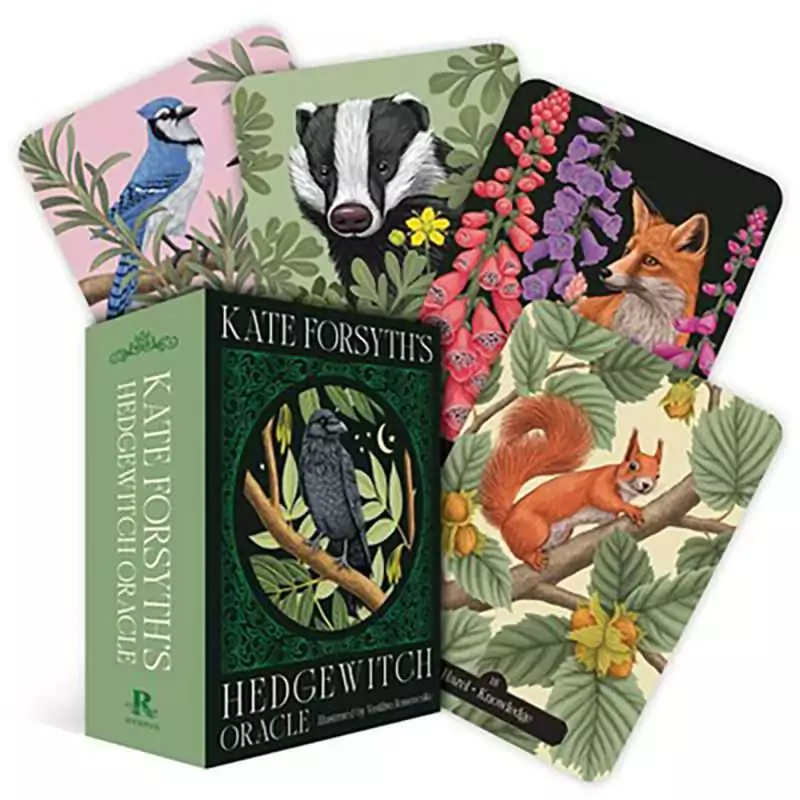
Kate Forsyth’s Hedgewitch Oracle features 44 plants from the hedgewitch way of life, which seeks to live mindfully and magically in tune with the natural world. Forsyth is an award-winning author, storyteller and folktale scholar, and she approaches each plant the way a folklorist does: through its history, its stories and its traditional uses. The plants are ones you can grow in your own garden, find in hedgerows, meadows and woods, or source from a reputable shop, so the deck stays close to ground you can walk across. Each card names a plant and gives it a keyword, and the hazel card in the box art pairs that plant with Knowledge. Because every card ties an idea to a living plant, the deck works as a bridge between divination and everyday gardening or walks outdoors. You can draw a card for a message, then step outside and look for the plant itself. That pairing of one plant with one idea, backed by the folklore that links them, is the pattern the deck follows from the first card to the last.
Vasilisa Romanenko, a Connecticut-based illustrator whose paintings and drawings draw on botany, natural history and textile design, illustrated the cards. The box art shows her approach: a blue jay on a pink card among slender leaves, a badger peering through sage-green foliage, a fox beside tall foxglove spikes on a black card, and a red squirrel among hazelnuts on a cream one. The plants are drawn with the detail of a vintage field guide, and animals appear on nearly every card, so each plant arrives with a creature that shares its space. Background color is part of the system. Pink, yellow, green and black grounds mark card groups with their own themes, from love and tenderness to friendship, fresh beginnings, intuition, boundaries, mystery and shadow. The box repeats the palette, with a dark green front showing a bird on a leafy branch under a crescent moon, sage-green sides and a patterned border. On the hazel card, a dark name plate near the foot gives the plant and its keyword, a layout that lets you read a draw at a glance. The artwork gives you plenty to study before you read a line of the guidebook.
Practical Ritual Applications
Draw one card in the morning and carry its keyword through the day, then look for its plant in a garden, a park or a hedgerow when you can. The guidebook’s spell for each card gives you a small practice to match the message. Keep a notebook beside the deck where you record the plant, the date, the weather and what you noticed; over a season that record becomes your own almanac. If you enjoy oracle work generally, keep this deck with the rest of my oracle decks collection and reach for it when you want a nature-led voice. If the plants draw you further, my herb and herbal books offer reference reading on identification and folklore. Foxglove, which appears in the box art, is poisonous if eaten, so check any plant against a reliable botanical source before you handle, burn or taste it, and read the deck’s lore as folklore; for eating or medicine, rely on a qualified source.
How to Read with the Hedgewitch Oracle
Here is a simple way to begin your first reading with the deck.
- Look Through the Cards by Plant
Spread the deck face up and go through it once, slowly, noting the plants you already know from gardens, walks or the kitchen. Pick two or three of them and read their guidebook entries, then compare what Forsyth says with what you already know about the plant. That comparison shows you how the deck speaks, and it makes the first question you ask feel less like a leap.
- Draw a Card for Your Day or Question
Shuffle while you hold a question or a theme in mind, such as what you need to notice this week. Draw one card and read its keyword, then look at the image: the plant, the animal beside it and the background color. Write down the first connection that comes to you before you read the guidebook, then compare your note with the entry and see where they meet.
- Follow the Card Outdoors
Take the plant out of the deck and into your week. Look for it in a garden, a park, a hedgerow or a nursery, or find a picture of it in a plant guide. If you try the guidebook's spell, use materials you have gathered safely, and skip any plant you can't identify with certainty. Record what you noticed, then return the card to the deck.
The Tarot Fellow Standard
I stock Kate Forsyth’s Hedgewitch Oracle because each card ties its message to a plant you can look up, grow or find outdoors, which keeps your readings tied to something you can see and touch. I choose oracle decks for readers who want a clear theme and tools they can act on, and this one delivers both. It also suits gardeners and plant lovers who have never picked up an oracle deck, since the theme meets them where they already are. If you want a deck that sends you outside as often as it sits on your table, it belongs in your collection.
Frequently Asked Questions
A hedgewitch is usually described as a solitary practitioner of folk magic who works with plants and the turning seasons. The name comes from the hedge, the living boundary between cultivated ground and wild land, and the plants most often linked with the path grow along that edge, among them hawthorn, elder and mugwort. Forsyth's deck sits on the plant side of that path.
No, they're two separate decks. The Hedgewitch Botanical Oracle is a 40-card deck by Siolo Thompson, packaged with a 192-page guide titled The Hedgewitch's Field Guide. Kate Forsyth's deck has its own cards, artwork and guidebook, and it centers on the history, folklore and uses of its plants. Both draw on herbal lore, so the shared word hedgewitch is the main thing they have in common.
No. A standard tarot deck has 78 cards, made up of 22 Major Arcana and 56 Minor Arcana in four suits, so its structure is the same from deck to deck. In an oracle deck, the creator chooses the card count, the theme and what each card means. Here every card is a plant, so each card's keyword and folklore carry the reading.
They're separate decks that share an author. Kate Forsyth's Fairytale Oracle is built on eleven fairy tales and illustrated by Merle Hunt, while the Hedgewitch Oracle is built on plants and illustrated by Vasilisa Romanenko. Each deck has its own guidebook and stands on its own, so you can start with either one.


Reviews
There are no reviews yet