
Quick Specs
- Brand: Sonavi
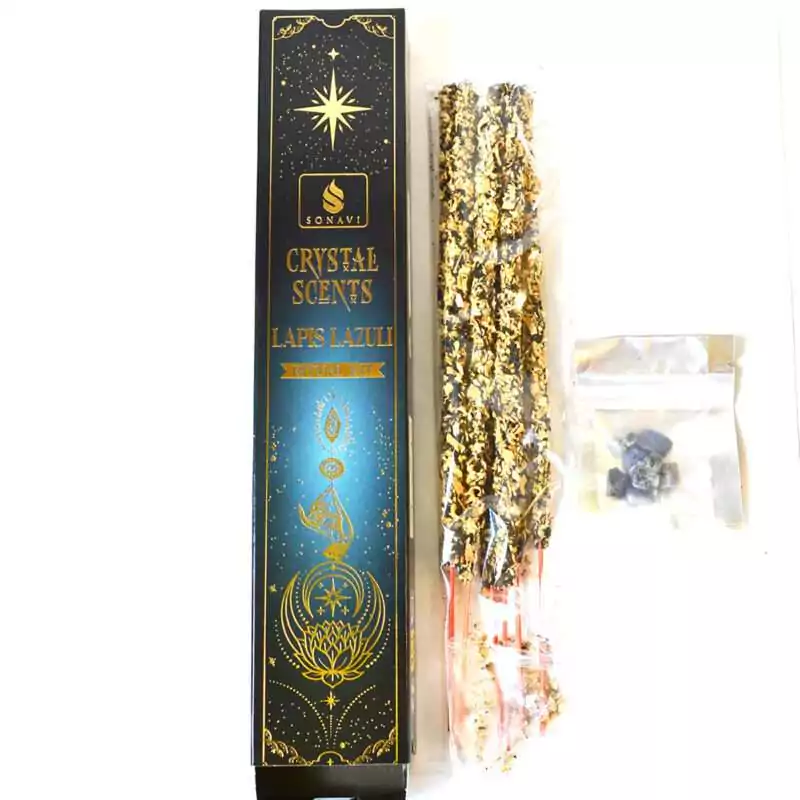
- Series: Crystal Scents Ritual Kit
- Type: Stick incense with crystal chips
- Count: 8 incense sticks
- Crystal: Lapis lazuli chips
- Sticks: Visible botanical grains
- Scent: Fragrance inspired by lapis lazuli
The Stone That Became Ultramarine
Lapis lazuli is a rock, a blend of the blue mineral lazurite with white calcite and brassy flecks of pyrite, which is why a good piece looks like a night sky scattered with stars. It is opaque and slightly porous, and it rates between 5 and 6 on the Mohs scale. The most prized color is a deep, even blue, and GIA notes that a scatter of small golden pyrite flecks can belong to top-quality stone. Lapis is typically cut into cabochons, beads and inlays. The mines of Badakhshan in Afghanistan have supplied lapis for thousands of years, and Egyptian craftspeople used it in amulets and in the funeral mask of Tutankhamun. This kit pairs eight incense sticks with a small bag of lapis chips. The sticks wear a coat of dried plant material that shows as visible botanical grains, and the fragrance is inspired by lapis lazuli. Chips are small broken pieces, and because lapis is a mix of minerals, a chip may carry white calcite or gold-colored pyrite beside the blue. Tip a few onto a saucer and you can compare how much blue, how much white and how many bright specks each one holds.
Painters knew lapis as a pigment. Renaissance artists ground the stone into ultramarine, a blue prized for its brightness, and Titian and Vermeer both used it. The name carries its own travel story: lapis is the Latin word for stone, and lazuli traces back to a Persian word. In modern crystal practice, lapis lazuli is associated with the third eye chakra and with wisdom, truth and self-expression. Those are lore associations, and they suit work that involves words: a letter you have been drafting for a week, an outline for a talk, a page of notes you want to get right. A stick burning beside the page gives the session a beginning, and the blue chips on the desk give your eyes somewhere to rest when a sentence will not come. Between paragraphs, pick one up, turn it over, and put it back. A chip in your palm belongs to a material with a long record, from Egyptian jewelry to the paint on Renaissance canvases, and the pyrite specks catch lamplight if you keep the room dim.
Practical Ritual Applications
Light a stick before you write anything that matters: a toast, a cover letter, a long message you want to word with care. Set the chips beside the page and pick one up while you search for the next sentence. The kit suits study sessions too, where a stick marks the start of a block of reading and the chips give a restless hand something to hold. At a reading table, light one before you describe a spread aloud to a friend, so the incense frames the conversation. Slip a chip into a notebook cover or a pencil case when you leave the house. If you would like more stones for desk and page work, my communication stones collection has more to browse.
How to Burn Lapis Lazuli Incense Sticks and Store the Chips Dry
Three steps pair a safe burn with a dry place for the stone.
- Lay out a dry, heat-safe space
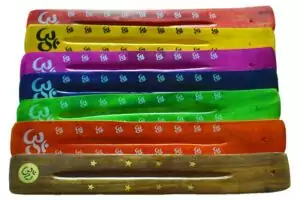
Stand a heat-resistant holder that catches falling embers on a flat, heat-resistant surface such as a ceramic tile, clear of curtains and paper, and open a window or door for ventilation. Put the chips in a dry saucer a hand's width away. Lapis is slightly porous, and minerals references advise keeping it away from chemicals and cleaning solvents, so keep the saucer clear of sprays and wipes.
- Light the stick before you begin to write
Hold the tip to a flame until it catches, let the flame die back, and stand the stick in the holder. Sit down with your notebook, your reading or your deck, and set the saucer beside the page. Pick up a chip whenever you want one, and return it to the saucer before you lean over the holder.
- Put out the stick and put the chips away dry
Stay in the room while the stick burns, and keep it out of reach of children and pets. Press the glowing tip into a fireproof dish until it is out, since blowing on a stick can spread sparks, and check that nothing is still smouldering. When the ash is cold, empty the holder. Wipe the chips with a soft cloth if they have gathered dust, and store them dry in their bag.
The Tarot Fellow Standard
I stock the Lapis Lazuli kit for writers, students and readers who want a deep blue stone and a stick to burn beside the page. The chips are small pieces, so they work as a token for the desk or a pocket, and the eight sticks give you several sessions. The slim box tucks into a gift bag or a card envelope for someone who loves notebooks. For more scents to try, my natural artisan blend stick incense collection has more stick incense to explore.
Frequently Asked Questions
Lapis lazuli is a rock. Its blue comes from the mineral lazurite, and the rock usually also holds white calcite and gold-colored flecks of pyrite, which is why the blue is often marbled or sparkling. Gem Society also lists haüyne, sodalite and nosean among its minerals, all of them members of the sodalite group.
Afghanistan is the world's leading source. Chile and Russia are other commercial sources, and smaller amounts have come from Canada, Argentina, Pakistan and a few American states. Lapis forms where limestone or marble has been altered by heat and fluids near igneous intrusions, and the blue lazurite grows within bands or layers of the host rock.
Both are blue and both belong to the sodalite group of minerals. Lapis lazuli usually shows brassy pyrite flecks and white calcite patches, while sodalite is a single mineral, usually blue to blue-violet with white veining and little or no pyrite. Gem Society calls sodalite the only readily available natural stone blue enough to pass for lapis, so pyrite flecks point toward lapis.
Reviews
There are no reviews yet