


Quick Specs
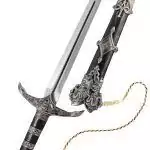
- Length: 18 inches
- Style: Ornate, Celtic and knightly imagery
- Best for: Altar display, ritual circle casting, ceremonial use, Wiccan and ceremonial magic practice
- Shipping note: Cannot ship to Massachusetts or California
The Ritual Sword in Western Esoteric Practice
The sword is one of the four classical elemental tools in Western ceremonial magic and Wiccan practice, corresponding to the element of air in most traditions derived from the Hermetic Order of the Golden Dawn, and to fire in Gardnerian Wicca. It serves as a power tool for casting the ritual circle, directing energy, and holding authority over spiritual forces during formal evocation or invocation. The sword is often the most visually impressive of the elemental tools, which gives it a secondary function as a statement piece: it announces the seriousness of a practitioner’s space before a word of ritual is spoken. Celtic and knightly sword iconography roots the piece in the chivalric and druidic lineage rather than the purely ceremonial magic tradition.
At 18 inches, the Lord’s Sword occupies the boundary between a functional altar athame-scale tool and a display piece with genuine presence. The ornate decorative elements, drawn from Celtic and knightly imagery, give it visual weight appropriate for a formal altar centerpiece. The lightweight construction makes it practical to hold and direct during ritual movement without the fatigue of a heavier ceremonial blade. This is a common design choice for altar swords: functional enough for use, comfortable enough for extended ritual work.
Circle Casting, Display, and Ritual Protocol
In traditional coven practice, the sword is used to cast and close the ritual circle by tracing its boundary in the air while walking deosil (clockwise). In solitary practice, either a sword or an athame serves this function. The Lord’s Sword at 18 inches gives the practitioner a visual sweep in space that smaller athames cannot match, making the circle-casting gesture more physically defined. Between rituals, it rests on the altar as a directional tool pointing east or south depending on the tradition’s elemental assignments. Celtic imagery on the hilt connects it to the druidic sword tradition, making it appropriate for both Wiccan and Celtic reconstructionist practice.
This sword cannot ship to Massachusetts or California due to state regulations on ceremonial blades. For practitioners in those states, I recommend exploring alternative athame options. For everyone else, browse my athames collection for the complete range of blades and ritual cutting tools available.
How to Use the Lord’s Sword
Three ways to integrate the Lord’s Sword into your ritual practice and altar setup.
- Cast the Ritual Circle
Hold the sword in your dominant hand with the tip pointing outward. Walk deosil (clockwise) around your ritual space, tracing the circle boundary in the air. Visualize energy from the tip as you move. Complete the full circle where you started.
- Consecrate and Dedicate the Blade
Before first use, cleanse the sword with incense smoke, salt, water, and candle flame to align it with the four elements. State your intention for the blade clearly. Many practitioners in the Western tradition speak their name and will over it.
- Display on Your Altar
Rest the Lord’s Sword across the altar surface or mount it on a wall behind the altar, pointing in the elemental direction your tradition assigns. Its Celtic and knightly imagery works well as a centerpiece that signals the nature of the space.
The Tarot Fellow Standard
I stock the Lord’s Sword because a ritual sword is not interchangeable with an athame in terms of presence, and practitioners building a serious altar deserve a blade that looks the part. The Celtic and knightly design language speaks to the Wiccan and ceremonial magic traditions most likely to use a sword of this scale. The shipping restriction to MA and CA is real and I note it prominently so you know before you order. See my full altar supplies collection for chalices, wands, cauldrons, and other elemental tools that complement this sword in a formal setup.
Frequently Asked Questions
A ritual sword is primarily used to cast the magic circle, direct energy during ritual, and represent the element of air or fire depending on tradition. In Wicca, it often substitutes for the athame in coven settings requiring a more visible tool.
Ceremonial swords like the Lord’s Sword are ritual and display tools, not weapons. The blade is intended for spiritual and symbolic work, not physical cutting. Western esoteric traditions specify that ritual blades are never used for physical harm.
Massachusetts and California have regulations governing the sale and shipment of certain bladed items. The Lord’s Sword falls under these restrictions. Practitioners in those states should browse my alternative athame options in the collection.
In Gardnerian Wicca, the sword corresponds to the element of fire. In traditions derived from the Hermetic Order of the Golden Dawn, the sword corresponds to air. The elemental assignment varies by tradition, so follow the system your practice uses.


Reviews
There are no reviews yet