
Quick Specs
- Type: Stick incense holder
- Size: 5 inches
- Material: Resin
- Shape: Scalloped lotus outline
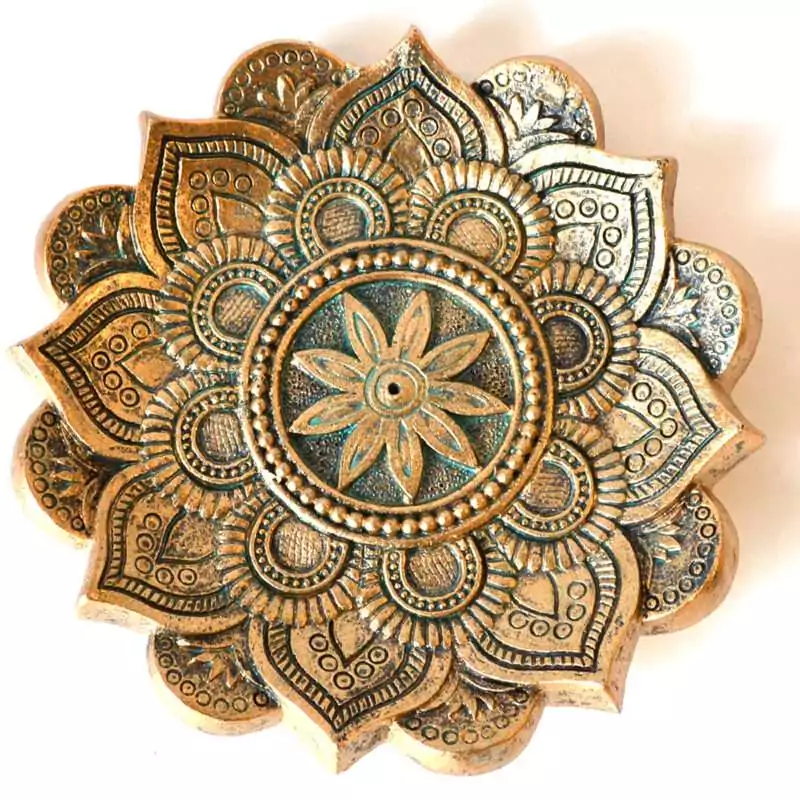
- Design: Layered petals around a beaded ring and an eight-petal flower with a center hole
- Finish: Aged gold with teal-green patina
A Layered Lotus Mandala in Aged Gold and Teal
The holder is a flat flower built up in layers. Its outline is scalloped, with pointed petals alternating with rounded ones around the edge, and every petal carries engraved pattern: rows of small circles, ridged arcs, and tiny leaf shapes, with dots circling the larger petals like beads on a necklace. The petals overlap in tiers toward the middle, where a ring of raised beads encloses a pebbled, teal-colored disc. An eight-petal flower lies on that disc, each petal outlined and hollowed along its length, and the center of the flower is a small round hole inside a raised ring. The finish moves from gold to teal. Gold wears bright along the edges and raised lines, and blue-green settles into the recesses, the way aged copper turns green over the years. Light from the side picks out the circles, the ridges, and the beads against the darker ground. The holder is cast in resin and measures 5 inches.
Mandala is a Sanskrit word for circle, and mandalas belong to Indian religions. The term first appears in the Rig Veda, and the form is used in Hinduism, Buddhism, and Jainism as a map representing deities. A circle enclosing an image such as a star or a flower is among the common arrangements, which is the arrangement here: a flower at the center, rings around it, and petals reaching out toward the edge. The lotus ties the pattern to a second old symbol. In Buddhist symbolism the lotus rises from muddy water unstained, and it stands for purity, detachment, and awakening. It is the specific symbol of Amitabha, the Buddha of the Lotus family, and it is also linked to Avalokiteshvara. This holder takes the lotus mandala as its decorative form, cast in resin to hold a stick of incense. The design carries traditions that people practice today, and its rings can be read from the center out to the scalloped edge.
Practical Ritual Applications
Stand a stick of incense upright in the hole at the center of the flower and set the holder on a table, a shelf, or a low altar. The flat, scalloped body sits level on a tray, a wooden board, or a tile, and a dark cloth beneath lets the gold and teal stand out. The flower at the center draws the eye straight to the smoke rising from it, which makes the holder a natural focal point for a bedside table, a reading table, or a quiet corner. Between sticks, it stays on display as a small piece of relief decor. My stick incense burner collection has other holders if you would like a second one in another room.
How to Burn Incense in the Lotus Mandala Holder
Prepare the surface, seat the stick in the center, and let the holder cool before you move it.
- Prepare a Stable Surface
Set the holder on a flat, heat-resistant surface such as a ceramic tile or a metal plate, and keep curtains, clothing, and paper well away from it. Choose a spot where nothing will knock it over, and keep it out of reach of children and pets.
- Seat the Stick in the Center Hole
Push the thin end of a stick into the small hole at the center of the flower, and light the tip until it glows before you shake out the flame. Stay with the incense while it burns. Fire services advise never leaving burning incense unattended.
- Let Ash and Holder Cool
Make sure the stick is completely out before you leave the room or go to bed. Incense ash and holders can stay hot after use, so wait until the holder is cool to the touch before you move it, and clear the ash when it is cold.
The Tarot Fellow Standard
I stock this holder as a decorative piece that uses the lotus and the mandala form. Mandalas belong to Hindu, Buddhist, and Jain practice, so I’d ask you to treat the pattern with respect and to see this holder as a way into learning about them. Temples, teachers, and the communities who work with mandalas are the best places to learn what they mean in practice. When you are ready to set a corner of your own, my altar supplies collection has bowls, cloths, and other pieces to set around it.
Frequently Asked Questions
Buddhists use mandalas as a support for meditation: Tantric Buddhists contemplate a mandala until they can visualize it in fine detail at will. Some are made from colored sand and swept away afterward in recognition of the impermanence of all things. Buddhist mandalas can show many subjects, from a Buddha at the center to the universe, and they vary as widely as the schools that use them.
Mandalas are used in Hinduism, Buddhism, and Jainism, and the mandala is still used as a meditative tool and spiritual exercise. A decorative holder cast with the pattern calls for care: keep it clean, set it in a tidy place, and learn what the pattern means from Hindu, Buddhist, or Jain teachers and temples. Their explanations come from practice, and a holder is a starting point for that learning.
The Indian lotus is an ancient symbol of purity, detachment, and fertility, used in various Indian religions. In Buddhism it is a symbol for the Buddha and his awakening, because the flower comes up from muddy water unstained, and the Buddha is said to transcend the world the same way. The lotus appears in early Buddhist art at sites such as Sanchi and Bharhut.

Reviews
There are no reviews yet