
Quick Specs
- Type: Stick incense holder
- Size: About 5 inches across
- Finish: Antiqued silver tone
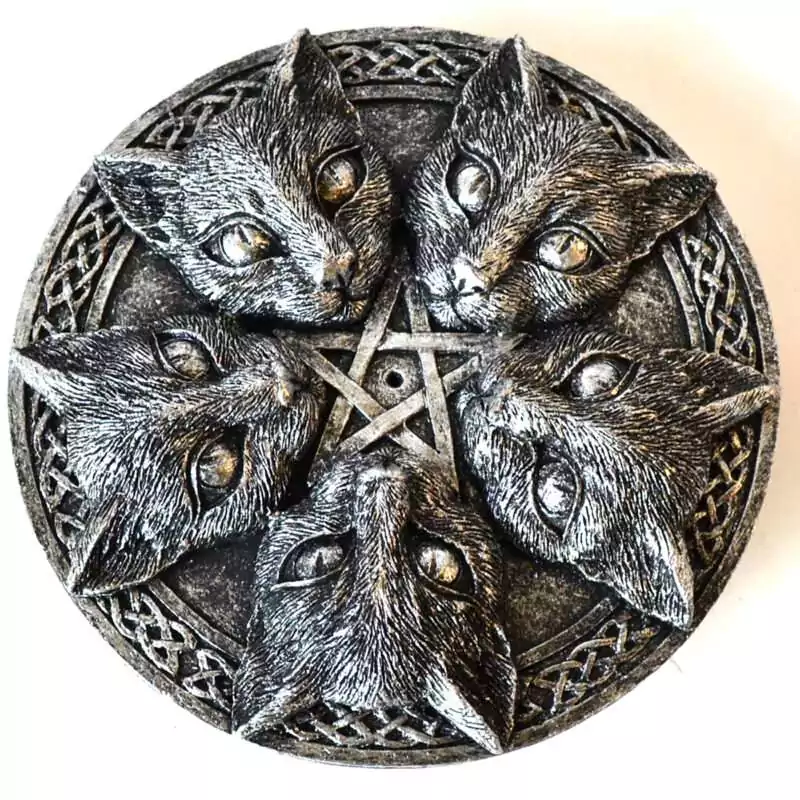
- Design: Five sculpted cat heads around a raised pentagram, with a knotwork border
- Shape: Round, with one hole at the center of the star
Five Cats Circling a Pentagram in Antiqued Silver
Five cat heads fill this round holder, each one turned toward the middle so that their noses meet around a raised pentagram. The sculpting is detailed. Fur is cut in fine, directional lines, the ears sweep outward and overlap their neighbors, and every pair of slanted eyes catches a warm gold-brown against the silver. The finish is a dark antiqued tone, worn lighter on the raised fur and the tips of the ears, so the faces stand out from the shadowed background behind them. The pentagram sits against a darker, recessed field at the center, with one point aimed straight up between the two upper cats, and a small round hole is cut into the middle of the star. That hole is where the incense stick stands. Around the outer edge, a narrow band of interlaced knotwork frames the whole design like the border of a manuscript page. At about 5 inches across, the holder is wide enough to show every face and small enough for a shelf, a desk, or the corner of an altar. A lit stick rises from the center of the pentagram, which puts the smoke at the heart of the design.
The pentagram is a five-pointed star, and the shape is far older than modern witchcraft. The Pythagoreans of ancient Greece used it as a sign of recognition among themselves, and Renaissance writers such as Heinrich Cornelius Agrippa kept it alive as a magic symbol. Today many Wiccans and other pagans use it as a symbol of their faith, and they generally display it with a single point up, the way it stands on this holder. The knotwork border has a history of its own. Interlaced bands like these belong to Insular art, the art of early medieval Britain and Ireland, which in Ireland ran from about the 6th to the 12th century and filled manuscripts such as the Book of Kells with knotwork. On this holder it does the work of a frame, a ring of woven line that holds the cats and the star inside one circle. Put together, the star, the cats, and the knots give you a piece that reads as witchcraft at first glance and rewards a closer look.
Practical Ritual Applications
Set the holder flat on a shelf, a desk, a windowsill, or the center of an altar. The cats face up, so a low surface shows the design better than a high one. One hole and one stick make this the simplest way to burn incense, which suits a first holder as well as a tenth. Choose any scent from my stick incense collection or from the stick incense you already own. Between sticks, the holder stays on display as a sculpture, and the pentagram makes it a natural focal point for an altar built around witchcraft. It also works as a gift for anyone who loves cats or keeps a shelf of witchy books, since the design carries itself with or without smoke.
How to Burn a Stick of Incense in Your Cats Pentagram Holder
A holder with one center hole needs a heat-resistant surface, a stick that stands straight, and a cool holder before you clean it.
- Set it on a heat-resistant surface
Place the holder flat on a ceramic tile or a metal plate, away from curtains, paper, and clothing. Keep it out of reach of children and pets, and choose a spot where nobody will knock it. A falling ember or a pinch of hot ash can scorch fabric and wood, so the surface should be flat, stable, and non-flammable.
- Stand the stick in the center hole and light it
Press the unlit end of a stick into the small hole at the center of the star until it stands upright and steady. Hold a flame to the tip until it glows, then blow the flame out. Watch the stick for the first minute to see that it stays straight and that the ash drops onto the holder.
- Let it burn out, then brush the ash away
Wait until the stick has burned down and the holder is completely cool. Tip the loose ash into a metal or ceramic dish, then use a soft, dry brush to clear the remaining ash from between the fur lines and the knotwork. Wipe the surface with a dry cloth, and the holder is ready for the next stick.
The Tarot Fellow Standard
I stock this holder for the sculpting. The five faces are modeled with fine fur lines and gold-toned eyes, the pentagram sits exactly where the incense stands, and the knotwork border finishes the circle. It is a stick holder first, so give it a tile and keep an eye on it while a stick burns. The rest of the time it is a small sculpture. If you are gathering symbols for an altar or a shelf, my pentagram and pentacle collection has more to set beside it.
Frequently Asked Questions
The meaning depends on who is using it. Wiccans often read the five points as earth, air, fire, water, and Spirit. Renaissance writers such as Agrippa also assigned elements to the points, and the Pythagoreans used the star as a mark of recognition. Other traditions assign their own meanings, so the points have no single reading that applies everywhere.
Not always. Pentagram strictly names the five-pointed star on its own, and many Wiccans use pentacle for a pentagram inside a circle. Usage overlaps, though: one major dictionary defines pentacle as a pentagram, and Gerald Gardner, an early figure in modern Wicca, used the two words interchangeably. On this holder no line circles the star, so pentagram is the word I use.
In European folklore of the medieval and early modern periods, witches and cunning folk were believed to be assisted by familiars, spirit helpers that most often took the form of small animals. Cats were among them, alongside toads, hares, and birds, and the link between witches and cats grew in medieval Europe. Some modern practitioners, including Wiccans, still work with the idea of a familiar.
No. Fire services advise never leaving burning incense unattended and putting it out when you leave the room or go to sleep. Check that the stick is out properly and not still smoldering before you walk away. Never burn incense when you feel sleepy or after alcohol, drugs, or medication, because you are more likely to cause a fire and less able to respond to one.


Reviews
There are no reviews yet