
Quick Specs
- Type: Stick incense holder
- Size: 5 inches
- Shape: Round
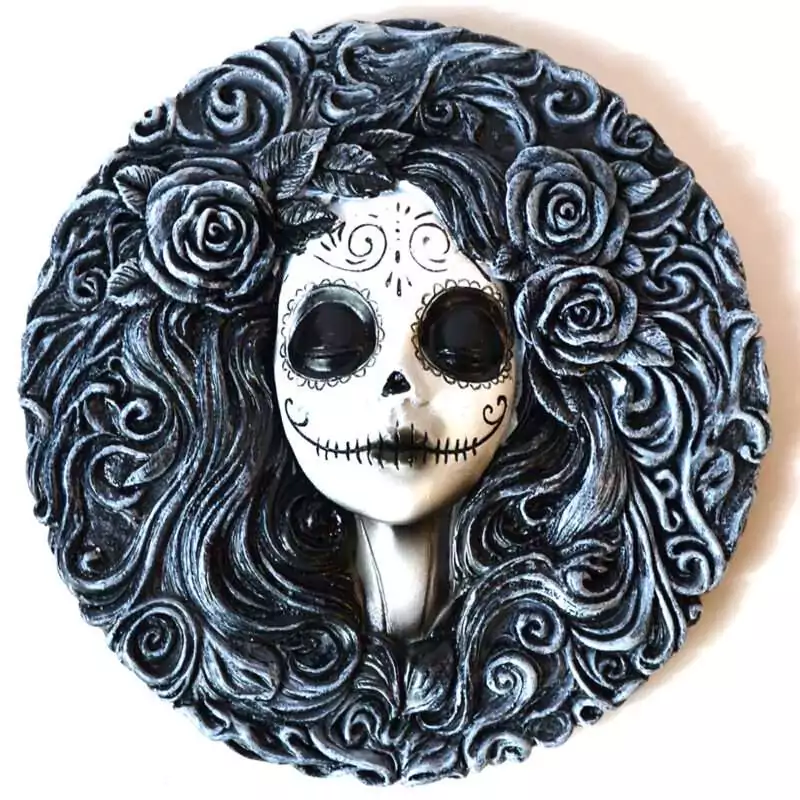
- Design: Woman in sugar skull makeup, hair curling into a circular border
- Flowers: Roses in her hair
- Colors: Black and gray hair with white highlights, white face
A Sugar Skull Face Framed by Curling Hair and Roses
The woman fills the center of a round disc, and her face is the one pale area on it. It is painted white, with large round black eye sockets outlined in a scalloped line, a small dark nose, and a row of short stitch marks across a smiling mouth. Swirls and small dots in fine black line decorate her forehead. Around her, the hair does the work of a frame: it flows in thick, wavy locks that curl into spirals toward the edge and wind around until the strands themselves make the circular border. Three roses sit in the hair, one at the upper left and two stacked at the upper right, with pointed leaves tucked beside them. The hair and flowers are black and slate gray, with white picking out the raised edge of every curl and petal, so the relief reads clearly against the dark ground. Her neck, in a pale silver-gray, drops from the face toward the bottom of the disc. The disc measures 5 inches, and every part of the surface carries some relief.
The imagery on this holder comes from Día de Muertos, the Day of the Dead, a Mexican observance that UNESCO inscribed in 2008 on the Representative List of the Intangible Cultural Heritage of Humanity as an indigenous festivity dedicated to the dead. UNESCO describes it as a festivity that commemorates the transitory return to Earth of deceased relatives and loved ones, held from the end of October into the beginning of November and practiced by Mexico’s indigenous communities. The celebration joins pre-Hispanic religious rites with Catholic feasts, which gives it a layered history. The skull is a common symbol of the holiday, and death is viewed there as a necessary part of life. A woman in sugar skull makeup is one of the best-known images of the holiday, and this holder is a modern decorative piece that draws on that look. It is made to hold a stick of incense, and it keeps the image on a shelf in any season.
Practical Ritual Applications
Seat a stick of incense in the holder and set it on a shelf, a desk, or a windowsill where the disc sits level and the relief catches light from the side. The white face stands out against dark wood or a plain wall, and a black cloth under the holder makes the roses and curls easier to see. When no incense is burning, the face and flowers work as a small piece of decor, so the holder keeps its place on display between uses. Stay clear of curtains and paper when you light a stick, and give the disc a spot with a little room on every side so the ash has somewhere to fall. My stick incense burner collection has other holders if you want a second one for a different corner of the room.
How to Burn Stick Incense in Your Day of the Dead Girl Holder
Three steps cover the surface, the lighting, and the cool-down.
- Choose a Heat-Resistant Surface
Place the holder on a flat, heat-resistant surface such as a ceramic tile or a metal plate, on a stable spot where nothing will knock it over. Keep it away from curtains, clothes, paper, and other things that burn, and out of reach of children and pets.
- Light the Stick and Stay Nearby
Seat the stick in the holder, light the tip until it glows, and let the flame go out. Keep the holder in sight while the stick burns, since fire services advise never leaving burning incense unattended. Let the ash fall where the holder catches it.
- Extinguish and Let It Cool
Make sure the incense is completely out before you leave the room or go to bed. Incense ash and holders may stay hot after use, so wait until both are cool to the touch before you move the holder or clear the ash away.
The Tarot Fellow Standard
I stock this holder as a decorative reference piece: a modern 5 inch stick incense holder that draws on the sugar skull look from Día de Muertos. The holiday belongs to the families and communities who keep it, so I’d ask you to treat the imagery with respect and to see this holder as a way into learning about the tradition. The people who observe the holiday are its best teachers, and the National Museum of Mexican Art’s published introduction to the Day of the Dead is a good place to begin. For other pieces for your shelf, browse my home decor collection.
Frequently Asked Questions
Day of the Dead is a living observance in which families honor relatives who have died, and UNESCO describes it as practiced by Mexico's indigenous communities. National Geographic describes it as a colorful, joyful holiday. Keeping a decorative holder with this imagery goes best alongside learning from the people who observe it, and Mexican cultural institutions such as the National Museum of Mexican Art publish introductions to the holiday and its altars.
Calaveras de azúcar, or sugar skulls, carry colorful designs that represent the vitality and individual personality of the departed, and they are inscribed with the recipient's name on the forehead. National Geographic notes that people of all ages have their faces painted to resemble skulls, and the Library of Congress lists sugar-skull makeup among the elements of traditional Mexican imagery for the holiday.
No. National Geographic describes Día de los Muertos as a colorful, joyful event that honors deceased relatives, and Halloween as a dark night of terror and mischief. UNESCO places the festivities from the end of October to the beginning of November and says they blend pre-Hispanic religious rites with Catholic feasts.
An ofrenda is an altar or shrine dedicated to the souls of the deceased. The National Museum of Mexican Art lists a photo of the deceased, religious statues, pan de muerto, candles, and cempasúchil flowers as typical items, and says families prepare favorite foods to invite the souls home. National Geographic describes ofrendas as built to welcome returning spirits with food, drinks, family photos, and candles.


Reviews
There are no reviews yet