
Quick Specs
- Type: Crescent moon pendant
- Size: About 1 3/4 by 1 1/4 inches
- Stone: Apophyllite, about 1/2 inch
- Finish: Silver-toned openwork scrolls
- Hanger: Ornate scrolled bail
A Scrolled Silver Crescent With a Hanging Crystal
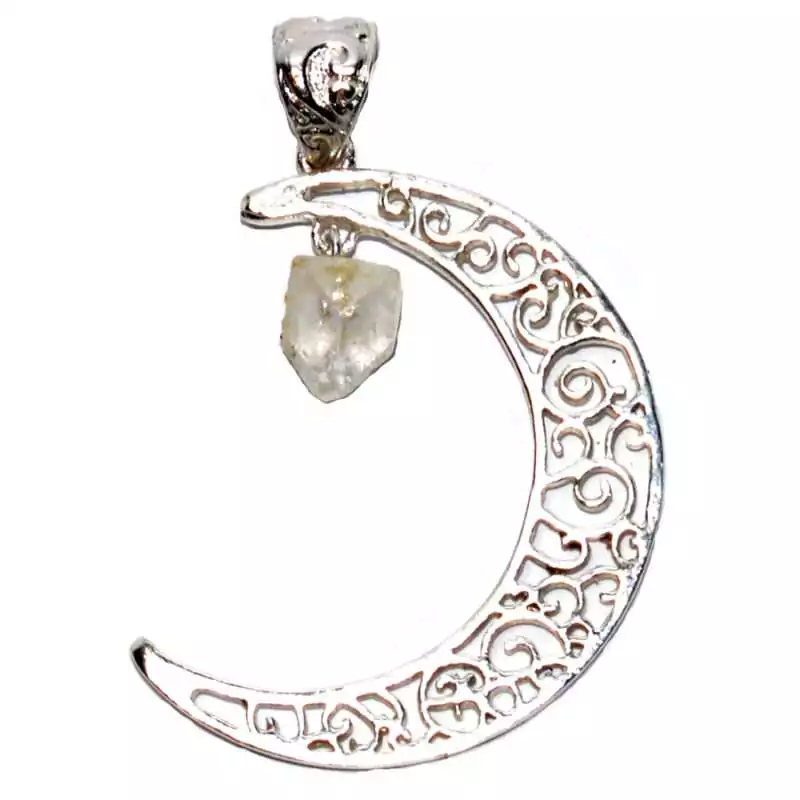
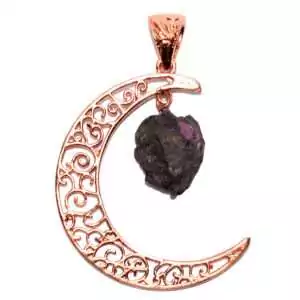
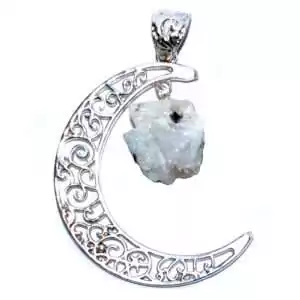
The pendant is a crescent moon cut in openwork, so the whole curve becomes a pattern of loops, spirals, and scrolls with light showing through the gaps. Scrolls of different sizes run the full length of the curve, and the metal between them is thin enough that the crescent reads as open, delicate work. The finish is silver-toned and bright, and an ornate bail with matching scrollwork sits at the top. Inside the curve, a small apophyllite crystal hangs on a short ring from the upper tip, so it swings free and turns as you move. The crystal is pale, white to colorless, with a slightly frosted look. The crescent is the Moon in its thin phases. NASA describes a crescent as a sliver of the sunlit side, seen after the new Moon as it waxes and before the next new Moon as it wanes, so the shape can mark either end of the lunar cycle on a pendant, depending on how you read it.
Apophyllite forms as a secondary mineral in gas cavities in basalt and other volcanic rock. India, Brazil, and Iceland are among its sources, and the basalt of Maharashtra, around Pune and Nashik, is a productive locality. In those cavities it often grows beside zeolite minerals. It is usually white or colorless, though green, yellow, and pink examples exist, and Indian crystals run from clear through pale green to a deeper apple green. Chemically it is a hydrated silicate of potassium and calcium with fluorine in its structure, so water is part of the mineral itself. It crystallizes in the tetragonal system, which is why its crystals grow as four-sided prisms, plates, and squared-off blocks. The piece on this pendant shows flat faces and a pointed top. Because it hangs free, the crystal catches light from every side as the pendant moves.
Practical Ritual Applications
Hang the pendant on a chain or cord from my neck chains, cords, and cages; the bail is the loop at the top, so check that your clasp or cord ends pass through it first. On a lunar altar the crescent can stand for the Moon: lay it on a cloth between candles, or hang it from a hook by a window where moonlight reaches the crystal. Wear it on days you want a moon charm close, or tuck it into a pouch as a pocket reminder of an intention. On a desk or windowsill the pendant can lie flat as a small moon marker beside a calendar or a lunar journal. It also makes a compact gift for someone who loves the night sky. Browse my moon collection for other crescent and celestial pieces to layer with it.
How to Wear and Care for the Moon and Apophyllite Pendant
Three steps cover choosing a chain, wearing the pendant, and storing it.
- Choose a Chain or Cord
The bail is the ornate loop at the top. Check that the end of your chain or cord can pass through it, then thread the pendant on and let it hang. Look at how the apophyllite sits: it should swing freely inside the curve without catching on the scrollwork. A fine chain shows off the open design, while a cord or heavier chain gives the crescent more presence.
- Wear It With Care
Apophyllite is softer than quartz and splits easily in one direction, so treat this as an occasional pendant. Take it off before exercise, sleep, or any task where the crystal could be struck, and keep it away from heat. The crystal hangs from a small ring, so lift the pendant by the crescent rather than pulling on the stone.
- Clean and Store It
Wipe the crescent and the crystal with a dry, soft cloth, and skip chemical cleaners. Store the pendant in a small pouch or a lined box on its own, so other jewelry can't scratch the finish or knock the crystal. When you aren't wearing it, you can hang it from a hook where the crescent shows.
The Tarot Fellow Standard
I stock this pendant because a crescent and a small crystal make a simple pairing that suits several uses: a moon charm for new-moon intentions, a piece for a lunar altar, or a small gift. Apophyllite is soft and splits easily, so I treat the pendant as an occasional piece to wear with care. The meanings that crystal practice attaches to apophyllite and to the Moon are themes for your own reflection, and what you bring to them is yours to decide.
Frequently Asked Questions
Dictionaries list two pronunciations: uh-POF-uh-lyte, with the stress on the second syllable, and ap-uh-FIL-yte, with the stress on the third. Both end like the word light, and either is accepted. The name comes from the Greek apophyllizo, meaning it flakes off. Strong heat drives out the water the mineral holds, and it splits into thin leaves, which is the flaking the name describes.
Apophyllite rates 4.5 to 5 on the Mohs scale and has perfect cleavage in one direction, so it is fragile. The International Gem Society says its low hardness calls for protective settings and occasional wear, and heat can make it flake apart. A dangling crystal like this one has no setting to guard it, which is why I treat the pendant as an occasional piece worn with care.
Crystal guides link apophyllite with the crown and third eye chakras and with themes of clarity, intuition, and spiritual connection. These pairings are modern crystal lore, so use them as themes for reflection. The crescent adds a lunar theme if you choose to read it that way.


Reviews
There are no reviews yet