
Quick Specs
- Type: Crescent moon pendant
- Size: About 1 3/4 by 1 1/4 inches
- Stone: Rhodonite, about 1/2 inch, rough
- Finish: Copper-toned openwork scrolls
- Hanger: Scrolled bail
Dark Rhodonite Hanging in a Copper-Toned Crescent
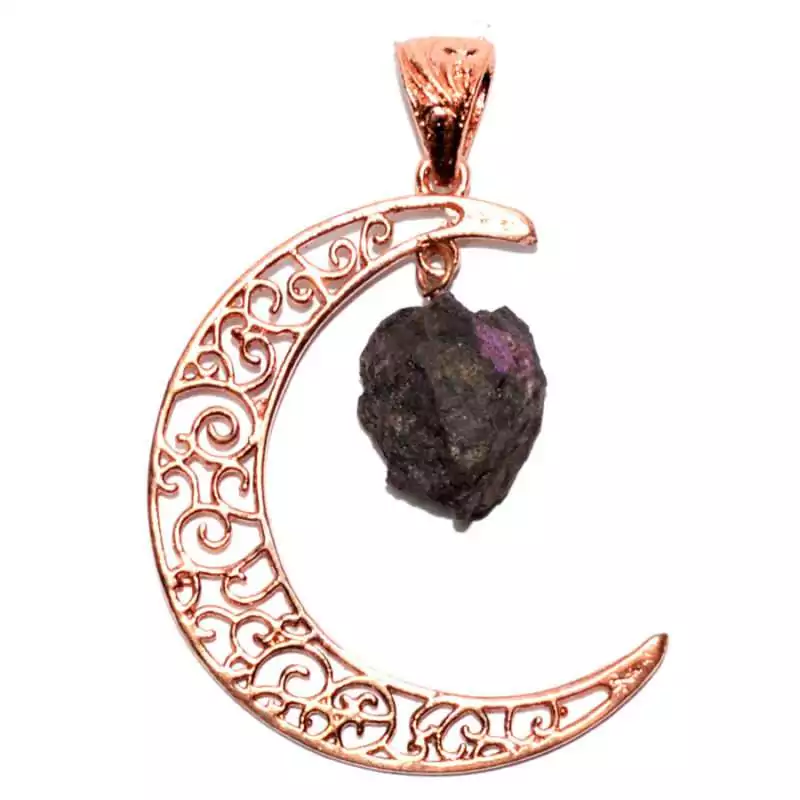
Copper-toned metal gives this crescent a warm, rosy cast. Spirals and scrolls pierce the whole curve, and a bail with its own scroll pattern sits at the top. The crescent opens to the right, with one tip reaching up toward the bail and the other sweeping out below, and a small ring at the upper tip holds the stone so it swings inside the curve. The rhodonite is rough, an unpolished lump about 1/2 inch across with a roughly heart-shaped outline and a matte, finely grained surface. Its surface is dark, shading from charcoal to brown, and a patch of pink-purple shows on the upper right. That dark skin with pink showing through is a familiar look for this mineral: weathered rhodonite often turns brown to black on the outside from oxidation and manganese oxides, while the rose color sits beneath. The copper tone echoes the warm pink in the stone, and the dark body of the rhodonite stands out against the open scrollwork. At 1 3/4 by 1 1/4 inches the crescent has presence on a chain, and the openwork keeps it light.
Rhodonite is a manganese silicate in the pyroxenoid group, and manganese gives it its rose color. Black manganese oxides often run through it as veins and dendrites or coat its weathered surface, and pink rhodonite veined with black is used as gem material. It crystallizes in the triclinic system and is also worked as an ornamental stone. Its Mohs hardness is 5.5 to 6.5, and it cleaves perfectly in two directions that meet near right angles, so a sharp knock can split it. Russia, Sweden and Peru are among the places it’s found, and Massachusetts has named it the state gem. In modern crystal practice, rhodonite is linked with the heart chakra and with themes of compassion and forgiveness. Those meanings belong to crystal lore, and you can take them as themes for reflection. Hung inside a crescent, the stone shares the pendant with a lunar symbol, so the piece can sit on an altar as a moon charm or go on a chain as a dark stone in a bright frame.
Everyday and Altar Uses for the Moon Pendant
Choose a chain or cord from my neck chains, cords and cages, check that its ends pass through the bail, and wear the crescent on days you want a moon charm close. On an altar it can lie on a dark cloth beside a candle, where the copper catches the flame. A dish beside a desk lamp gives the metal a place to glow, and a mirror frame or bedpost holds it on evenings when you want the crescent and the dark stone in view. Pair it with a heart-chakra intention if that theme matters to you, or keep it as a plain moon charm. Wear it alone or layered with a longer chain. It also suits a gift for someone who collects moon pieces.
How to Wear and Care for the Rhodonite Moon Pendant
Three steps cover threading the pendant, wearing it, and cleaning it.
- Thread It and Check the Ring
Slide your chain or cord through the scrolled bail and let the pendant hang. The small ring at the upper tip of the crescent holds the stone, so look at it closely and confirm it sits closed and snug. A fine chain shows the openwork, and a cord gives the crescent more presence. Fasten the chain before you let go of the pendant, so it never drops while you work the clasp.
- Wear It With Care
Rhodonite cleaves perfectly in two directions, and geology.com says its low hardness and cleavage make faceted pieces too fragile for jewelry. A rough stone hanging free is an occasional-wear piece. Take it off before exercise, sleep and heavy chores, and keep it away from sharp knocks. Prolonged direct sunlight may fade the color, so a bright windowsill is a poor place to leave it.
- Clean and Store It
Fire Mountain Gems suggests warm soapy water and an untreated cloth for rhodonite, and says to avoid boiling it. Wipe the stone and the copper-toned metal, then dry both right away. Store the pendant on its own in a pouch or lined box, away from harder gems, so nothing scratches the stone or the finish.
The Tarot Fellow Standard
I stock this pendant because it sets a rough rhodonite inside a copper-toned crescent at a size that suits a chain. The stone shows the dark outer look that rhodonite often has, with pink showing through in one patch. Rhodonite has perfect cleavage, so I treat the pendant as an occasional piece to wear with care. The heart chakra link is modern crystal lore and a theme for your own reflection. If you’d like other stones to wear beside it, browse my crystal and gemstone pendants.
Frequently Asked Questions
The black is manganese oxide. Wikipedia notes that pink rhodonite contrasting with black manganese oxides is sometimes used as gemstone material, and that the exterior is commonly black from the same oxides. Geology.com says rhodonite is often found with black manganese oxides as dendrites, fracture fillings or matrix. Fire Mountain Gems describes the black as dendrite veins that form patterns in the pink.
No. Both are pink, manganese-rich minerals with similar names, but rhodonite is a manganese silicate with a Mohs hardness of 5.5 to 6.5, and rhodochrosite is a manganese carbonate rated 3.5 to 4. Wikipedia calls rhodochrosite distinctly softer, and geology.com says the two names are the most common source of confusion.
Crystal guides link rhodonite with the heart chakra, along with compassion and forgiveness. Fire Mountain Gems lists the heart chakra and describes the properties as things the stone is thought to have, and astrology.com says rhodonite is most commonly associated with the heart chakra. The chakra system comes from Indian traditions, and the modern seven-color scheme is largely a Western arrangement.


Reviews
There are no reviews yet