

Quick Specs
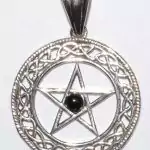
- Type: Pendant with a wide, ribbed bail
- Material: Sterling silver (.925)
- Stone: Black obsidian cabochon
- Design: Pentacle in a circle, Celtic knotwork border, twisted-rope edge
- Width: 1 1/4 inches
Black Obsidian: Volcanic Glass With a Long Working History
Black obsidian is volcanic glass. It forms when lava cools so fast that crystals barely begin to grow. The result is a smooth, non-crystalline stone, colored by iron and other elements anywhere from dark brown to black, and it breaks into razor-sharp edges, which is why it has long been worked into blades. Polished obsidian also made some of the earliest mirrors. Aztec priests used obsidian mirrors for scrying, and the god Tezcatlipoca’s name means “smoking mirror” in Nahuatl. The mirror John Dee used to call his spirits in Elizabethan England, now in the British Museum, has been traced to Aztec obsidian from Mexico. That long history as both a mirror and a blade is the root of the stone’s modern reputation: in crystal lore, black obsidian is paired with protection, grounding and scrying. On this pendant the stone is a small, round, domed cabochon set where the star’s lines cross at its center. It reads as a single dark point inside a field of bright silver, so your eye lands there first, and the polished surface catches the light the way a tiny mirror does.
The five-pointed star sits inside a thin ring, and around that ring runs a band of Celtic knotwork: braided strands that cross over and under in an unbroken loop. A fine twisted-rope line edges the outside of the whole design. The open work lets light pass through the silver, so the star reads as clean, slim lines inside a textured frame, and the black stone is the only solid dark point on the piece. A cabochon has a smooth domed top with no facets or sharp corners to catch on clothing, which suits a pendant you wear against fabric. Against a dark shirt the silver lines stand out sharply, and against bare skin the stone is the first thing you see. At the top, a wide ribbed bail carries the pendant on a chain or cord of your choice. Sterling silver runs through every part of the design, from the bail to the braid to the star, so the pendant reads as one finished piece in a single bright metal.
Practical Ritual Applications
Wear the pendant as a daily symbol, or save it for the days that call for one. The Celtic border gives it a look that suits a wider pagan wardrobe as well as a Wiccan one. A short chain keeps the pentacle near the throat, and a longer one lets it rest over the heart. Put it on before a tarot reading or a meditation, or lay it on your altar at the center of your working space. Black obsidian is a favorite for shadow work, so the pendant also keeps company with a journaling session or a late-night spread. It layers well with a plain chain or with other pieces from my pentacles, pentagrams and Wicca pendants, and it makes a gift for someone who marks the sabbats.
How to Use the Pentacle Black Obsidian Pendant
Choose a cord, set one intention, and wear the pendant for daily protection or ritual work.
- Choose a Chain or Cord and Cleanse the Pendant
Thread the bail onto a chain or cord that fits through its opening. Before the first wear, pass the pendant through incense smoke at a distance from the flame, or leave it where moonlight reaches it overnight. Keep the stone away from heat, since obsidian is sensitive to it, and leave it off sunny windowsills and radiators.
- Set an Intention and Wear It
Hold the pendant in your closed hand and name one intention, such as protection for the day ahead or steadiness while you work. Slip it on so the pentacle rests over your chest or at the base of your throat. Wear it under a collar or over a shirt, whichever suits the day, and touch the stone when you want to return to your intention.
- Bring It Into Ritual or a Reading
Lay the pendant at the center of your altar during a working, or hold it in your non-dominant hand as you shuffle for a tarot reading or begin a scrying session. Use the polished stone as a point to settle your eyes on, then return the pendant to its cord or to a soft pouch when you finish.
The Tarot Fellow Standard
I carry this pendant for how much it holds in a small space: a pentacle, a ring of Celtic knotwork, a twisted-rope edge and a black obsidian stone, all worked in sterling silver. The pentacle is a faith symbol for Wiccans, who practice a living religion with covens, teachers and communities of their own, and the pendant is a piece of jewelry that carries that symbol. If you like stones set in silver, browse my crystal and gemstone pendants for more.
Frequently Asked Questions
Wiccans generally read the five points as earth, air, fire, water and spirit, with spirit at the top point. The circle around the star is often read as binding the elements together or bringing them into harmony. Pairing five elements with the five points goes back further than Wicca: Renaissance writers such as Agrippa assigned five elements to a pentagram's points. Exact assignments vary by tradition and by author.
A pentagram is the five-pointed star on its own. A pentacle is that star drawn inside a circle, though people often use the two words interchangeably. Wiccans and other Neopagans generally display the symbol with one point up, and the form with two points up is the one most associated with Satanism, which is why orientation matters when you choose a piece.
Yes. Sterling silver darkens as it reacts with sulfur compounds in the air, and moisture, skin oils, perfume and lotion speed that up. Put the pendant on after lotion and perfume, and take it off before swimming or showering, because chlorine and salt water damage silver. Rub light tarnish away with a silver polishing cloth in straight strokes. Because a stone is set in the silver, skip ultrasonic cleaners.
Obsidian is hard but brittle. It rates 5 to 6 on the Mohs scale, and because it's volcanic glass it breaks with a curved, glassy fracture, so a hard knock can chip it. It's also sensitive to heat. Clean it with mild soap, a soft brush and warm water, not hot, and avoid mechanical cleaners. Take the pendant off before swimming, because chlorine and salt water also harm the silver around the stone.
A Celtic knot is an interlace pattern: bands that cross over and under one another and loop back into themselves, most often with no beginning or end. The style is best known from early medieval Britain and Ireland, in works such as the Lindisfarne Gospels and the Book of Kells, though interlace began in the late Roman Empire, in the floor mosaics of the third and fourth centuries. Knots like these are used for decoration.


Reviews
There are no reviews yet