
Quick Specs
- Type: Stick incense holder
- Size: 5 1/2 inches
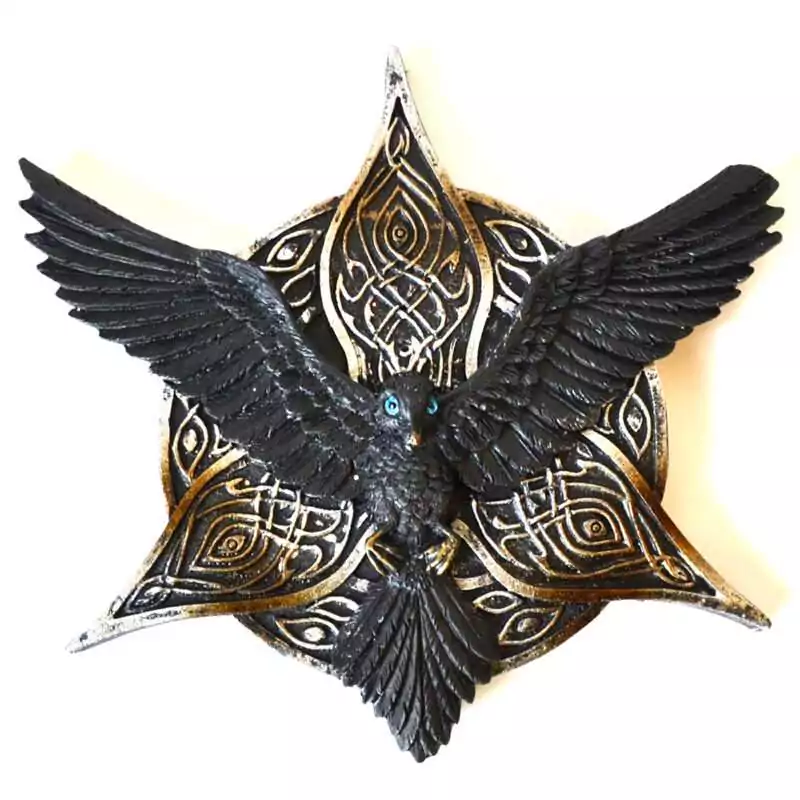
- Design: Raven with wings spread wide over a three-lobed plaque
- Details: Interlaced knotwork and almond-shaped eyes in gold lines
- Colors: Black raven, blue eyes, gold and silver edging
- Style: Celtic-inspired detailing
A Black Raven With Spread Wings Over Gold Knotwork
The raven takes up most of the piece. It is seen from above and slightly in front, with its wings flung out to either side and its tail fanned below, as though it has just come in to land. Its head tilts down at the center, and the eyes are a bright, glassy blue that stands out against the black plumage. Every feather is modeled separately, from the long flight feathers at the wingtips to the shorter ones across the back, and the beak and feet carry a touch of gold. Behind the bird, a round plaque has three large pointed lobes, one pointing up and two pointing down and outward, and each lobe is edged in gold fading to silver. Inside the lobes, gold lines run over a dark ground in loops and crossings of interlaced knotwork, each set around an almond shape with a small raised dot at its center, like a stylized eye. The holder measures 5 1/2 inches, and the raven’s wingspan gives it a broad, dramatic outline on a shelf. The black plumage has a soft sheen with pale highlights along the feather edges, which lets the wings read as layered.
Ravens carry a long weight in northern European story. In Norse tradition Odin is attended by two ravens, Huginn and Muninn, whose names point to thought and memory. The Poetic Edda poem Grímnismál has Odin say that the pair fly over the world each day, and Snorri’s Prose Edda has them sit on his shoulders and report what they have seen and heard. Scholars debate whether the two ravens stand for Odin’s own mental powers. The Prose Edda calls Odin the raven-god because of the birds, and Norse leaders carried ravens on their banners. In Welsh myth the giant Brân, whose name is translated as crow or raven, has his head buried in London as protection against invasion. The knotwork on this holder is Celtic inspired, and it sets a bird with deep roots in northern myth against the kind of interlace that fills the pages of early Insular manuscripts such as the Book of Kells.
Practical Ritual Applications
Seat a stick of incense in the holder and give it a flat, level spot with room around it, since the wings and points reach well past the center. Dark wood, a black cloth, or a slate tile makes the gold edging and the blue eyes stand out, and a candle at a safe distance lights the feathers from the side. A shelf of books about northern myth, a mantel, or the end of a writing desk suits a raven, and an empty stretch of wall behind it keeps the outline clear. If you write by lamplight, the gold edging catches the glow from a lamp as readily as from a candle. Between sticks, the bird stays on display as relief decor. My Viking and Celtic collection has other pieces from the same lore to set beside it.
How to Burn Stick Incense in the Raven Wings Holder
Give the wings room, light the stick, and let everything cool before you touch it.
- Give the Wings Room
Set the holder on a flat, heat-resistant surface such as a ceramic tile or a metal plate, with clear space on every side. Keep curtains, clothing, and paper well away from the stick and the piece, and keep it out of reach of children and pets.
- Seat the Stick and Light It
Place a stick in the holder, light the tip until it glows, and shake out the flame. Stay in the room while it burns. Fire services advise never leaving burning incense unattended, and a stick that leans toward fabric or paper can start a fire.
- Extinguish and Let It Cool
Check that the stick is completely extinguished before you leave the room or go to bed. Incense ash and holders may stay hot after use, so wait until the piece is cool to the touch before you move it or clear the ash from around the raven.
The Tarot Fellow Standard
I stock this holder because the raven is carved with feather-by-feather detail, with blue eyes and gold-toned feet, and it sits over a gold-edged plaque of Celtic-inspired interlace. At 5 1/2 inches, it is a good-sized piece for a shelf or an altar, and it burns stick incense. With its wings open, the raven gives a shelf a clear focal point, and the knotwork rewards a closer look. If you like dark birds, northern myth, or a gothic corner of the room, browse my stick incense burner collection for more holders to set beside it.
Frequently Asked Questions
A common raven is the larger bird: a mature raven ranges from 54 to 71 centimeters (21 to 28 inches) with a wingspan of 116 to 153 centimeters. It has a heavier black beak, shaggy feathers at the throat, and a longer, wedge-shaped tail. In flight it soars with less wing flapping, and its usual call is a deep croak of a much more sonorous quality than a crow's call.
A legend holds that if the Tower of London ravens are lost or fly away, the Crown will fall and Britain with it. The earliest known reference to captive ravens at the Tower is an illustration from 1883, and the Tower's official historian, Geoffrey Parnell, considers the ancient history of captive ravens a legend invented during the Victorian era. At least six ravens are kept today, looked after daily by the Ravenmaster.
Fire services advise placing the holder on a flat, heat-resistant surface such as a ceramic tile or a metal plate, on a stable spot where nothing will knock it over. They advise keeping burning incense away from curtains, clothes, paper, and other flammable materials, and out of reach of children and pets, and never leaving it unattended.


Reviews
There are no reviews yet