
Quick Specs
- Material: Red agate (chalcedony)
- Shape: Heart
- Size: 1 to 1 1/2 inches (about 25 to 38mm), sizes vary
- Finish: Polished
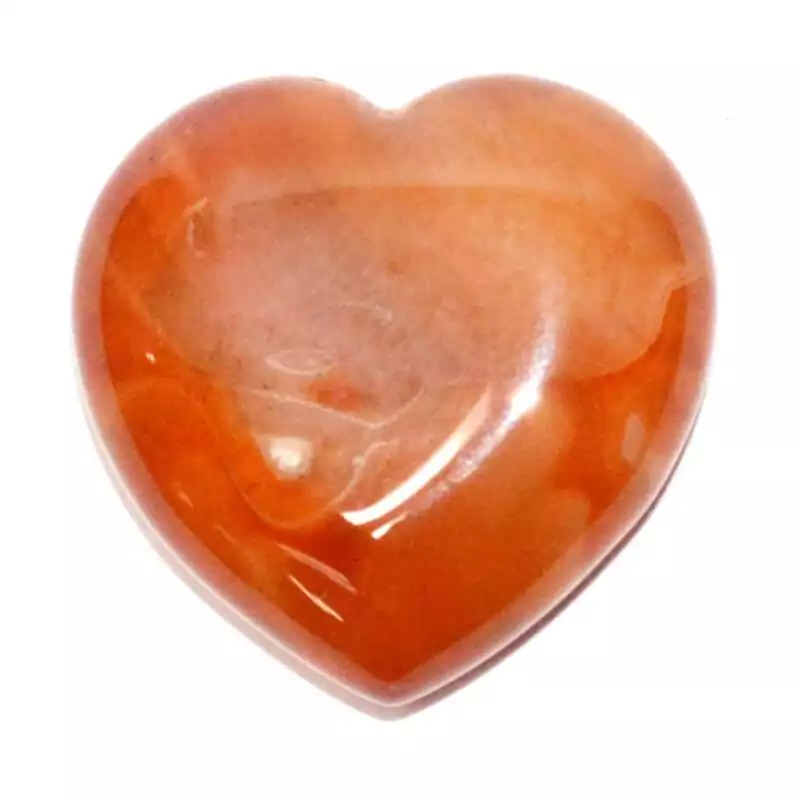
- Color: Translucent orange-red with a pale cloudy center
- Quantity: Single piece
- Mohs Hardness: 6.5 to 7
Red Agate: A Translucent Stone Shaped as a Heart
Agate is a translucent variety of microcrystalline quartz, and its habit of letting light through its thin edges is what gives this heart its glow. It forms in cavities in volcanic rock, where silica from groundwater is deposited layer on layer, and iron supplies most of its colors, with hematite coloring many red bands. The layers build inward from the cavity wall or settle in level sheets, and a cut across them shows up as bands, rings or cloudy patches. Agate has been shaped into ornaments for a very long time. Ancient Egyptians, Mycenaeans and Romans all used it in jewelry, and Greek warriors carried agate seal stones. Carnelian, the translucent orange to red chalcedony closely related to red agate, appears in Minoan layers at Knossos from about 1800 BC. Lapidaries today cut agate into cabochons, beads and small sculptures, and hearts are a common shape for a small polished piece. Traders often heat or dye orange-red agate, because the porous stone takes dye readily.
This heart measures 1 to 1 1/2 inches, so it rests in the center of a palm or between a thumb and two fingers. The color is a warm orange-red, deepest along the lower edges and lighter toward the top, with a pale, cloudy patch near the middle where the stone turns milky. Light passes through the thinner edges and gives them a glow, and the outline reads as a clean heart with two rounded lobes and a shallow notch at the top. Polishing leaves the curves smooth under the thumb, with no sharp corners to catch on a pocket lining or a pouch. Highlights slide across the high gloss as you turn it. Because hearts are sold singly in a range of sizes, each one differs a little in color and cloudiness. It slips into a pocket, sits upright on a small stand, or lies flat on a cloth beside a candle in a holder.
Practical Ritual Applications
A heart is a ready-made token, so give it or keep it for a reason that matters to you. Set it on your altar beside a red candle in a safe holder, or place it on your reading table when you lay out a spread about relationships. Carry it in a pocket on a day you want a small reminder, or hold it between your palms for a minute before you shuffle. A line of three hearts in different sizes makes a simple display, and one tucked into a card pouch travels well. Pair it with a Tarot card that matches your question, and leave both on the table while you journal about it. For more stones in this shape, browse my eggs and hearts collection.
How to Use a Red Agate Heart
Three steps for giving the heart a place in your practice.
- See the Glow
Hold the heart up to a window or a lamp and turn it slowly. Watch the orange deepen where the stone is thicker and brighten where light passes through the edges, and find the pale cloudy patch near the center. Choose the angle you like best, and show that face when you set the heart on display.
- Pick a Purpose
Decide what the heart is for before you put it in place. You might set it on your altar as a marker for a relationship you tend, give it to a friend, or keep it in a pocket as a reminder to speak kindly. Say the purpose aloud or write it on a slip of paper and tuck it under the stone. Move the heart and the note whenever the purpose changes.
- Rinse Briefly and Display
When the heart needs freshening, rinse it briefly in water and dry it with a soft cloth, avoiding sudden temperature changes. Keep it out of strong sun for long periods, because some red stones fade in light. Display it on a small stand, or rest it on a cloth in a dish, and wrap it in soft fabric when it travels.
The Tarot Fellow Standard
A heart is an easy gift and a good small altar piece, and the glow of this one comes from the stone itself. At 1 to 1 1/2 inches it suits a pocket, a shelf or a gift pouch, and the translucent orange-red looks warm beside candles, wood and brass. Each heart is polished to a bright gloss, and the cloudy patch in the middle gives this one its own character. If you want to pair the heart with another stone for a relationship or heart-centered altar, browse my love and relationship stones.
Frequently Asked Questions
The names overlap. Carnelian is translucent orange to red-brown chalcedony colored by iron oxide, and one reference classes it as a type of agate. Another says the line between carnelian and its darker cousin sard is loosely drawn, and the names are often used interchangeably. Orange-red agate is sold under either name, and heating or staining is a common way of deepening the color in both.
Yes, to some degree. Agate is described as a translucent variety of quartz, and carnelian is translucent orange, red or brown chalcedony. Thin edges and cloudy patches let light through, while bands and thicker areas look denser. A polished heart shows the effect best when you hold it up to a lamp or window.
Crystal guides link agate with stability and grounding and with the root chakra, and they link red shades of carnelian with the root chakra and orange shades with the sacral chakra. Romans considered carnelian a stone of courage. These are traditional and modern crystal-lore associations.
Reviews
There are no reviews yet