
Quick Specs
- Material: Pyrite with druse (iron sulfide, FeS2)
- Shape: Heart
- Size: 1 1/4 inches (about 32mm)
- Finish: Polished body with exposed druse crystals
- Color: Brassy gold crystals on a pale silver-grey body
- Mohs Hardness: 6 to 6.5
Pyrite With Druse: Brass-Gold Crystals in a Polished Heart
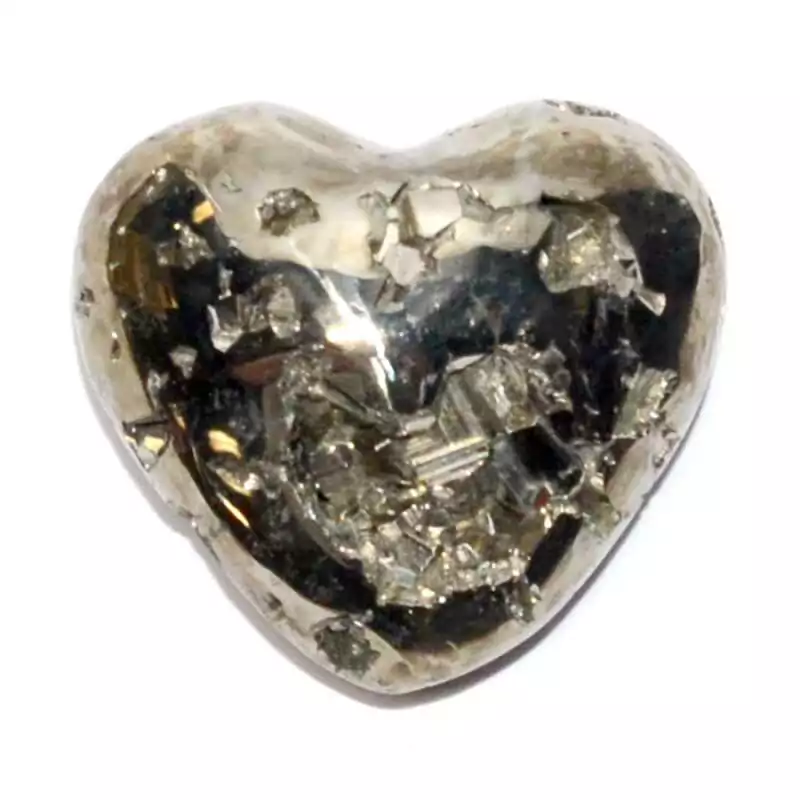
Pyrite is iron sulfide, FeS2, the most common sulfide mineral on Earth. Its color is a pale brass-yellow with a bright metallic luster, and it ranks 6 to 6.5 on the Mohs scale. Pyrite usually grows as cube-shaped crystals, and it tarnishes darker over time, sometimes with an iridescent film. Druse is a crystal habit: a coating of small crystals on a rock surface, or a lining of crystals inside a cavity or vug. A pyrite druse looks like thousands of tiny brass mirrors, each crystal face catching light at its own angle, which gives the glitter you see when you tilt the heart. In this piece the druse fills an opening in the polished body, and the pale silver-grey stone around it has been cut and polished to the shape of a heart. Some small crystals break through the polished surface around the cavity, so the sparkle reaches past the opening and across the front of the heart.
At 1 1/4 inches the heart is small enough to rest in the center of a palm and light enough to slip into a pocket. The front shows the cavity, where clustered pyrite crystals stand in rough, stepped shapes, some with visible cube faces. Around them the body is smooth and pale, with a silvery sheen and a few small patches where more crystals break the surface. The polish makes a good contrast with the crystals: the rim is glossy, and the druse is sharp and sparkling. The cavity is the focus of the front, and crystals standing at different heights give it depth, so the heart looks different from each angle. Shape and finish suit a desk, a shelf or a small dish. Each heart is cut from a different piece of stone, so the size of the cavity and the spread of the druse differ from heart to heart. Pyrite is brittle at its surface, so set the heart down gently on a soft cloth.
Practical Ritual Applications
Keep the heart in a pocket or a small pouch for a day when you want a bright little reminder to stay steady, or set it in a dish on your desk where the druse can catch the light. Crystal guides call pyrite a protection stone, which makes a small piece a natural companion to carry or to place by a doorway or a window shelf. On a reading table, rest it beside your Tarot deck and let the glitter give your eye something to settle on between cards. Hold it in your palm for a minute before you begin a task, and let the weight of the stone settle your attention. A heart also makes a familiar shape for a small gift to someone who collects crystals. To see other smooth shapes in stone, browse my eggs and hearts collection.
How to Care for and Use Your Pyrite Heart
Three steps for looking, keeping the heart dry and giving it a home.
- Tilt the Heart in Lamplight
Hold the heart under a single lamp and tilt it slowly. The druse shows its best sparkle at an angle, when the tiny crystal faces line up with the light, and the polished body shows reflections of the room. Look closely at the cavity, where the crystals stand in layers, and at the rim, where the polish meets the crystals. A few minutes of tilting teaches you where the heart looks its brightest, which is the side to face forward when you display it.
- Keep It Dry
Choose a dry spot for the heart, such as a shelf in a living room or a drawer with a pouch, and keep it out of bathrooms and kitchens, where steam and damp air are common. A small box with a silica gel packet gives it a very dry home. Dust it with a soft, dry brush or cloth, working gently around the crystals.
- Give It a Resting Place
Rest the heart on a small square of felt, a saucer or a stand, to protect the crystal faces from scrapes. Keep it apart from quartz and other harder stones. When you carry it, wrap it in a cloth or keep it in its own pouch, which protects the druse from keys and coins.
The Tarot Fellow Standard
I stock this heart for people who like a small stone with something to look at. The polished body gives it a pleasant weight in the hand, and the druse adds a sparkle that changes whenever the light moves. At 1 1/4 inches it fits a pocket, a desk or a shelf of small treasures, and the brassy gold against pale silver-grey suits candlelight and window light alike. Each heart has its own cavity, so every piece has a character of its own. For more crystals and stones, browse my crystals, stones and gemstones collection.
Frequently Asked Questions
Druse is a layer of tiny crystals covering a rock surface or lining a cavity in a rock or mineral. On pyrite it shows as a glittering crust of brass-colored crystal faces, and each face reflects light separately. The crystal faces stay natural and unpolished, which is why the druse sparkles while the polished body around it shines.
Moisture is pyrite's weak point. Pyrite oxidizes when it is exposed to air and moisture, and it can break down into iron oxyhydroxides and release sulfuric acid. Conservation guidance for pyrite specimens warns of decay above about 60 percent relative humidity, so a dry shelf is the better home.
Pyrite is found worldwide, because it forms in many geological settings. It is the most common sulfide mineral, and well-known sources include Canada, Mexico, Namibia, Peru, Russia and Spain. Pyrite is also found in coal seams.




Reviews
There are no reviews yet