
Quick Specs
- Material: Shungite (a carbon-rich mineraloid)
- Shape: Heart
- Size: 1 1/4 inch (about 32mm)
- Finish: Polished
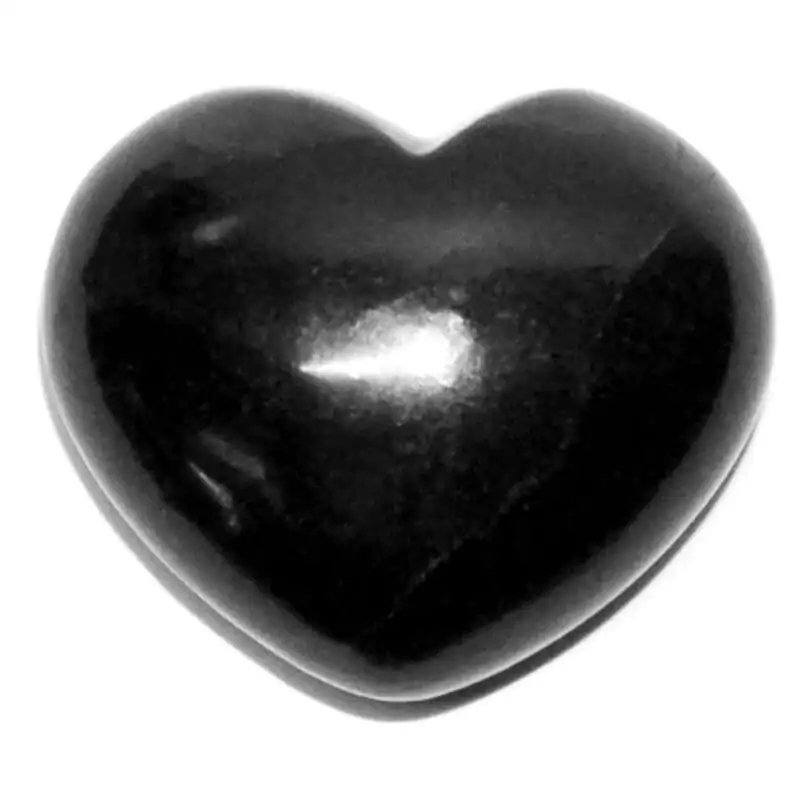
- Color: Deep, even black
- Mohs Hardness: 3.5 to 4
Shungite: A Black Carbon Stone From Karelia
Shungite is a black, carbon-rich mineraloid, a mineral-like material built from non-crystalline carbon with no regular internal structure. It was described in 1879 and takes its name from Shunga, a village in Karelia, Russia, near Lake Onega, where the main deposits lie. The rock dates to the Paleoproterozoic, about two billion years ago, and researchers trace its carbon to ancient organic matter, most likely algae and bacteria, that was buried and metamorphosed. It occurs in layers or seams and in veins that cut across other rock, and smaller occurrences are reported in Austria, India and the Democratic Republic of the Congo. Its luster ranges from bright to dull, and a polished surface like this heart’s shows the bright end. Shungite is soft, rated 3.5 to 4 on the Mohs scale, and some metals can scratch it, which is worth remembering when it travels in a pocket with keys or coins.
The heart measures 1 1/4 inches, about 32mm, at its widest, small enough to close inside one hand or slip into a pocket. Its front is domed, the outline has a soft dip at the top, and the polish is deep and glossy, so the piece reads as black glass with a single bright highlight where the room light lands. The color is an even black from edge to edge, and turning the heart under a lamp slides the highlight across the dome. The outline is all curves, and the smooth face gives your thumb something to trace. In modern crystal practice, guides link shungite with the root chakra, grounding and protection, and a black heart gives those themes a form you can hold or keep on a shelf. At this size the heart sits beside a Tarot deck on a table and fits in a small pouch.
Practical Ritual Applications
Keep the heart on your desk or altar as a dark anchor beside lighter stones: a clear quartz point, a white candle or a small bowl of salt. Hold it through a few slow breaths at the start of a Tarot reading, then rest it beside the cards you draw. In a seven-stone chakra layout, lay it at the base of the row, where the root stone belongs in modern chakra practice. Rest it on a journal page while you list what you want to keep steady, or set it beside a candle as a dark counterpoint to the flame. A black heart also works as a keepsake for someone who likes dark, polished stones and fits in a small pouch. For other shapes carved in stone, browse my stone eggs and hearts.
How to Work With a Shungite Heart
Three steps for giving a small black heart a place in your practice.
- Hold It Through Ten Breaths
Sit with your feet flat and rest the heart in the palm of your dominant hand. Close your fingers loosely around it and breathe slowly, counting ten full breaths while you feel the weight and the smooth curve of the stone. Set the heart down where you can see it and say or write the thought you came to settle. Repeat the exercise at the same time each day if you want a steady cue.
- Place It at the Base of a Layout
Lay a row of stones on a cloth from your lowest chakra to your highest, in the order modern chakra practice uses, and put the heart at the bottom of the row for the root. Leave an inch of space between stones so each one sits clearly. Keep the layout on a flat surface for as long as you like, then lift the stones one at a time, starting from the top, and return them to their pouch.
- Carry It for a Day
Slip the heart into a small cloth pouch and carry it in a bag or coat pocket, away from keys and coins, which can scratch the soft surface. At night, set it on a nightstand or a shelf where you will see it. Rotate between carrying it and keeping it at home, so the polish stays glossy and the stone stays easy to find.
The Tarot Fellow Standard
I stock this heart for people who want shungite in a form that is easy to hold: a smooth, even-black heart at 1 1/4 inches that fits a palm and sits comfortably on a desk or altar. Shungite has a long geological history and a distinctive look, and a polished heart shows the stone at its glossiest. The associations with the root chakra and grounding belong to modern crystal practice, and they work best as themes you choose to reflect upon. Browse my grounding and earth energy stones for more stones with similar associations.
Frequently Asked Questions
Shungite is a mineraloid, a mineral-like material made of non-crystalline carbon, so it has no regular crystal structure. Geologists describe it as a carbon-rich rock, and the name is also used for shungite-bearing rocks in which the carbon is mixed with other minerals. The richest material is nearly all carbon and carries the bright luster seen in polished pieces.
Shungite formed about two billion years ago, in the Paleoproterozoic. The main deposit is at Zazhoginskoye near Shunga village in Karelia, in the Lake Onega area of Russia, and the stone takes its name from that village. Researchers trace the carbon to organic matter, most likely algae and bacteria, that was buried and altered by heat and pressure. Smaller finds are reported in Austria, India and the Democratic Republic of the Congo.
Crystal guides link shungite with the root chakra, the base of the modern seven-chakra system, along with grounding and protection themes. The chakra idea itself comes from Indian traditions, where texts count anywhere from four to eight centers, and the seven-chakra scheme reached the West in the 1880s through Theosophists. Treat the pairing as a modern crystal-lore theme.
Yes. Clean it with warm, soapy water and let it air dry for several hours. Shungite is very soft and some metals can scratch it, so use a soft cloth and skip scouring pads or abrasive polish. Black carbon residue can come off onto hands or clothes, which is normal for this material.

Reviews
There are no reviews yet