
Quick Specs
- Material: Red agate (chalcedony)
- Quantity: 1 lb lot of pebbles
- Stone Size: 40-70mm (about 1.6 to 2.8 inches)
- Finish: Tumbled and polished
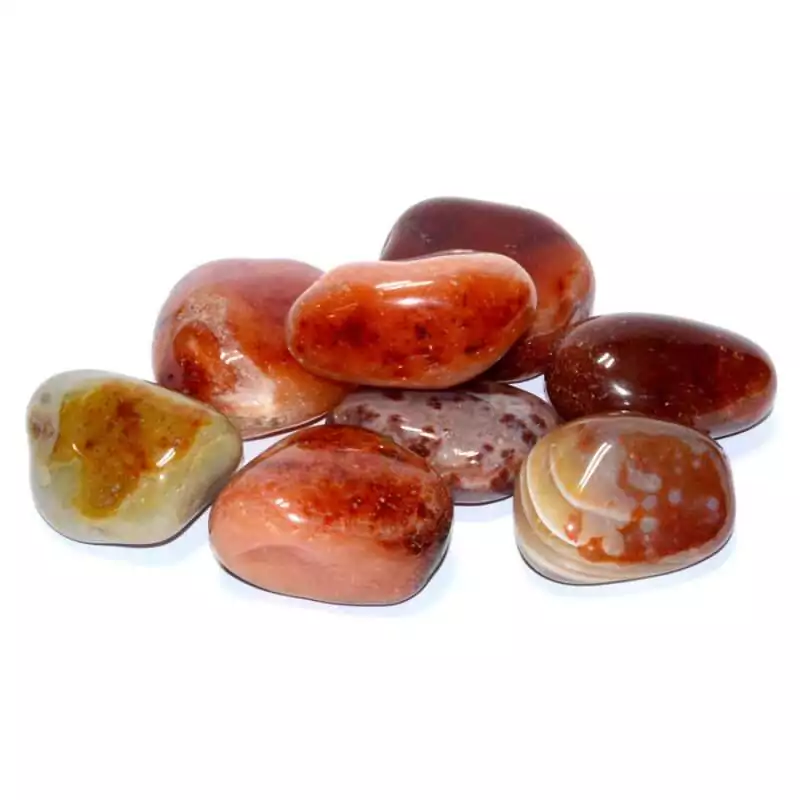
- Color: Orange-red, terracotta and brown with speckles and cream bands
- Grade: Sold as A quality
- Mohs Hardness: 6.5 to 7
Red Agate Pebbles: Large Nodules Polished Smooth
Agate grows as nodules, rounded lumps that fill gas-bubble cavities in volcanic rock such as basalt and andesite. Silica-rich groundwater fills each cavity in layers, and the layers take their colors from impurities. Iron produces most agate band colors, with red bands often colored by hematite and yellow ones by goethite. A nodule of agate can be large, and Rio Grande do Sul in Brazil is known for big ones. Agate is banded chalcedony, a microcrystalline form of quartz, and geology references call it the most popular rough for tumbled stones. Rough agate looks dull on the outside, and polishing brings out its color and pattern. At 40 to 70mm, a pebble gives the layers room to show: you can follow a band across the surface and see where it widens, narrows or breaks into spots. Natural agate comes in brown, white, red, gray, pink, black and yellow, colors that geology references trace to impurities in the silica.
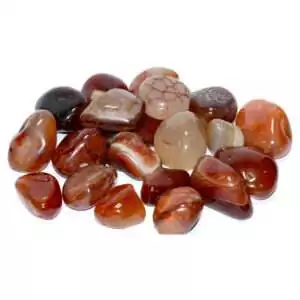
These pebbles run from about 1.6 to 2.8 inches, large enough that a single stone fills the center of a palm and a pound makes a small handful. The colors are warm: orange-red, terracotta and rust, dark red-brown speckled with brighter red flecks, and a few pieces with cream bands, pale rings or soft orange spots. Some stones lean olive-gold with an orange center, and others are pinkish-brown with fine speckles. The shapes are rounded and irregular, with a high gloss on every face, and the larger stones show a wide stretch of pattern across a single side. A 70mm pebble is nearly 3 inches across, so it works as a paperweight or a desk piece as easily as an altar stone. Heating or dyeing is a common trade practice for red and orange agate. At this size the patterns are easy to read without a loupe, and each pebble has enough weight in the hand to work as a display piece on its own.
Practical Ritual Applications
Crystal guides link agate with grounding and the root chakra, and large stones suit that theme because you can feel their weight. Hold one of the bigger pebbles in both hands for a minute before a reading, or rest it on your desk while you work. Set a pebble at each corner of an altar to mark the space, or use the largest as a plinth for a small bowl or a figurine. A line of three on a shelf makes a simple display, and one pebble beside your Tarot cards gives the table a warm anchor. A favorite pebble also makes a fine keepsake to give to a friend with a note about why you chose it. For more stones associated with steadiness, browse my balance and grounding tumbled stones.
How to Use Red Agate Pebbles
Three steps for giving a pound of large pebbles a place in your space.
- Pick Your Anchor Stone
Pour the pebbles onto a cloth and lift each one to feel its weight and the smoothness of its polish. Choose the stone that sits best in your hand as your anchor, and set the rest aside in a bowl. Look at the surface under a lamp for rings, speckles and bands, and decide which side you want facing up. The anchor stone gets the most handling, so choose one you like holding.
- Mark Out a Space
Place three or four pebbles on a table or altar in a loose line or a square, leaving room in the middle for a candle in a holder, a Tarot card or a small dish. Keep the arrangement well back from the edge of the surface, since stones of this size are heavy to drop. Rearrange the pebbles to change the feel of the space.
- Keep Them Clean and Cushioned
Rinse the pebbles briefly in water when they need freshening and dry them with a soft cloth, avoiding sudden temperature changes, because they can stress the stone. Store the pebbles in a sturdy bowl or a lined box and place a cloth between stones so each one sits apart. Keep dyed or heated red stone out of strong sun for long stretches, because some red stones fade in light.
The Tarot Fellow Standard
These red agate pebbles are for people who want stones with real presence. A stone of 40 to 70mm can sit alone on a shelf as a centerpiece. The red, terracotta and brown tones match wooden altars, brass bowls and candles, and the polish is bright enough to look good under a lamp. A pound of stones this large is a small handful, so each one is a piece to choose with care, and a favorite from the pound makes a fine keepsake or gift. If you prefer a smaller size, browse my bulk tumbled stones collection.
Frequently Asked Questions
People have used agate for thousands of years. Jewelry from Sumer dates to about 2500 BCE, and ancient Greeks made agate seal stones and jewelry. Agate was later used for mortars and pestles and for bearings in laboratory balances. Today it is cut into cabochons, beads, small sculptures, bookends and paperweights, and it is the most popular rough for tumbled stones like these pebbles.
No. Both are silica stones in the chalcedony family, and both rate 6.5 to 7 on the Mohs scale, but jasper is opaque while agate is translucent and banded. Jasper is made mostly of very fine-grained quartz or chalcedony, and its common red color comes from iron inclusions. Red agate gets its red from iron as well, which is why the two can look alike at a glance.
Rough stones go into a rotating barrel with abrasive grit and water. The barrel turns slowly, and the stones grind against each other. A coarse grit shapes them first, then finer grits smooth them, and a polishing powder such as cerium oxide or tin oxide finishes the surface. A full polish typically takes several weeks, and rotary barrel tumbling tends to round the stones.



Reviews
There are no reviews yet